Introduction
Walk through any branded hotel lobby and you'll likely assume the company whose name hangs above the door is also running the property. In most cases, that assumption is wrong.
According to JLL research reported by Hotel Dive, nearly 5.9 million branded hotel rooms — roughly 46.9% of all branded supply worldwide — are operated by third-party management companies rather than the brands themselves. Yet the market remains strikingly fragmented: no single third-party operator controls even 3% of that pool.
For hotel owners, investors, developers, and lenders, that fragmentation creates both opportunity and risk. The right management company can significantly accelerate returns. The wrong one can quietly erode asset value long before problems surface in the financials.
This guide covers 50+ hotel management companies organized into six categories:
- Global brand operators
- Large US third-party managers
- Boutique and independent specialists
- Resort and lifestyle operators
- International firms
- Emerging niche players
Use it to identify firms matched to your property type, target market, and investment strategy.
Key Takeaways
- ~46.9% of branded hotel rooms globally are managed by third parties — making operator selection one of the most consequential ownership decisions
- Base management fees typically run 2–4% of total operating revenue, with 3% most common, plus performance incentives
- No single third-party operator manages even 3% of global branded inventory — fit matters more than firm size
- Global brand operators offer distribution scale; boutique specialists offer differentiation; the right choice depends on your asset type and investment thesis
- Independent asset management is the most reliable way to protect owner interests and keep operators accountable
What Is a Hotel Management Company?
Most hotel investments involve three distinct parties, each playing a different role.
Each brings something different to the table:
- Owner: Provides the capital and holds the real estate
- Brand (Marriott, Hilton, IHG): Licenses its name, distribution system, and operating standards
- Hotel management company: Runs the property day-to-day — staffing, revenue, finances, and brand compliance
An owner can maintain all three relationships simultaneously, or engage an independent operator without any brand flag at all.
How Management Fees Work
HVS research places standard base fees at 2–4% of total operating revenue, with 3% the most common structure. On top of that base, incentive fees typically equal 10–20% of cash flow above a defined performance threshold — often once the owner has received an 8–12% return on invested capital.
How that incentive is structured shapes where a manager's loyalty sits:
- Base fee only (tied to gross revenue): Motivates top-line growth regardless of cost discipline
- GOP-linked incentive: Aligns the manager with owner profitability, not just revenue volume
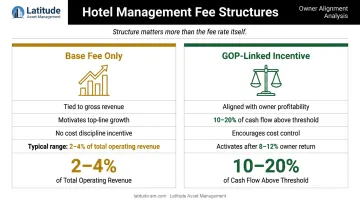
The structure of the agreement matters more than the fee rate itself.
50+ Hotel Management Companies to Know in 2026
Companies below are organized into six categories to help you identify the firms most relevant to your property type, market, and investment strategy. Each entry covers background, portfolio scope, and one key differentiator.
Global Brand Operators
These companies act as both brand licensor and direct manager for much of their own-flag inventory, while also operating under franchise and third-party arrangements. They offer unmatched distribution, loyalty program infrastructure, and brand standards — but typically require significant capital investment to meet those standards.
| Company | Scale | Key Differentiator |
|---|---|---|
| Marriott International | 9,800+ properties, 30+ brands, 145 countries/territories | Marriott Bonvoy loyalty ecosystem; tiered portfolio spanning ultra-luxury to extended stay |
| Hilton Worldwide | 9,200+ properties, 28 brands, 144 countries/territories | Early tech adoption (digital check-in, keyless entry); Hilton Honors; consistent service standards that aid repositioning |
| IHG Hotels & Resorts | 6,900+ hotels, 20 brands, 100+ countries | Growing luxury presence through Six Senses and Regent; strong ESG commitments built into brand standards |
| Accor | 5,836 hotels, ~45 brands, 110+ countries | Bold acquisition strategy; strong EMEA and Americas presence; flexible structures across ultra-luxury to economy |
| Hyatt Hotels Corporation | 1,500+ hotels, 35+ brands, 83 countries | Strong owner relations culture; expanded all-inclusive capabilities following the Apple Leisure Group acquisition |
| Wyndham Hotels & Resorts | 8,300+ hotels, 25 brands, ~100 countries | World's largest hotel franchising company by property count; dominant in economy and midscale with highly developed franchise infrastructure |
| Radisson Hotel Group | 1,640+ hotels, 10 brands, 100+ countries | Strong European and Middle Eastern presence; known for flexible owner agreements and midscale-to-upscale positioning |
Large Third-Party U.S. Operators
These firms specialize in managing hotels on behalf of outside investors under franchise agreements with major brands. They generate economies of scale through centralized revenue management, purchasing, HR, and technology platforms that smaller operators simply cannot replicate.
Aimbridge Hospitality — The largest US third-party manager by property count, with 1,116 hotels reported in the most recent survey. Widest brand coverage in the industry; proprietary owner reporting portal and 1,600+ field-level sales professionals dedicated to RevPAR performance.
Highgate — Dominant in US gateway markets (New York, Miami, Boston, San Francisco, Honolulu) with expanding European presence. Proprietary revenue management technology and a strong track record in repositioning and complex institutional transactions.
HHM Hotels — Philadelphia-based operator of 240+ hotels across 30 US states. Rare ability at scale to manage both major branded properties and genuinely independent hotels — including landmark independents like The Rittenhouse and The Joule.
Pyramid Global Hospitality — 220+ hotels, resorts, and conference centers across the US, Caribbean, and Western Europe with reported revenues exceeding $2.5 billion. Strong full-service and resort expertise combined with meaningful independent hotel management capability.
Crescent Hotels & Resorts — Manages luxury, upper-upscale, and upper-midscale properties with a focus on institutional partnerships. Proven track record in complex asset transitions, rebranding initiatives, and management takeovers requiring operational sensitivity.
Hotel Equities — Development and management company with 261 hotels across the US and Canada. Handles ground-up development, asset repositioning, and ongoing management — particularly strong in upper midscale and full-service segments.
Davidson Hospitality Group — Nearly 50-year-old firm with a deliberately selective portfolio and owner-centric philosophy. Treats each property as if owner-operated; strong top-line and bottom-line performance reputation.
Concord Hospitality Enterprises — Raleigh-based operator of 148 hotels with a track record of consistent financial performance driven by deliberate operational discipline across branded and independent properties.

Mid-Tier and Growth-Stage Operators
Crestline Hotels & Resorts — 129 hotels, 18,500+ rooms across 28 states and Washington DC. Multi-brand expertise spanning Hilton, Marriott, Hyatt, and IHG plus independent soft-brand properties.
GF Hotels & Resorts — Founded in 1988 with partnerships across Hilton, Marriott, Hyatt, IHG, Choice, and Wyndham; 169 hotels reported. Comprehensive end-to-end services including a full proprietary accounting system.
TPG Hotels & Resorts — Nationally recognized for people-first culture with experience across 500+ hotels in 40 states. Empowers property-level managers to drive innovation while maintaining brand compliance.
White Lodging Services — Merrillville, Indiana-based operator focused on premium-branded hotels in urban and high-barrier-to-entry markets. Vertically integrated development-to-management capability with deep Marriott, Hilton, and Hyatt relationships.
Remington Hotels — Dallas-based third-party manager with a full-service and upper-upscale specialization. Intensive asset stewardship approach and owner-aligned culture, particularly effective in transitioning or underperforming assets.
Sage Hospitality — Denver-based operator managing hotels, restaurants, and entertainment venues with deep independent and soft-brand expertise. Integrated F&B and social venue operations drive RevPAR and NOI across lifestyle urban markets — a model few third-party managers replicate at this scale.
Stonebridge Companies — Denver-based owner-operator active in upscale select-service and extended-stay with an aggressive growth strategy; the May 2024 acquisition of Real Hospitality Group signals continued consolidation appetite.
Boutique and Independent Hotel Specialists
These firms excel at managing independent, lifestyle, and soft-branded hotels where local authenticity and design-forward thinking create differentiated ADR premiums. Particularly relevant for boutique property owners targeting premium positioning over branded standardization.
Charlestowne Hotels — 45+ years of independent hotel management with a custom-tailored approach for lifestyle, collegiate, seasonal, and destination properties. Non-bureaucratic management model with a sophisticated five-pillar revenue optimization system.
Aparium Hotel Group — Chicago-based firm founded in 2011, focused on urban experiential properties in secondary US markets. Philosophy blends world-class operational discipline with deep community and cultural integration to create high guest loyalty.
Rosewood Hotel Group — Ultra-luxury portfolio operator whose "Sense of Place" philosophy ensures each property reflects its local culture and geography, commanding luxury pricing premiums and strong guest loyalty.
Noble House Hotels & Resorts — Manages approximately 30 distinctive independent hotels, resorts, and spas in destination-oriented markets. Focus on authentic character positions properties as the preferred choice for experiential leisure travelers.
Auberge Resorts Collection — Curated collection of luxury residential-style resorts in iconic lifestyle destinations. Standout culinary programming, wellness offerings, and deep real estate integration position Auberge properties to attract both high-net-worth guests and residential buyers — a dual demand driver that supports premium pricing.
Salamander Hotels & Resorts — Luxury independent operator of distinctive resort and spa properties. Personalized service philosophy with culinary and wellness programming tailored to high-net-worth leisure travelers.

Lifestyle, Resort, and Select-Service Specialists
These firms have built deep expertise in specific property types — often outperforming generalist operators through focused systems, specialist talent, and category-specific revenue strategies.
EOS Hospitality — Lifestyle-focused management company with deep independent and soft-branded hotel expertise. President Mark Keiser has noted that incentive contract structure matters more than fee rate — EOS designs agreements to maximize owner NOI, not just top-line growth.
Driftwood Hospitality Management — Full-service operations company active since 1999 with an entrepreneurial team culture. Company-wide quality control programs and a track record of brand relationship depth across Marriott, Hilton, Hyatt, and IHG.
AZUL Hospitality Group — San Diego-based specialist in lifestyle resort and underperforming asset management. Integrated platform covering repositioning, operational restructuring, and revenue management with proven turnaround capability.
RAR Hospitality — Cross-segment expertise spanning luxury, full-service, select-service, and extended-stay combined with strong digital marketing and an asset management mindset from day one.
PM Hotel Group — Founded 1996; self-describes as a top-15 management company with a dedicated Director of Sales for every managed property. Associate satisfaction–driven culture produces measurable NOI improvements.
McKibbon Hospitality — Hotel and restaurant management company with a 100-year history. Strong select-service and extended-stay expertise across Marriott, Hilton, and IHG flags with consistent guest satisfaction scores.
OTO Development — Operating since 2004; develops then manages its own properties and third-party hotels. The integrated development-to-management model eliminates transition friction, reducing opening costs and accelerating ramp to stabilized performance.
HP Hotels — Portfolio of approximately 45 hotels in 16 states, consistently ranked among the top 50 US hotel management companies. Business intelligence combined with franchise compliance expertise and a promote-from-within HR culture.
International and Americas-Focused Operators
Regional expertise matters enormously for owners investing in Mexico, the Caribbean, Colombia, and broader Latin America. These operators bring either global luxury pedigree or specific regional execution capabilities essential for cross-border success.
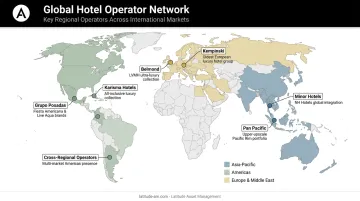
Four Seasons Hotels & Resorts — Manages 135 hotels and resorts in 47 countries with consistent Forbes Five-Star service standards. The gold standard in ultra-luxury management; known for staff-to-guest ratios and service consistency that competitors rarely match at scale.
Belmond — 43 properties across 24 countries/territories under the LVMH umbrella, spanning iconic hotels, trains, and river cruises. Once-in-a-lifetime experiential positioning in Venice, Machu Picchu, South Africa, and Latin America drives exceptional RevPAR premiums.
Grupo Posadas — Mexico's largest hotel operator managing Fiesta Americana, Live Aqua, and Curamoria Collection brands. Unmatched brand recognition and distribution network across Mexico with deep domestic corporate and leisure relationships.
Karisma Hotels & Resorts — Manages award-winning all-inclusive resorts across Mexico, Dominican Republic, Jamaica, Colombia, and Montenegro under its Gourmet Inclusive® model. Premium positioning in high-growth resort markets with strong European and Latin American tour operator distribution.
Minor Hotels — Bangkok-based group managing 640+ hotels in 59 countries under Anantara, Avani, NH, NH Collection, nhow, Oaks, and Tivoli brands. Diversified portfolio with growing Americas, Middle East, and Africa presence.
Kempinski Hotels — Founded in Berlin in 1897, Europe's oldest luxury hotel group with properties across gateway cities and resort destinations. European heritage luxury aesthetic combined with local cultural integration; strong Central and Eastern European and Middle Eastern presence.
Pan Pacific Hotels Group — Singapore-headquartered manager of 50+ hotels under Pan Pacific, PARKROYAL COLLECTION, and PARKROYAL brands across Asia, Oceania, and the Americas. Strong Asia-Pacific feeder market access combined with expanding Americas presence.
Emerging and Niche Operators
These firms are gaining market share through specialization, lean overhead, and willingness to take on assets that larger operators pass over. Particularly relevant for boutique, lifestyle, and independent hotel opportunities.
Lore Group — Design-forward independent operator managing narrative-driven lifestyle properties across Europe and the US (London and Washington DC confirmed). Storytelling-as-strategy drives strong ADR premiums and organic media coverage.
Shaner Hotel Group — 45+ years as a franchisee and management company operating Marriott, Hilton, and IHG brands across 65+ hotels. One of the industry's most experienced franchise compliance operators; owner-operator hybrid model ensures development and operational accountability are aligned.
Peregrine Hospitality — Roots dating to 1992; owner-operator specializing in destination resorts, hotels, and clubs. Competitive fee structure combined with senior-level attention typically unavailable at larger operators; well-suited for family-owned and small-portfolio investors.
Coury Hospitality — Boutique-focused manager known for luxury independent hotels and historic properties through its Ambassador Hotel Collection. Restoration-focused expertise preserving landmark character while optimizing modern financial performance.
Spire Hospitality — Manages 30+ US properties with 35+ years of operating history. Agile management team that adapts to local market conditions; strong in tertiary and secondary US markets often overlooked by larger operators.
How We Chose These Companies
This list was assembled using Hotel Management magazine's annual third-party management survey, JLL and STR market research on branded hotel supply, company self-disclosures, and independent hospitality industry research for international and Americas-focused operators.
One important note: Hotel Management's rankings are based on voluntarily self-submitted US room and property counts — they're useful for scale screening, but should not be treated as audited figures. Brand portfolio totals from Marriott, Hilton, and IHG reflect entire brand systems — not the subset of hotels those companies directly manage as a third party.
Evaluation Criteria
Companies were assessed across six dimensions:
- Portfolio breadth and geographic reach in relevant markets
- Experience with specific hotel types — luxury, select-service, resort, independent, extended-stay
- Brand affiliation and franchise compliance track record
- Fee and incentive structure flexibility and owner alignment
- Technology and revenue management capabilities
- Regional market expertise for international firms, particularly across the Americas
The Most Common Mistake Owners Make
Selecting a management company by brand name or property count alone — without verifying whether the firm has genuine experience with the specific asset type, brand flag, or target market — is one of the most reliable ways to leave value on the table.
The wrong operator can erode value long before the financials signal a problem. An independent hotel asset manager, such as Latitude Asset Management, gives owners an objective lens for evaluating candidates and negotiating contract terms — without the conflicts that come with relying on a self-reporting manager to grade its own performance.
Conclusion
The hotel management landscape in 2026 is wide, diverse, and highly specialized. There is no universally best management company — only the right fit for your specific asset, brand flag, market, and investment thesis. Owners who take time to match management company to property type outperform those who default to the most familiar name.
As transaction volume grows and cross-border investment deepens across Mexico, the Caribbean, and Latin America, owners and investors need an independent partner who can evaluate, oversee, and hold operators accountable — not another operator acting in their own interest.
Latitude Asset Management works alongside hotel owners, developers, and investors across the US, Mexico, the Caribbean, and Latin America — covering operator selection, contract negotiation, ongoing performance oversight, and eventual disposition. Contact the team at latitude-am.com to discuss how independent asset management can protect your investment and improve returns.
Frequently Asked Questions
What is the difference between a hotel brand and a hotel management company?
Hotel brands (Marriott, Hilton, IHG) license their name, distribution systems, and operating standards to property owners. Hotel management companies actually run the operation day-to-day — handling staffing, revenue management, brand compliance, and daily operations. Most branded hotels have all three parties present: an owner, a brand licensor, and a third-party management company running the property.
How much do hotel management companies charge?
The industry standard base fee is approximately 3% of total operating revenue, within a typical range of 2–4%. Performance incentive fees are layered on top, generally equal to 10–20% of cash flow above a defined threshold. How that incentive is structured (tied to GOP versus gross revenue) is critical to ensuring the manager is genuinely aligned with owner profitability, not just top-line growth.
What is the difference between hotel management and hotel asset management?
Hotel management companies operate the property on behalf of the owner — staffing, sales, brand compliance, and daily operations. Hotel asset managers represent the owner's interests by overseeing the management company, protecting capital value, and maximizing returns across the investment lifecycle. Owners operating at scale typically need both working in tandem.
How long is a typical hotel management contract?
Independent operators typically work on 3–5 year terms; brand-managed agreements often run 10–20 years. Termination provisions, performance cure periods, and the right to exit on sale are the critical negotiating points — they directly determine how much flexibility an owner retains to reposition or sell the asset.
What should I look for when choosing a hotel management company?
Five criteria matter most:
- Experience with your specific property type and brand flag — not just hospitality in general
- Verifiable performance track record in your target market, backed by references
- Fee and incentive structure tied to owner NOI, not just gross revenue growth
- Revenue management and technology capabilities matched to your competitive set
- Cultural fit: confirm it directly by speaking with other owners they currently manage for