
Introduction
A refinancing is underway. A buyer has expressed interest. The first question that follows is almost always the same: which valuation tool to use — a Broker Opinion of Value (BOV) or a formal appraisal.
Both estimate a hotel's value. But they serve different purposes, carry different weight with lenders, and come with very different costs and timelines. Choosing the wrong one at the wrong moment can delay a closing, misalign lender expectations, or consume capital on due diligence the deal wasn't ready for. Appraisals typically run $8,000–$15,000+ and take four to six weeks; a BOV can be completed in days at a fraction of that cost — a gap that matters when timing is a factor.
Hotels are income-generating assets with layered operational complexity — RevPAR trends, management contract structures, brand affiliation, FF&E reserves. That complexity means the BOV-versus-appraisal decision carries real strategic weight — the right tool depends on where you are in the transaction, who's asking, and what the valuation needs to accomplish.
This guide breaks down what each tool is, when each applies, and how to avoid the most common missteps hotel owners make when navigating valuation in transactions.
Key Takeaways
- A BOV is an informal, broker-prepared market estimate — faster, lower cost, and suited for early-stage decisions and deal screening
- Formal appraisals are USPAP-compliant, lender-required evaluations — legally recognized for institutional transactions and financing
- Hotel appraisals examine income projections, FF&E reserves, management contracts, and competitive set analysis in depth
- Choosing between them comes down to transaction stage, lender requirements, and how much credentialed evidence the deal demands
- Most hotel transactions will use both tools — at different points in the investment lifecycle
BOV vs. Appraisal: Quick Comparison
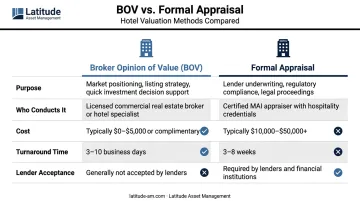
| Factor | Broker Opinion of Value (BOV) | Formal Appraisal |
|---|---|---|
| Purpose | Deal screening, pricing guidance, internal decisions | Financing, legal proceedings, institutional transactions |
| Who Conducts It | Licensed broker or hotel-specialized advisor | State-certified independent appraiser (USPAP-compliant) |
| Cost | Often low or no cost — may be offered to win a listing | Engagement-specific; varies by property size, complexity, and location |
| Turnaround | Days to a few weeks | Several weeks to a few months |
| Lender Acceptance | Not accepted for loan underwriting | Required for federally regulated CRE loans above applicable thresholds |
| Legal Standing | None | FIRREA-compliant; accepted by regulators |
What Is a Broker Opinion of Value in Hotel Real Estate?
A BOV is a professional market estimate prepared by a qualified broker or hotel investment advisor. It is not a certified appraisal. A well-constructed BOV draws on comparable transactions, current market conditions, and the property's income profile to produce a meaningful estimate of likely market value.
The Three Valuation Approaches a BOV Typically Uses
A hotel-specific BOV will generally incorporate:
- Sales comparison approach — analyzing comparable hotel transactions to establish a market-based pricing range
- Income approach — capitalizing net operating income or running a discounted cash flow analysis based on projected hotel performance
- Cost approach — applied selectively, typically for newly built or recently repositioned assets where replacement cost is a relevant reference point
What Makes a Hotel BOV Different from a Generic Commercial BOV
A BOV prepared by a generalist commercial broker and one prepared by a hotel-specialized advisor are not the same document. Meaningful hotel-specific inputs include:
- RevPAR trends, ADR, and occupancy relative to the competitive set
- EBITDA multiples and NOI margins specific to the property's operating profile
- Management contract terms and their impact on net cash flow to ownership
- Brand affiliation and franchise fee structures
- FF&E reserve requirements and their effect on distributable income
- Market segmentation analysis and demand generator evaluation
Without these inputs, a BOV is a real estate estimate applied to a hospitality asset — not a hospitality valuation. Latitude Asset Management's advisory team — drawing on careers at Hyatt, Loews, and IHG — applies this operational layer as a baseline requirement when evaluating hotel assets.
That operational depth also shapes how a BOV gets used. Knowing what the analysis captures makes it easier to identify the right moment to commission one.
When to Use a BOV
A hotel BOV is the right tool for:
- Preliminary deal screening — before committing due diligence capital, confirm whether the deal pencils out
- Initial pricing — establishing a defensible asking or bidding price anchor
- Portfolio reviews — internal valuation of assets without triggering formal appraisal costs
- Repositioning and brand conversion analysis — quantifying the value impact of a flag change or operator transition
- Early capital conversations — supporting equity partner or lender discussions before a formal appraisal is warranted
A credible BOV from a hotel-specialized advisor can also open lender conversations productively. It signals that ownership understands the asset's market position and investment thesis — useful context before a formal appraisal enters the process.
What Is a Hotel Property Appraisal?
A formal appraisal is a certified, independent evaluation conducted by a state-licensed appraiser operating under USPAP (the Uniform Standards of Professional Appraisal Practice, developed and maintained by the Appraisal Standards Board of The Appraisal Foundation). It is legally recognized and required by lenders for commercial real estate financing above defined thresholds.
What a Hotel Appraisal Actually Covers
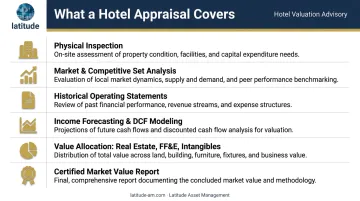
The scope of a hotel appraisal goes well beyond what a BOV delivers:
- Physical inspection of the property
- Detailed market and competitive set analysis
- Review of historical operating statements
- Income forecasting and discounted cash flow modeling (HVS, one of the leading hotel appraisal firms, employs a 10-year income and expense forecast as its primary methodology)
- Allocation of total value among real estate, personal property or FF&E, and intangibles such as goodwill (a distinction the OCC specifically notes for hotel appraisals)
- A comprehensive written report arriving at a certified market value opinion
All three standard approaches — income capitalization, sales comparison, and cost — may be considered, though USPAP requires only the approaches necessary for credible results given the assignment's scope. For hotels, the income approach typically carries the most weight, with comparable sales serving as a reasonableness check.
The FIRREA Regulatory Context
Under the 2018 interagency rule, federally regulated lenders are generally required to obtain a certified appraisal for CRE transactions above $500,000. A separate $1 million threshold applies specifically to qualifying business loans secured by real estate — but a hotel loan must first meet the definition of a qualifying business loan before that higher threshold applies.
For SBA financing, the requirements are stricter: Standard 7(a) loans above $350,000 secured by commercial real property require an appraisal by a state-licensed or state-certified appraiser under SOP 50 10 Version 8 (effective June 1, 2025).
When a Formal Appraisal Is Required
A certified appraisal is non-negotiable in these situations:
- Acquisition financing or refinancing from a regulated lender
- SBA 7(a) or 504 loan applications for hotel properties
- CMBS underwriting: the CREFC principles-based framework requires a third-party USPAP valuation from a qualified appraiser
- Estate settlements, partnership disputes, or eminent domain proceedings
- Any transaction where an institutional investor or lender requires certified value evidence
BOV vs. Appraisal: Which Should You Use for Your Hotel?
The right choice depends on where you are in the transaction — and what the deal actually requires at that stage.
Use a BOV When:
- You're evaluating whether a deal makes sense before committing to full due diligence costs
- You need a pricing anchor for initial lender or equity conversations
- Time or cost constraints make a formal appraisal premature
- You're analyzing a repositioning or brand conversion before proceeding to a full transaction process
Use a Formal Appraisal When:
- Financing from a regulated lender is required
- The transaction involves CMBS, SBA, or institutional capital
- The deal is approaching closing and certified value evidence is needed
- Any party — lender, co-investor, co-owner — requires USPAP-compliant documentation of value
The Misconception That Delays Closings
Some hotel owners assume a BOV from a well-credentialed advisor carries the same weight as a formal appraisal with lenders. It does not.
Banks, CMBS lenders, and SBA lenders require a certified appraisal regardless of a BOV's quality or depth. A BOV cannot substitute for a required appraisal in a federally related transaction. Treating them as interchangeable can create significant closing delays — if a lender rejects the BOV, the appraisal process starts from scratch.
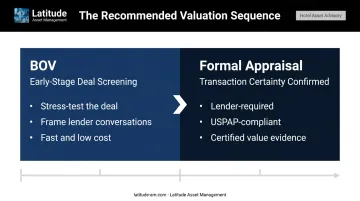
The sequence that avoids this: use a BOV early to stress-test the deal and frame lender conversations, then commission the formal appraisal once the transaction has sufficient certainty to justify the cost and timeline.
Latitude Asset Management works with hotel owners across the Americas to determine which valuation tool fits each stage of the investment cycle — and to ensure the right documentation is in place before lenders and institutional investors ask for it.
Conclusion
A BOV is a fast, flexible, market-informed tool best suited for early-stage decisions. A formal appraisal is the certified, lender-accepted standard for financing and institutional transactions. Using the wrong tool at the wrong stage doesn't just create delays — it can undermine a deal or expose a lender to valuation risk.
Because hotels carry layered operating structures, both tools require hospitality-specific expertise to produce meaningful results. A valuation that overlooks a management contract structure, an upcoming PIP obligation, or a brand affiliation mismatch will distort value — sometimes significantly. That distortion shows up at the negotiating table and in the lender's underwriting model, where it's hardest to recover from.
If you're approaching a transaction, refinancing, or portfolio review, the right starting point is identifying which valuation tool your situation actually requires and what inputs will make it credible to the parties across the table. Latitude Asset Management works with hotel owners, investors, and lenders across the Americas to answer exactly that question — and to ensure the underlying analysis holds up when it matters most.
Frequently Asked Questions
What is a broker's opinion of value?
A BOV is a market estimate of a property's value prepared by a licensed broker or specialized advisor, based on comparable transactions, income analysis, and market conditions. It is not a certified appraisal but serves as a useful decision-making tool for deal screening, pricing, and early-stage capital conversations.
What is the difference between a broker's opinion and an appraisal?
A BOV is informal and prepared by a broker or advisor, while an appraisal is a certified evaluation conducted by a licensed independent appraiser operating under USPAP standards. Only the appraisal is accepted by lenders and regulators for financing and institutional transactions.
When should a hotel owner use a BOV instead of an appraisal?
A BOV is best suited for early-stage deal screening, pricing discussions, internal portfolio reviews, and pre-financing conversations — situations where speed and cost matter more than certified credentialing. Once financing is required, an appraisal is necessary.
Can a broker opinion of value be used for hotel financing?
No. Most regulated lenders — including banks, CMBS lenders, and SBA lenders — require a certified, USPAP-compliant appraisal for hotel financing and will not accept a BOV as a substitute. A BOV can help owners prepare before ordering the formal appraisal.
How long does a hotel appraisal take compared to a BOV?
A BOV can typically be completed in days to a few weeks. A formal hotel appraisal — given its inspection, market research, income forecasting, and reporting requirements — often takes several weeks to a few months depending on the property's complexity.
How accurate is a broker opinion of value for hotel properties?
Accuracy depends heavily on the advisor's hospitality expertise and the quality of data used. A BOV from a hotel-specialized advisor — one incorporating RevPAR trends, competitive set analysis, and income projections — will be far more reliable than a generic estimate that treats the hotel as a standard income property.