
Introduction
Most hotel investors underperform not because they pick bad assets — but because they never build a coherent brand strategy around the ones they own.
The result is predictable: franchise flags that overlap, assets consuming resources without a clear return, and RevPAR that underperforms against the competitive set. CBRE's ten-year analysis of six major hotel companies found that brand counts grew at a 7% CAGR — yet adding more brands did not produce stronger RevPAR. Breadth alone creates complexity, not value.
What follows is a three-step framework for building a portfolio where every brand has a purpose, a market, and a clear path to returns.
Key Takeaways
- Brand proliferation increases cost and complexity without guaranteeing RevPAR improvement
- Each flag in a portfolio must serve a distinct guest segment or it erodes value
- Franchise fees average near 11% of rooms revenue — justification requires rigorous financial analysis
- "Gray assets" need portfolio-level context before any retain, convert, or exit decision
- A roadmap without capital allocation and ownership accountability fails at execution
What Is a Brand Portfolio Strategy in Hospitality?
A brand portfolio strategy is the structured approach to managing multiple hotel flags (franchised, managed, or independent) so each serves a distinct market segment, avoids internal cannibalization, and collectively maximizes asset value.
Two concepts get confused here. A brand (say, a Marriott Autograph Collection property) carries guest expectations, loyalty program integration, pricing power, and emotional connection built over years. An offering (a rooftop bar, a conference center) is a feature. Investors who treat franchise flags as interchangeable features miss the strategic value of brand positioning entirely.
Why This Matters for Investment Performance
The brand attached to a hotel asset directly influences:
- Cap rates and buyer appetite at exit
- Lender terms and loan-to-value ratios
- Revenue ceiling and achievable ADR
- Guest mix and demand source diversity
A Cornell study of 45,035 U.S. property-year observations confirmed that branded hotels achieve approximately 6% higher RevPAR and 2.8% higher occupancy versus independents, but only 1.4% higher EBITDAPAR.
That gap is where franchise fee economics, PIP capital, and brand-standard costs consume most of the top-line advantage.
Understanding that compression — between revenue lift and net operating income — is what separates a disciplined brand portfolio strategy from one that simply adds flags.
Step 1: Identify and Prioritize Your Most Valuable Hotel Brands
Before building any architecture, you need to know which brands in the current portfolio are actually working — and which are consuming capital without a commensurate return.
The Two Evaluation Lenses
Strategic intent: For each branded property, assess whether the brand has:
- A clearly defined target guest segment
- A defensible positioning in the local competitive set
- A role in supporting portfolio growth (loyalty reach, market extension, competitive offense against rival flags)
Financial performance: Review occupancy, ADR, RevPAR, and — above all — the RevPAR Index (RGI) against the competitive set. STR defines an RGI of 100 as fair share; assets consistently below 100 are losing demand to the competition. Track RGI alongside EBITDAPAR, not just top-line RevPAR, to understand actual owner cash flow after fees and capital.
Understanding "Gray Assets"
Some properties don't fit neatly into strong or weak categories. A soft-brand flag might drive solid occupancy but lack alignment with an investor's long-term market positioning. A hard-branded select-service property might perform financially but sit in a segment the investor is trying to exit.
These are "gray assets" — and they should never be evaluated in isolation. The right question isn't just how a hotel is performing, but what role it plays relative to the rest of the portfolio. A gray asset may be funding growth elsewhere, filling a segment gap, or serving as a transitional vehicle before repositioning.
The Branded vs. Independent Debate
That portfolio-level context extends directly to brand structure. Not every hotel benefits from a hard-brand flag. Some assets perform better under soft-brand collections (Autograph Collection, Curio, Tapestry) or as independents — depending on market context and competitive dynamics.
The evaluation must compare:
| Factor | Hard Brand | Soft Brand | Independent |
|---|---|---|---|
| Distribution support | High | Moderate | Low |
| Franchise fee obligation | High | Moderate | None |
| Brand standard flexibility | Low | Moderate | Full |
| PIP requirements | Mandatory | Variable | Owner-controlled |
| Loyalty integration | Full | Partial | None |
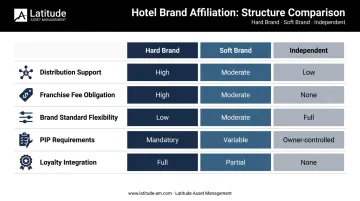
Hilton's 2026 FDDs show Curio and Tapestry each carrying 9% of Gross Rooms Revenue in combined royalty and program fees, while Hampton reaches 10%. HVS's franchise fee research places average total franchise fees near 11% of rooms revenue when all recurring charges are included. These figures must be tested against incremental RevPAR and EBITDAPAR — not assumed to be justified by brand affiliation alone.
Step 1 Output
A prioritization matrix with three categories:
- Invest: Brands with strong financial performance and clear strategic intent
- Rationalize or exit: Brands with weak performance and no defined portfolio role
- Further analysis needed: Gray assets requiring portfolio-level context before a decision
Step 2: Define Your Hotel Brand Portfolio Architecture
With a clear prioritization of current holdings, the next step is designing the architecture — the structural logic that determines how brands relate to one another and to the market.
Two Primary Models
Branded house: A single master brand covers all properties. Common among boutique hotel groups and lifestyle collections. Marketing investment is concentrated, guest loyalty builds around one identity, and operational standards are consistent. The trade-off is limited segmentation flexibility.
House of brands: Distinct flags operate independently under a parent owner — the model typical among institutional investors holding Marriott, Hilton, and IHG franchises simultaneously. Each brand targets a distinct guest segment, but management complexity increases with every flag added, and each agreement carries its own franchise obligations, PIP requirements, and brand compliance demands.
Neither model is universally superior. The right choice depends on the investor's capital base, management infrastructure, and target market coverage.
Mapping Brands to Guest Segments
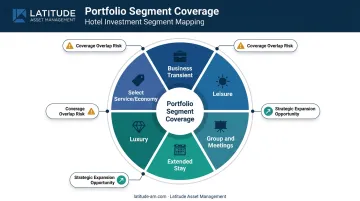
The core discipline of portfolio architecture is segment mapping: ensuring each brand in the portfolio serves a distinct traveler type without internal overlap.
Marriott's own portfolio taxonomy offers a practical reference — five explicit categories (Luxury, Premium, Select, Longer Stays, Collections) each carrying a distinct customer proposition and stay occasion. When each brand has a defined positioning and corresponding KPI set, a portfolio of 30+ flags can be managed coherently. When segment boundaries blur, the brands compete against each other before competing against the market.
Work through your own portfolio by mapping each flag to its target traveler:
- Business transient
- Leisure
- Group and meetings
- Extended stay
- Luxury
- Select service / economy
Two flags in the same segment signals internal overlap. An uncovered segment signals a growth opportunity.
Identifying Gaps and Divestiture Candidates
Latitude Asset Management works with hotel owners across the Americas to evaluate franchise options, negotiate brand agreements, and position each asset within a coherent portfolio architecture. The team includes Anthony Del Gaudio (35+ years across Hyatt, Loews, and IHG) and Germán Ongay (former Regional VP of Franchise Development for IHG Mexico). In Latin American markets, brand conversions have been documented to unlock ADR improvements of 15–40% — a figure that directly affects valuation, NOI, and exit multiples.
Step 3: Build Your Brand Portfolio Roadmap
A prioritization matrix and an architecture model are analytical outputs. The roadmap is what converts them into decisions with deadlines, capital allocations, and accountable owners.
What the Roadmap Contains
A hotel brand portfolio roadmap is a phased, time-bound plan that answers four questions for each asset:
- What capital investment is required — PIP, renovation, repositioning, or flag conversion?
- What role does this asset play in the near term — growth engine, cash flow engine, or transitional asset?
- What milestones must be achieved to support the broader investment thesis?
- In what sequence should changes be implemented across the portfolio?
Sequencing Drives Outcomes
Execution order directly determines whether the plan creates or destroys value. Repositioning a high-performing asset too early disrupts cash flow. Delaying a struggling property's conversion extends value erosion. The roadmap must sequence decisions based on:
- Current asset performance — which properties can sustain transition costs without impacting portfolio-level cash flow
- Market cycle positioning — where each submarket sits in its demand cycle relative to new supply
- Capital availability — which reinvestments can be funded from operating cash flow versus requiring new equity or debt
Capital Allocation by Brand Role
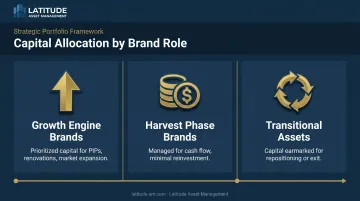
Each brand in the portfolio should carry a defined capital mandate:
- Growth engine brands receive prioritized capital for PIPs, renovations, and market expansion
- Harvest phase brands are managed for cash flow with minimal reinvestment
- Transitional assets have capital earmarked for conversion or repositioning, with a defined exit or re-entry point
Translating these mandates into executable plans requires financial rigor at the asset level. Javier Revelo, CFA, Financial Analysis and Research Advisor at Latitude Asset Management, applies scenario analysis and capital structure evaluation to multi-brand roadmaps. He stress-tests performance across market cycles and ensures franchise fee obligations are modeled asset by asset before any capital commitment is made.
Execution Infrastructure: Where Roadmaps Succeed or Fail
A roadmap without execution infrastructure is a document. It requires:
- Clear ownership for each decision and milestone
- Defined KPIs for every asset (RGI target, ADR index, occupancy benchmark, NOI goal)
- The operational capability to manage brand and operator transitions — including the 90–180-day handover process when flags change
Most roadmaps that underperform don't fail because the strategy was wrong — they fail because no one owned the execution at the property level when it mattered.
Common Brand Portfolio Mistakes Hotel Investors Make
Over-Branding
Holding too many franchise flags creates administrative complexity, dilutes management focus, and stacks franchise fee obligations that aggregate into a meaningful drag on returns. Each agreement carries royalty fees, program fees, brand compliance costs, and PIP obligations. Adding a flag without a clear demand role is cost accumulation, not diversification.
Ignoring Brand-Market Fit
Choosing a flag based on lender requirements or prior brand relationships — rather than local market demand — is a costly and correctable mistake. A luxury flag in an oversupplied market, or a select-service brand in a destination leisure location, can permanently cap achievable ADR and constrain exit valuation. No amount of operational improvement fully overcomes a brand-market mismatch at the outset.
Treating the Portfolio as a Collection of Isolated Assets
Each branded property in a portfolio shares guests, loyalty touchpoints, and distribution channels with others under the same ownership — whether the investor manages them that way or not. Failing to build a portfolio-level commercial strategy leaves cross-referral potential unrealized and makes it harder to negotiate favorable terms with brands and operators at scale. Marriott reported that Bonvoy members booked 72% of U.S. room nights in 2024, a statistic that illustrates the distribution scale available through brand loyalty systems — and the opportunity for coordinated portfolio positioning within those systems.
Frequently Asked Questions
What is a brand portfolio strategy?
A brand portfolio strategy is the structured plan for managing multiple brands so each serves a distinct market segment, avoids internal competition, and collectively maximizes value. Applied to hotels, it determines which flags to hold, grow, convert, or exit — and in what sequence.
What are the 5 pillars of brand strategy?
The five pillars are purpose, positioning, personality, perception, and promotion. In hospitality, these translate to a hotel brand's mission, target guest segment, service style, market reputation, and marketing approach — each of which must be clearly defined to avoid brand dilution across a portfolio.
What are the 4 C's of brand strategy?
The 4 C's — clarity, consistency, character, and connection — describe what makes a brand durable. In hotel management, consistency is consequential: every guest touchpoint either reinforces or erodes brand equity, which directly supports or undermines the RevPAR premium the brand is supposed to deliver.
What is the 3-7-27 rule of branding?
The rule states that it takes 3 seconds to make an impression, 7 interactions to be remembered, and 27 interactions to build trust. For hotel brands, this means consistent guest experience from booking to checkout is foundational to long-term brand value, not a discretionary operational standard.
How many hotel brands should an investor hold in their portfolio?
There is no universal number. The right size depends on the investor's capital base, management capacity, and market coverage goals. Each brand should serve a distinct segment without overlap, and portfolio complexity should be proportional to the operational infrastructure in place to manage it.
What is the difference between a branded house and a house of brands in hospitality?
A branded house consolidates marketing power under a single identity (common in boutique hotel collections). A house of brands allows distinct flags to target different guests under one ownership group, as seen with institutional investors holding Marriott, Hilton, and IHG franchises simultaneously — at the cost of greater operational complexity and higher per-brand investment requirements.