
Introduction
Every traveler compares properties before booking. That reality alone makes competitive set awareness non-negotiable — not just for revenue managers, but for any owner or investor with capital at stake in a hotel asset.
The problem is that most hotels either inherit a compset nobody has questioned in years, build one based purely on a map radius, or treat it as a one-time exercise completed at budget time and forgotten. Each approach creates the same outcome: blind spots in pricing, positioning, and capital decisions.
Getting the compset right — and actually using it — is where institutional discipline separates disciplined owners from those perpetually reacting to the market. This guide walks through how to build one that holds up to scrutiny, which metrics matter most, and how to turn compset data into decisions that protect and grow asset value.
Key Takeaways
- A compset is the 5–10 properties guests actively compare to yours — not every hotel nearby
- Build it around how guests actually shop: price range, service level, amenities, and target segment
- Diagnose performance using three STR metrics: MPI, ARI, and RGI
- Owners should treat compset analysis as a direct accountability tool, not a back-office reporting function
- Letting your compset go stale produces flattering but useless benchmarks
What Is a Hotel Competitive Set?
A hotel competitive set is the specific group of properties that guests actively consider as direct alternatives to your hotel during the booking process. That's a narrower definition than it might sound.
The broader market includes every hotel in a geographic area, regardless of whether guests actually compare them. A compset is property-specific — the hotels a guest might book instead of yours, given similar price, quality, and purpose.
STR defines a compset as hotels against which a property competes for business, typically in the same geographic area with similar services and amenities. That last clause — similar services and amenities — is what separates a meaningful competitive reference group from a proximity-based list.
Compset analysis is precise and comparative: it benchmarks your occupancy, rate, and revenue against those specific substitutes. Market analysis is macro-level, tracking new supply, economic conditions, destination-level demand, and the short-term rental environment. Conflating the two leads owners to benchmark against the wrong reference points — and draw conclusions the data doesn't actually support.
Types of Hotel Competitive Sets
Not every analytical question requires the same compset. Four types serve distinct purposes:
- Primary — Your core daily competitors. Used for recurring occupancy, ADR, and RevPAR benchmarking. This is the set that shows up in STR STAR reports.
- Seasonal — A separate set for periods when your guest mix shifts materially, such as weekday versus weekend, or high season versus shoulder. If your property competes against different hotels during spring break than during a mid-week corporate period, one static list won't capture both dynamics accurately.
- Aspirational — Higher-tier properties used as a benchmark when planning a renovation, rebrand, or repositioning. This isn't a current-performance accountability set — it's a scenario tool to understand where you're trying to go.
- Reverse — The hotels that include your property in their own compset. Peer-reviewed research defines this as hotels that identify the subject hotel as a competitor, often surfacing competitive dynamics that management's self-selected set overlooks entirely.
Why Competitive Set Analysis Matters for Hotel Owners and Investors
For hotel operators, compset data informs daily pricing. For owners and investors, it's a direct indicator of asset health.
Consistent underperformance relative to the compset on RevPAR or occupancy is an early warning signal. It may reflect pricing misalignment, a positioning gap, operator underperformance, or a capital reinvestment need — and it demands investigation either way. Flat performance in a rising market isn't neutral. It's a loss of relative position.
Compset Data and Hold/Sell/Reposition Decisions
An asset that lags its compset on RGI year over year, even when the broader market is healthy, raises a specific question: is this a property problem or an operator problem? The answer shapes the decision:
- Brand conversion — Sound product and location, but the brand isn't generating rate or demand at compset levels? A flag change may close the gap
- Management change — When the compset is growing and your property is flat, operator execution deserves scrutiny
- Targeted capital expenditure — Guest scores trailing competitive peers typically point to a product quality gap that reinvestment can address
HVS notes that hotel management performance tests — which appear in many management agreements — frequently use RevPAR relative to a competitive set as a core accountability measure. That means the quality of the compset directly affects how operator performance is evaluated and what remedies are available to the owner.
Separating Market Softness from Operator Underperformance
This is where fair share metrics earn their place. If the compset is up 8% in RevPAR and your property is flat, that gap requires an explanation and a specific action plan , not a general reference to "challenging market conditions." The compset is the control group. It isolates what's happening in the market from what's happening at your asset.
That accountability function sits at the core of how Latitude Asset Management uses compset data in its asset management engagements — acting as the owner's proxy to ensure performance gaps are diagnosed at the source and addressed with precision, not absorbed as acceptable variance.
How to Build Your Hotel Competitive Set
The right filter for every selection decision is a single question: Would a traveler consider this hotel an alternative to mine? Geography is a starting point — the compset should reflect the booking decision, not the map.
Selection Criteria
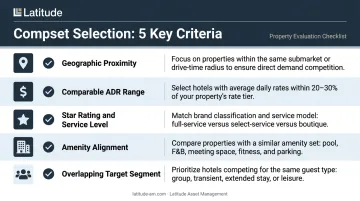
Apply these criteria to each candidate property:
- Geographic proximity — Start with a radius (typically 1–2 miles in urban markets), but treat it as a starting point, not a rule
- Comparable ADR range — Properties priced materially above or below your rate won't attract the same guest
- Star rating and service level — Budget, select-service, upscale, and luxury hotels compete for fundamentally different guests
- Amenity alignment — F&B, meeting space, pool, fitness facilities, and loyalty program participation all influence the booking decision
- Overlapping target segment — Business travelers, leisure guests, group blocks, and extended-stay guests each have distinct alternatives
Avoiding the Proximity Trap
A budget hotel two blocks away is not a competitor to a full-service upscale property. A comparable upscale hotel five miles away — same service level, similar ADR, targeting the same corporate accounts — almost certainly is.
Focusing on geography alone creates a misleading reference group. Cornell's research found that hotel-selected competitive sets and customer-perceived competitive sets frequently diverge, directly testing whether management's chosen competitors match the hotels guests actually consider. Validate your compset against how guests actually shop — OTA search behavior, brand.com cross-shopping data, and guest research are more reliable inputs than a proximity radius.
Set Size and Structure
5–10 properties is the functional range for a primary compset. Fewer than five limits statistical reliability in benchmarking. More than ten dilutes focus and makes it harder to draw actionable conclusions from benchmarking data.
Most properties benefit from maintaining multiple sets in parallel:
| Set Type | Purpose | Review Frequency |
|---|---|---|
| Primary | Daily benchmarking and operator accountability | Twice annually minimum |
| Seasonal | High/low demand periods with different guest mix | Before each season |
| Aspirational | Renovation or repositioning planning | As needed |
| Reverse | Competitive discovery and positioning awareness | Annually |
How to Analyze Your Hotel Competitive Set
Three indexes form the core of compset performance analysis. All three are typically sourced from STR STAR reports or equivalent industry benchmarking data.
The Three Core Indexes
| Index | Formula | Score Above 100 Means |
|---|---|---|
| MPI (Market Penetration Index) | Hotel occupancy ÷ Compset occupancy × 100 | Capturing more than fair share of demand |
| ARI (Average Rate Index) | Hotel ADR ÷ Compset ADR × 100 | Pricing at or above the compset average |
| RGI (Revenue Generation Index) | Hotel RevPAR ÷ Compset RevPAR × 100 | Generating more than fair share of revenue |
RGI is the summary measure — it captures both rate and occupancy in a single number. MPI and ARI explain why RGI looks the way it does.
Reading the Indexes Together
The diagnostic value comes from reading all three in combination:
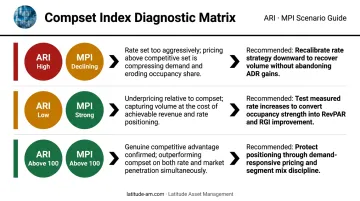
- High ARI, declining MPI — Rates are aggressive and the property is losing bookings to better-priced competitors. The rate premium isn't sticking with enough demand. Consider whether rate adjustments or enhanced value positioning could recover occupancy without sacrificing meaningful revenue.
- Strong MPI, low ARI — The property is filling rooms by underpricing. Volume is there; revenue isn't. This is often fixable through disciplined yield management and a more confident rate positioning strategy.
- Both above 100 — Strong RGI reflects genuine competitive advantage in both rate and volume. The harder question is what's driving it. Demand mix, channel strategy, and product quality each contribute differently — and not all of them hold under pressure.
Cornell research found that a 1% increase in online reputation score correlates with up to a 1.42% increase in RevPAR — which means review sentiment isn't soft data. It belongs alongside rate and occupancy metrics in any serious competitive analysis. That connection between reputation and revenue is precisely why qualitative intelligence matters — the numbers surface the gap; the qualitative data explains what created it.
Layering In Qualitative Intelligence
Three qualitative sources consistently add the most diagnostic value:
- OTA reviews, Google, and TripAdvisor surface what guests value most — and where competitors fall short. A property consistently praised for breakfast quality and penalized for parking is revealing an exploitable gap.
- Rate behavior across OTAs and brand.com tells a strategic story over time: early discounting ahead of soft periods, last-minute spikes around local events, promotional patterns tied to specific demand windows. Tracking these reveals how competitors manage yield — and where they're vulnerable.
- A SWOT overlay maps compset data against your property's specific position. Superior guest scores, unique amenities, and direct booking share are advantages worth protecting. Distribution gaps, service inconsistencies, and product deficits are vulnerabilities worth closing before competitors exploit them.
Common Compset Mistakes and How to Avoid Them
Inheriting and Never Updating
Markets shift constantly. New hotels open. Competitors renovate. Short-term rental supply fluctuates. A compset built three years ago may no longer reflect the actual competitive landscape — but if nobody has questioned it, it's still shaping pricing decisions, budget assumptions, and performance reviews.
At minimum, review the compset twice per year. Review it immediately after any significant market event: a new hotel opening, a competitor rebrand, or a material change in short-term rental supply. EHL's guidance supports at least annual revalidation as standard practice.
Building a Weak Compset to Flatter the Numbers
Filling a compset with lower-tier properties produces strong-looking MPI and ARI scores. It also tells you nothing useful, because guests aren't comparing your hotel to those properties. The benchmarking reference group must reflect genuine competition for the same guest — otherwise the indexes are measuring a race you've already won before it started.
The stakes are highest when compset performance enters operator accountability clauses. HVS identifies the quality of the competitive set as a key difficulty in RevPAR performance tests — a weak denominator can mechanically inflate the indexes and make underperformance invisible to ownership.
Treating It as a One-Time Exercise
The value of a compset comes from consistent tracking over time. A single data pull at budget season captures a snapshot. Patterns in occupancy, rate, and revenue relative to the set only become visible — and actionable — when data is reviewed on a regular cadence.
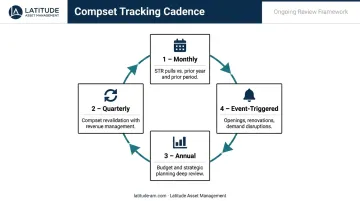
A practical tracking approach includes:
- Monthly STR pulls reviewed against the prior year and prior period
- Quarterly compset revalidation discussions with revenue management
- Annual deep reviews tied to budget and strategic planning cycles
- Event-triggered reviews after openings, renovations, or demand disruptions
How Latitude Asset Management Approaches Competitive Set Analysis
Latitude Asset Management incorporates competitive set analysis as an ongoing component of its hotel asset management process — a continuous discipline that informs pricing strategy, capital planning, operator reviews, and ownership-level decision-making.
Latitude applies two analytical lenses simultaneously — one operational, one investment-focused — that most operators and consultants treat as separate exercises:
- The operational lens — understanding what drives compset gaps at the property level: staffing, revenue strategy, product condition, distribution mix, and service consistency
- The investment lens — translating compset performance into asset valuation, return on investment, and strategic positioning decisions
That dual perspective — reflected across Latitude's team, which includes Cornell-certified hotel investment professionals, former brand executives from Hyatt, Loews, and IHG, and operators with decades of hands-on experience — allows the firm to give hotel owners a complete picture of what's happening competitively and what it means for asset value.
That analysis only holds when benchmarks reflect the right competitive context. Across the Americas, competitive dynamics, guest behavior, and market structures vary enough to render generic comps unreliable. The all-inclusive segment operates differently in the Caribbean than in Mexico. Colombia's tourist-rental housing supply grew 80% in two years according to CBRE — alternative-lodging competition that must factor into any honest market analysis.

Latin American markets in particular require on-the-ground intelligence that STR data alone won't capture.
Latitude's regional teams — with senior partners in Mexico, Colombia, and the Caribbean — conduct market-specific competitive set analysis that reflects the nuances of each geography, drawing benchmarks from the right peer set and applying local context to what the numbers actually mean for an owner's position and asset value.
Frequently Asked Questions
How many hotels should be in a competitive set?
Five to ten properties is the recommended range for a primary compset. Fewer than five limits statistical reliability, while more than ten makes it difficult to draw focused conclusions. Secondary and aspirational compsets can expand coverage for specific analytical purposes without diluting the primary benchmark.
How often should a hotel competitive set be reviewed?
At least twice per year, and immediately after any significant market event — a new hotel opening, a competitor renovation or rebrand, or a material shift in short-term rental supply. Demand patterns and competitive positioning shift well ahead of annual budget cycles.
What is the difference between MPI, ARI, and RGI?
MPI measures occupancy share relative to the compset, ARI measures rate performance, and RGI measures overall RevPAR. RGI provides the most complete picture because it captures both occupancy and rate together ; MPI and ARI then explain the source of any gap.
What is a reverse compset and why does it matter?
A reverse compset identifies the hotels that include your property in their own competitive benchmarking sets. This reveals how your property is perceived in the market and whether you're competing for guests your own compset doesn't track — dynamics that standard benchmarking often misses.
How does competitive set analysis help hotel owners and investors make better decisions?
Compset performance data helps owners separate market-wide softness from operator underperformance, identify repositioning opportunities, and ground hold/sell/reinvest decisions in objective benchmarking rather than operator-reported metrics alone. That external reference point is what makes performance accountability credible.
Can a hotel have more than one competitive set?
Yes, and most hotels benefit from maintaining multiple sets. A primary set serves daily benchmarking, seasonal sets account for shifts in demand and guest mix, and an aspirational set supports renovation or repositioning planning.