
The quality of your operations manager shapes everything from your TripAdvisor score to your labor cost ratio. And both of those flow directly to your bottom line.
This article covers the formal job description, core responsibilities, required skills, common challenges, and — critically for hotel owners and investors — why operations management quality is one of the most direct drivers of NOI and asset value.
Key Takeaways
- The hotel operations manager oversees daily departmental performance across front desk, housekeeping, F&B, and maintenance, typically reporting to the General Manager
- Core accountabilities include guest experience, staff management, budget control, compliance, and vendor oversight
- The operations manager executes tactically; the General Manager leads strategically — these are distinct roles with distinct scopes
- Strong operations management measurably improves NOI through labor efficiency, cost control, and reduced revenue leakage
- For hotel owners and investors, evaluating operations management quality is a non-negotiable part of asset oversight and acquisition due diligence
What Is a Hotel Operations Manager?
A hotel operations manager is a senior professional responsible for coordinating the day-to-day functioning of a hotel across multiple departments — front desk, housekeeping, food & beverage, maintenance, and security — to deliver consistent guest experiences, cost efficiency, and operational discipline.
Within the hotel hierarchy, the role sits directly below the General Manager. The operations manager is the practical executor of the hotel's service strategy — translating the GM's direction into department-level delivery. In smaller, select-service properties, the GM often absorbs these duties entirely.
In larger full-service and branded hotels, the operations manager is a dedicated senior position with direct reports across every major department.
According to the U.S. Bureau of Labor Statistics, the U.S. alone supports approximately 52,000 lodging manager positions as of 2024, with 5,400 openings projected annually through 2034. Globally, the industry spans more than 211,000 hotel properties and 19.5 million rooms — a scale that demands professional, structured operations leadership at every level.
Hotel Operations Manager vs. General Manager
These roles are frequently confused, even within the industry. For hotel owners structuring a management team — or evaluating a management company's setup — the distinction has real consequences.
Scope and Reporting Structure
| General Manager | Operations Manager | |
|---|---|---|
| Primary focus | Strategic direction and P&L ownership | Day-to-day departmental execution |
| Reporting to | Ownership / management company | General Manager |
| Manages | Department heads + Operations Manager | Heads of Department (HODs) directly |
| Key responsibilities | Brand relationships, financial strategy, investor reporting | SOP compliance, service quality, cross-departmental coordination |
| Decision horizon | Long-term | Immediate to short-term |
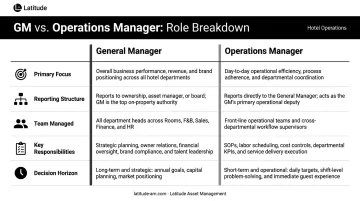
The GM holds full financial accountability and sets the business direction. The operations manager translates that direction into departmental performance: running daily ops meetings, conducting property inspections, managing escalated guest issues, and keeping every department aligned.
In larger full-service hotels and branded chains, the operations manager functions as the GM's operational right hand. This distinction matters most when hotel owners are evaluating whether their management team is properly structured — or where accountability gaps between strategy and execution are costing them performance.
Core Roles and Responsibilities of a Hotel Operations Manager
Specific duties vary by property type and size, but the following covers the standard scope across full-service and mid-scale hotels.
Department Oversight and Daily Operations
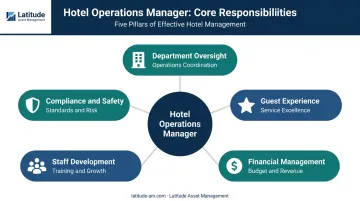
The operations manager coordinates with all heads of department — front office, housekeeping, F&B, maintenance, and security — to ensure each area delivers consistently high service and operates within defined SOPs. This includes:
- Conducting daily operations briefings and cross-departmental meetings
- Completing duty management shifts and property inspections
- Monitoring SOP compliance and escalating deficiencies
- Coordinating inter-departmental handoffs (arrivals, group check-ins, events)
Guest Experience Management
The operations manager owns the hotel's service culture. That means handling escalated guest complaints, monitoring online review scores, and driving service recovery processes. Guest satisfaction scores are not a soft metric — they have direct revenue implications, which we address in a later section.
Financial and Budget Management
Operations managers carry meaningful financial accountability:
- Managing departmental operating budgets
- Tracking and controlling labor, supply, and utility costs
- Working with the GM on weekly revenue forecasts
- Identifying inefficiencies and eliminating revenue leakage
- Ensuring all outlets — including F&B and ancillary revenue centers — contribute to profitability
Operations managers who understand the revenue side — not just cost control — give ownership a materially different level of visibility into where value is being created or eroded.
Staff Management and Development
People management is one of the most demanding aspects of the role:
- Recruiting, onboarding, and training departmental staff
- Conducting performance reviews and managing disciplinary processes
- Resolving team conflicts and fostering a positive workplace culture
- Driving ongoing training initiatives to maintain service standards
Labor is the single largest operating cost in most hotels, and turnover compounds it. An AHLA study of more than 4,000 U.S. hotels found that even the lowest-turnover hotel cohort experienced a 50% increase in turnover compared to 2019. The operations manager is on the front line of this challenge every day.
Compliance, Health, and Safety
Non-compliance is a liability in every sense. Operations managers are responsible for:
- Conducting fire safety walks and health & safety audits
- Ensuring adherence to local regulations and brand standards
- Managing security personnel and protocols
- Maintaining inspection documentation and audit trails
Lapses in this area can result in fines, liability exposure, or reputational damage — none of which show up as a line item until it's too late.
Vendor and Inventory Management
Operations managers oversee supplier relationships and procurement across all major cost categories. Key responsibilities include:
- Negotiating vendor contracts for linen, F&B supplies, and maintenance equipment
- Maintaining inventory levels that align with occupancy forecasts and budget parameters
- Auditing procurement processes to prevent cost leakage and unauthorized spend
Key Skills and Qualifications Required
The operations manager role demands a blend of operational expertise, financial discipline, and people leadership that is rare in a single hire. Getting this right matters — for both the asset's daily performance and its long-term investment returns.
Leadership and Communication
Cross-departmental leadership is the foundation. An operations manager must motivate a diverse team, manage conflict across multiple departments, and communicate clearly at every organizational level. When this skill is missing, the consequences cascade quickly — into guest complaints, staff turnover, and revenue loss.
Financial Acumen
Strong operations managers understand the numbers:
- Budget management and cost control across departments
- Basic P&L literacy and performance trend analysis
- Fluency in hospitality KPIs — occupancy, ADR, RevPAR, GOP
- The ability to connect operational decisions to financial outcomes
The strongest performers work both sides of the ledger — managing costs while actively driving revenue outcomes.
Problem-Solving and Crisis Management
Hotels run on controlled chaos. A sudden staff shortage, a guest incident, an equipment failure at midnight — operations managers handle these without escalating to ownership. Calm, decisive judgment under pressure is a baseline requirement for the role.
Technology Proficiency
Technology competency is now a baseline expectation across the industry:
- Property Management Systems (PMS) proficiency
- Familiarity with channel management and distribution platforms
- Comfort with reporting dashboards and performance analytics
The data reflects how significant these gaps can be. Hospitality Technology's 2024 Lodging Technology Study found that 69% of hotel operators cite legacy-system integration as a barrier to performance, and 54% identify insufficient technology expertise as a key obstacle. Operations managers who can navigate these gaps reduce manual workload and support faster, better-informed decisions.
Education and Experience Requirements
- Bachelor's degree in hotel management, business administration, or a related field
- 5–8 years of progressive hotel operations experience across multiple departments
- Certifications in hospitality management strengthen the profile, particularly for larger or branded properties
- For full-service and branded assets, direct brand-side experience is highly valued
Common Challenges Hotel Operations Managers Face
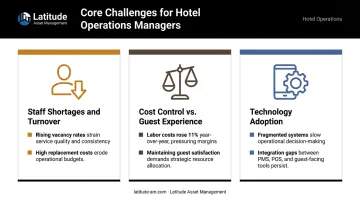
Three persistent pressures define the operations manager role across most hotel environments today:
- Staff shortages and turnover: Industry-wide attrition forces operations managers to maintain service quality with understaffed departments — a daily test of leadership and creative problem-solving.
- Cost control vs. guest experience: With labor costs rising approximately 11% year over year through September 2024 (per STR/CoStar data), managers face constant pressure to reduce expenses without degrading service. No formula exists; it demands sound financial judgment applied in real time.
- Technology adoption: Implementing new property management systems, training staff on updated platforms, and meeting guest expectations for mobile check-in, digital keys, and AI-assisted service all fall under the operations manager's domain — often running alongside ongoing daily responsibilities.
How Hotel Operations Management Impacts Hotel Asset Performance
For hotel owners and investors, operations management is not a back-office function: it is a direct driver of asset value.
The NOI Connection
Well-run operations teams reduce labor inefficiencies, control supply costs, and close revenue leakage gaps. These improvements flow directly to net operating income. STR/CoStar benchmark data shows that full-service hotels carry five-year average GOP margins of 25–35%, while select-service properties run at 40–50%. The gap between those ranges within any single segment often comes down to operational discipline — and total U.S. hotel operating expenses grew 4.1% in 2024, with salaries and benefits up 4.8%, making cost management at the operations level more consequential than ever.
Guest Satisfaction and Pricing Power
Day-to-day operations drive the review scores that determine a hotel's pricing power. Cornell University's research using ReviewPro and STR data found that a one-point increase on a 100-point review index is associated with 0.89% higher ADR, 0.54% higher occupancy, and 1.42% higher RevPAR. Hotels with consistently high scores command rate premiums and depend less on OTA discounting to fill rooms.
The inverse is equally true. J.D. Power's 2025 study of nearly 40,000 branded hotel guests found that service problems — the direct output of operational failures — were associated with a 217-point satisfaction decline on their scale. That kind of score damage takes months to recover.
The Asset Management Perspective
Hotel owners and investors should evaluate operations manager performance as a core component of asset oversight, not a secondary concern. The right metrics to track include departmental KPIs, labor cost ratios, guest satisfaction trends, and SOP compliance.
This is where a hotel asset management partner like Latitude Asset Management provides meaningful value. Latitude positions itself as the owner's proxy, sitting between the investor and the operator and holding operations leadership accountable to performance benchmarks defined by ownership objectives. The firm's oversight spans:
- Revenue strategy and yield optimization
- Labor cost control and supply chain efficiency
- Guest service standards and brand compliance
- Financial performance against ownership-defined targets
When Latitude takes on a new engagement, the operational deficiencies they most commonly encounter — weak revenue management, underdeveloped cost structures, misaligned operators — frequently trace back to insufficient accountability at the operations management level. As the firm has observed: the wrong operator can steadily erode value long before issues show up in the financials.
Operational due diligence at acquisition matters for the same reason. Evaluating the strength of existing operations leadership — before close, not after — is one of the clearest signals of a property's true value-add potential.
Frequently Asked Questions
What are the main roles and responsibilities of an operations manager in the hotel industry?
The operations manager oversees daily performance across front desk, housekeeping, F&B, and maintenance departments. Core duties include managing staff, controlling departmental budgets, ensuring SOP compliance, handling escalated guest issues, and maintaining health and safety standards — all with the goal of delivering consistent guest experiences and protecting the hotel's financial performance.
What is the difference between an operations manager and a hotel manager?
The hotel (general) manager holds full strategic and financial responsibility for the property, including P&L accountability and brand relationships. The operations manager focuses on day-to-day execution and departmental coordination, reporting directly to the GM. In smaller properties, one person may cover both roles.
What skills are required to be an operations manager in the hotel industry?
The most critical skills are cross-departmental leadership, financial acumen (budget management, P&L literacy, KPI interpretation), problem-solving under pressure, clear communication across all organizational levels, and proficiency with hotel management technology including PMS platforms.
What is the minimum salary of an operations manager in the hotel industry?
According to BLS data, the national median for lodging managers was $68,130 in May 2024, with the bottom 10% earning less than $39,490 and the top 10% earning more than $126,990. Compensation varies by hotel size, brand affiliation, and market — with state averages in high-demand markets like Hawaii reaching $119,640.
What qualifications do you need to become a hotel operations manager?
A bachelor's degree in hotel management or business administration is standard, alongside several years of progressive operations experience across multiple departments. Familiarity with brand standards and PMS platforms is expected; certifications in hospitality management strengthen a candidate's profile for larger or branded properties.
How does strong operations management impact hotel investment returns?
Strong operations management reduces labor inefficiencies, controls cost growth, and improves guest satisfaction scores — directly improving NOI and RevPAR. For investors, operations quality is a direct input to asset valuation and belongs in acquisition due diligence, not just top-line revenue analysis.