
For hotel owners, developers, and investors operating across the Americas, financial risk takes many forms: volatile RevPAR, debt service pressure, currency mismatches, and operational failures that can erode returns before an asset ever stabilizes. Getting ahead of these exposures requires more than intuition.
This article covers what financial risk actually is, the four core types every investor should know, how to conduct a structured assessment, and practical strategies for reducing exposure — with specific context for hotel and real estate investment throughout.
Key Takeaways
- Financial risk is measurable and manageable — unlike pure uncertainty, it can be identified, quantified, and treated
- The four foundational types are market, credit, liquidity, and operational risk
- Hotel assets carry a distinct risk profile — daily repricing and operational dependency create faster-moving exposures than most asset classes
- A four-step process (identify, analyze, treat, monitor) converts risk from a reactive problem into a managed discipline
- Mitigation tools — diversification, hedging, risk transfer — reduce exposure but don't replace active oversight
What Is Financial Risk?
Financial risk is the possibility that an investment or business decision results in financial loss — whether that means loss of capital, disrupted cash flow, or an inability to meet financial obligations on schedule.
One distinction matters here: risk is not the same as uncertainty. Risk is measurable. You can estimate the probability that interest rates rise 200 basis points, model the impact on debt service coverage, and stress-test your capital structure accordingly. Pure uncertainty — events with no historical precedent or probability distribution — is different and largely unquantifiable.
Risk Appetite vs. Risk Tolerance
Two related concepts shape how organizations and investors respond to financial risk:
- Risk appetite is the high-level determination of how much risk an investor is willing to accept in pursuit of returns — for example, willingness to take on development risk in an emerging market for higher projected yields
- Risk tolerance operationalizes appetite through specific, measurable limits — minimum DSCR thresholds, maximum leverage ratios, or defined caps on FX exposure
Defining both before making investment decisions is foundational to disciplined capital allocation. Without defined parameters, capital allocation decisions rest on shifting assumptions rather than consistent criteria.
Systematic vs. Unsystematic Risk
Financial exposures also divide into two broad categories:
- Systematic risk refers to market-wide factors — recessions, interest rate shifts, inflation — that affect all assets and cannot be diversified away
- Unsystematic risk is specific to a particular asset, company, or market — management quality, local demand dynamics, operator performance — and can be reduced through diversification and active management
Separating the two matters because systematic risk demands structural hedging strategies, while unsystematic risk is where skilled asset management and underwriting discipline directly move the needle.
The 4 Core Types of Financial Risk
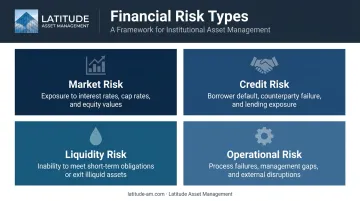
Most institutional investment analysis and capital frameworks — including Basel capital and liquidity standards — organize financial risk into four foundational categories: market, credit, liquidity, and operational risk. Broader enterprise frameworks often add legal/compliance risk and foreign exchange risk as additional categories, both of which are particularly relevant for cross-border investors.
Market Risk
Market risk is the potential for financial loss due to fluctuations in market prices, interest rates, equity values, or commodity prices.
For hotel and real estate investors, this shows up most directly in two ways:
- Rising debt service costs when interest rates increase, compressing NOI margins and threatening DSCR compliance
- Cap rate expansion that reduces asset valuations even when operating performance is stable
Market risk is largely systematic. You can't eliminate it, but you can structure around it: scenario testing, conservative underwriting, and capital reserves sized for realistic downside scenarios all help limit exposure.
Credit Risk
Credit risk is the risk that a borrower, tenant, or counterparty fails to meet their financial obligations.
Lenders evaluate creditworthiness using the 5 C's of credit:
- Character — the borrower's track record and reputation
- Capacity — ability to service debt from operating cash flow
- Capital — equity invested in the deal
- Collateral — the asset securing the loan
- Conditions — market and economic environment at underwriting
Hotel investors benefit from understanding this framework when structuring acquisitions, evaluating operator agreements, or seeking refinancing. The same lens lenders apply also reveals how exposed a given deal structure actually is.
Liquidity Risk
Liquidity risk is the inability to meet short-term financial obligations — either because cash is insufficient or because assets cannot be converted to cash quickly without significant value loss.
Real estate, including hotel assets, is inherently illiquid. Selling a property takes months, not days, and distressed conditions typically force price concessions. For investors with near-term capital needs, managing this risk requires adequate reserves, realistic debt maturities, and a capital structure that doesn't depend on a fast exit.
Operational Risk
Operational risk covers losses arising from failed internal processes, systems, people, or external events.
In a hospitality context, this includes:
- Management failures and leadership gaps
- Technology breakdowns and system outages
- Fraud, labor disruptions, and supply chain failures
- External events (natural disasters, health crises, regulatory changes)
Each can directly impair a hotel's financial performance. Because hotel value tracks operational performance so closely, operational risk in this asset class carries heavier financial consequences than in most other property types.
Financial Risk in Hotel and Real Estate Investment
Hotels carry a distinct financial risk profile compared to office, multifamily, or industrial assets. Revenue is highly cyclical, assets are capital-intensive, and operational performance directly determines both property value and debt serviceability. Hotels also reprice their inventory daily, which means demand shocks transmit into NOI, DSCR, and valuation faster than in any long-lease asset class.
Revenue Volatility
Hotel income (measured through occupancy, ADR, and RevPAR) swings significantly with economic cycles, demand shocks, and seasonality.
The data on downside scenarios is stark. U.S. hotel RevPAR fell 79.9% year-over-year to $17.93 in April 2020, with occupancy dropping to 24.5%. Even in a more typical recessionary period, RevPAR declined 16.5% nationally in 2009. These aren't outlier scenarios to dismiss — they're the range that hotel underwriting must account for.
Effective revenue risk management requires stress-testing at genuine shock levels, not just mild cyclical reversals.
Leverage and Debt Service Risk
Hotels are typically acquired and developed using significant debt. When NOI declines, debt service coverage ratios deteriorate quickly. According to HVS, hotel lenders in the current higher-rate environment typically require DSCR of 1.30x–1.50x, meaning net operating income must cover annual debt obligations by that margin.
When RevPAR drops sharply, that margin can evaporate fast. The consequences cascade quickly:
- Covenant breaches that trigger lender intervention
- Restricted distributions to equity holders
- Forced asset sales at distressed valuations
- Default and loss of the investment
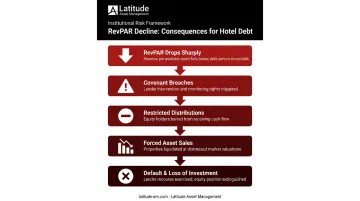
Stress-testing debt structures before capital is committed is the difference between a recoverable downturn and a permanent loss.
Currency and FX Risk for Cross-Border Investors
Investors operating across Latin America and the Caribbean face additional exposure from exchange rate volatility between the USD and local currencies: MXN, COP, BRL, and others. The Mexican peso, for example, appreciated approximately 10% against the USD in the 12 months preceding the IMF's 2023 Mexico report. That was a favorable movement, but currency cycles cut both ways.
Currency mismatch creates real financial consequences: local-currency revenues that shrink in USD terms, debt service costs that rise when local currencies weaken, and distribution yields that fluctuate independent of operational performance. Matching the currency of revenue, debt, and investor distributions, or hedging the mismatch, is essential for cross-border deals.
Latitude Asset Management's regional partners in Mexico, Colombia, and the Caribbean bring firsthand understanding of these dynamics, helping investors time market entry relative to currency cycles and structure deals that account for the actual cost of FX exposure.
Development and Construction Risk
Hotel development projects add another layer of exposure: cost overruns, construction delays, permitting complexity, and market timing risk can all erode projected returns before a single room is sold. CBRE has reported hotel construction costs rising 10%–20% in most markets, with labor availability and material price volatility adding further pressure.
These risks compound in emerging markets where regulatory environments and supply chains are less predictable. Working with a specialized hotel investment and asset management firm — one with hands-on experience in hotel openings, repositioning, and cross-border transactions — helps investors identify and quantify these property-level risks before and during capital deployment, rather than discovering them mid-construction.
How to Assess Financial Risk: A Step-by-Step Process
A structured financial risk assessment follows four steps. Before beginning, organizations and investors should establish clearly defined risk tolerance thresholds: these thresholds guide every downstream decision in the process.
Step 1: Identify Financial Risks
Risk identification starts with a thorough review of:
- Financial statements, balance sheets, and cash flow projections
- Debt structures, maturity schedules, and covenant requirements
- Market data, competitive supply, and demand trends
- Operational performance and management agreements
Risks should be categorized as internal (operational inefficiencies, management gaps, capital structure issues) or external (market conditions, regulatory changes, macroeconomic factors). All identified risks belong in a risk register: a documented inventory that enables tracking, ownership assignment, and accountability over time.
Step 2: Analyze and Prioritize Risks
Each identified risk gets scored on two dimensions:
- Likelihood — how probable is the event given current conditions?
- Financial impact — how severe would the consequences be if it occurred?
Multiplying these scores and plotting them in a risk matrix helps teams prioritize which exposures need immediate treatment versus ongoing monitoring. Analysis should also factor in business objectives and strategic priorities — a risk that scores moderate in isolation may become high-priority if it threatens a critical milestone.
Step 3: Develop a Risk Treatment Plan
Every identified risk requires a documented treatment decision. The four primary options:
| Treatment | Definition | Example |
|---|---|---|
| Accept | Knowingly tolerate within defined limits | Minor occupancy seasonality within projected range |
| Avoid | Alter the decision to eliminate the exposure | Exit a market with unacceptable regulatory uncertainty |
| Transfer | Shift risk to a third party | Insurance, performance guarantees, indemnity clauses |
| Mitigate | Implement controls that reduce likelihood or impact | Interest rate hedges, operator accountability structures |
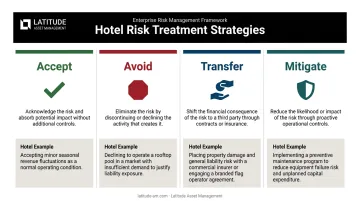
Even accepted risks need documentation — the reasoning should be recorded, not assumed.
Step 4: Monitor and Reassess Continuously
Financial risk monitoring is ongoing, not periodic. Best practice involves:
- Tracking mitigation action progress against defined timelines
- Updating the risk register as market conditions, asset performance, or capital structures change
- Conducting full reassessments at least annually
Material events — an acquisition, a significant demand shift, a regulatory change, or a notable performance deviation — should trigger off-cycle reassessments. Establishing trigger criteria in advance ensures reassessments are structured and timely, not driven by crisis.
How to Reduce and Manage Financial Risk
Diversification and Active Asset Management
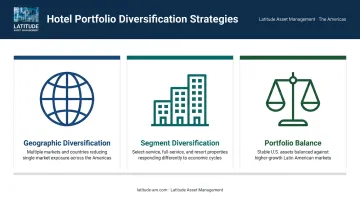
Spreading exposure across asset types, geographies, and revenue streams reduces concentration risk. For hotel investors, this means:
- Geographic diversification across multiple markets and countries, so a single-market downturn doesn't impair overall returns
- Segment diversification across select-service, full-service, and resort properties, each of which responds differently to economic cycles
- Portfolio balance between stable U.S. assets and higher-growth Latin American markets, creating a natural counterbalance
Active hotel asset management — monitoring operator performance, KPIs, and market conditions on a continuous basis — keeps risk mitigation embedded in day-to-day ownership rather than treated as a periodic review. Latitude Asset Management builds this oversight into its core mandate, covering both where and when to invest and how each property performs within a single coordinated framework.
Hedging Instruments
Financial instruments can reduce or fix specific market and FX exposures:
- Interest rate swaps exchange floating-rate obligations for fixed-rate ones, locking in borrowing costs
- Forward contracts fix an exchange rate for a future transaction, removing currency uncertainty from cross-border deals
- Options provide the right — not the obligation — to transact at a set rate, preserving upside while capping downside
Each instrument carries trade-offs — counterparty risk, basis risk, or option premiums — and the right choice depends on the specific exposure, deal structure, and jurisdiction involved. Qualified financial and legal counsel should be engaged before executing any hedging strategy.
Risk Transfer Mechanisms
Contractual and insurance-based risk transfer shifts specific financial exposures to third parties:
- Property and liability insurance covers physical and operational loss events
- Performance guarantees in hotel management agreements create financial accountability when operators miss agreed performance thresholds — as HVS documents, these are a recognized mechanism for transferring operational risk from owner to operator
- Indemnity clauses in franchise agreements allocate specific legal and financial exposures between franchisee and franchisor
Risk transfer reduces exposure — it doesn't eliminate it. Counterparty strength, policy exclusions, and residual gaps all warrant ongoing review alongside active management.
Frequently Asked Questions
What are the 4 types of financial risk?
The four core types are market risk, credit risk, liquidity risk, and operational risk — the grouping used in Basel capital frameworks and institutional investment analysis. Broader enterprise frameworks (such as COSO's ERM model) add legal/compliance risk and foreign exchange risk as additional categories.
What are the 4 components of financial risk analysis?
The four components are risk identification, risk analysis, risk treatment, and risk monitoring. Together they form a continuous cycle that helps organizations anticipate exposures and respond before losses materialize — a structure aligned with ISO 31000's risk management process.
What do financial risk analysts do?
Financial risk analysts identify potential financial exposures, model their likelihood and impact, develop mitigation strategies, and monitor risk on an ongoing basis. In hotel investment contexts, they also support due diligence, acquisition underwriting, capital structure evaluation, and portfolio performance reporting.
How is financial risk different in hotel or real estate investments?
Hotel and real estate investments carry distinct risk factors: illiquidity, leverage sensitivity, revenue volatility, and (for cross-border deals) currency exposure. Because rooms reprice daily, demand shocks hit cash flow and valuation faster than in most asset classes — making industry-specific operational expertise as important as standard financial analysis.
What is the difference between financial risk and investment risk?
Financial risk is the broader concept — it encompasses all threats to an organization's financial position, including cash flow disruption, capital loss, and inability to meet obligations. Investment risk refers specifically to the chance that an investment underperforms or loses value. Investment risk is one subset of overall financial risk.