

Introduction
Hotel investors across the Americas are managing increasingly complex portfolios — multiple properties, multiple markets, multiple brands, and layered capital structures — while facing sustained pressure to deliver returns in a tighter operating environment. In that context, how accurately you assess your portfolio isn't a technical question. It determines how well you protect and grow your investment.
Most hotel owners treat portfolio analysis as a periodic formality — pulled out before a refinancing or when a lender requests it. That gap between intention and discipline is where performance erodes, risks compound unnoticed, and capital gets allocated based on familiarity rather than evidence.
This article covers the practical, measurable benefits of consistent portfolio analysis — what it actually delivers when applied with discipline, not just when circumstances demand it.
Key Takeaways
- Portfolio analysis gives hotel investors a structured way to evaluate performance, risk, and strategic fit across every asset in the portfolio.
- Regular analysis reveals which assets are underperforming, where capital is best deployed, and which risks are growing unnoticed.
- Without ongoing analysis, investors make reactive decisions — at a higher cost than proactive ones require.
- Spotting patterns early means correcting problems sooner and capturing opportunities before they close.
- Portfolio analysis is the foundation of disciplined, value-driven asset management — for any investor holding multiple properties across markets or brands.
What Is Portfolio Analysis?
Portfolio analysis is the structured process of evaluating all investments within a portfolio — their performance, risk, and alignment with the investor's objectives — to guide smarter decision-making.
In a hotel investment context, it spans the full asset base: individual hotels, multi-property holdings, and cross-border portfolios. It examines both financial metrics and operational performance drivers:
- Occupancy trends and RevPAR
- NOI and EBITDA contribution
- Brand positioning and capital structure
- Competitive market positioning
Portfolio analysis is not a reporting exercise. It is how investors maintain strategic control over their assets — catching risk early, spotting where capital is underperforming, and acting before problems require a reactive response.
Key Advantages of Portfolio Analysis for Hotel Investors
The advantages below are grounded in operational and financial outcomes that hotel investors and asset managers actually measure. Each connects directly to how a portfolio performs, how risk is managed, and how capital decisions are made.
Advantage 1: Performance Visibility Across the Entire Asset Base
One of the most fundamental benefits of portfolio analysis is the ability to see the full performance picture — not just individual property returns, but how each asset contributes to or detracts from the portfolio's overall trajectory.
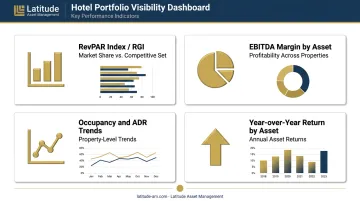
In practice, this means aggregating performance data across properties, comparing RevPAR growth, NOI margins, EBITDA contribution, and occupancy trends, and benchmarking them against peer sets, market averages, and the investor's own return targets.
Why it matters:
Without a consolidated performance view, investors tend to over-rely on the strongest properties to mask issues in weaker ones. That pattern delays course correction and erodes overall returns over time. CBRE's 2025 brand performance study documented a 26% cumulative RevPAR spread between the strongest and weakest brand families from 2019–2024, with only 28% of brands beating the sample average — dispersion that stays invisible if assets aren't benchmarked individually against their competitive sets.
Knowing which assets are performing at or above target — and which are lagging — is what drives every major capital, operational, and disposition decision.
KPIs most directly influenced:
- RevPAR Index (RGI) — measures market share relative to competitive set
- EBITDA margin by asset — compares profitability across properties of different sizes
- Occupancy and ADR trends by property
- Year-over-year return by asset
Highest-impact scenarios:
This advantage is especially critical for investors managing three or more properties, operating across multiple markets or brands, or entering a repositioning or refinancing process where lenders require clear performance justification.
Advantage 2: Risk Identification Before It Becomes a Problem
Portfolio analysis surfaces concentration risks and systemic vulnerabilities that are invisible when assets are reviewed in isolation. Geographic concentration, over-reliance on one demand segment, single-brand exposure, or currency risk in cross-border holdings: none of these show up clearly in a property-by-property review.
In practice, analysis maps exposure across markets, segments, and asset types and tests correlations. It reveals, for example, if multiple properties depend on the same feeder market or are vulnerable to the same macroeconomic trigger.
Why it matters:
The 2020 performance data is instructive. CoStar's STR-based profit study found that urban hotel GOPPAR fell 99.1% in 2020, with TRevPAR down 71.3% driven by the collapse of group and corporate-transient demand in central business districts. Airport hotels fared only marginally better, with GOPPAR down 85.3%. Portfolios concentrated in those segments absorbed the full impact, with no offsetting stability from differently positioned assets.
Identifying concentration early allows investors to adjust acquisition pipelines, renegotiate brand arrangements, or restructure capital before external pressure forces the decision.
KPIs most directly influenced:
- Portfolio-wide RevPAR volatility
- Market Penetration Index (MPI) by asset
- Debt Service Coverage Ratio (DSCR) by property — HVS currently reports lender expectations of approximately 1.30x–1.50x
- Exposure ratio by geography or demand segment
When it's most critical:
This advantage is highest-impact for investors with cross-border portfolios spanning multiple countries (the U.S., Mexico, the Caribbean, and Latin America) where currency fluctuations, regulatory environments, and travel demand patterns vary significantly across markets.
Advantage 3: Smarter Capital Allocation and Value Creation
Portfolio analysis directly informs where capital expenditure, management attention, and strategic investment should go. Without it, CapEx decisions tend to be driven by urgency or familiarity rather than evidence.
In practice, comparing each asset's current performance against its market potential and capital structure reveals which properties have genuine value-creation upside through renovation, repositioning, rebranding, or operational improvement and which are candidates for disposition.
The real cost of skipping this step:
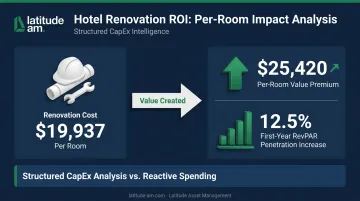
The return differential between structured and ad hoc capital deployment is real. An HVS study of 46 U.S. extended-stay hotels found that renovated properties achieved an estimated $25,420 per-room value premium against an average renovation cost of $19,937 per room, with renovated hotels recording a 12.5% first-year increase in RevPAR penetration. The figures are illustrative, not universal — but they show why asset-specific discounted cash flow analysis, grounded in portfolio context, consistently outperforms reactive spending.
Disciplined capital allocation compounds: it improves asset performance, builds portfolio value, and strengthens positioning when refinancing or exit scenarios emerge. Portfolio analysis is what connects financial strategy to on-the-ground execution — and what separates reactive ownership from deliberate value creation.
KPIs most directly influenced:
- Return on Invested Capital (ROIC) per asset
- Cap rate movement
- Equity multiple by property
- CapEx-to-NOI improvement ratio
- Portfolio total asset value
When it's most relevant:
This advantage is especially relevant at key investment inflection points: pre-acquisition due diligence, annual budget cycles, pre-refinancing reviews, and portfolio repositioning or exit planning.
What Happens When Portfolio Analysis Is Skipped
Managing hotel assets individually — without a portfolio-level view — produces consistent, costly outcomes: decisions made on incomplete information, performance erosion that compounds quietly, and strategic drift that only surfaces once it's expensive to reverse.
The most common consequences in hotel investment contexts:
- Underperforming assets stay in the portfolio too long. Without a structured trigger — a portfolio-level flag showing an asset is lagging against its peer set — there's no mechanism to initiate repositioning or disposition before value erodes further.
- Capital gets allocated based on urgency, not evidence. The property with the loudest problem gets the investment, not necessarily the one with the highest return potential.
- Concentration risks go unnoticed. A demand collapse in a single city or currency devaluation in a key market forces a reactive response that a structured portfolio review would have flagged months earlier.
- Lender and co-investor confidence weakens. Investors who cannot present a clear, consolidated view of portfolio performance — showing how each asset contributes to overall returns — face harder refinancing terms and narrower access to future deal flow.
These consequences compound. Each unresolved issue narrows future options and raises the cost of corrective action. HVS notes that buyers do not accept deferred property improvement plans at face value — they underwrite them at a premium and add contingency. The same principle holds at the portfolio level: delayed analysis tends to surface its costs at refinancing, disposition, or lender covenant review, precisely when flexibility matters most.
How to Get the Most Value from Portfolio Analysis
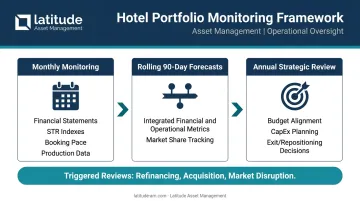
Portfolio analysis delivers the most value when treated as a regular, structured discipline rather than a one-time audit. The strongest supported practice, based on HVS's foundational lender monitoring framework, is monthly operational and financial monitoring — covering financial statements, STR indexes, booking pace, and production data — combined with rolling 90-day forecasts and a comprehensive annual strategic review aligned to budget and capital planning cycles. Major events like refinancing, acquisition, or significant market disruption should trigger additional out-of-cycle reviews.
Cadence alone isn't enough. The conditions below determine whether that monitoring actually drives decisions:
- It integrates both financial performance data and operational metrics. RevPAR, NOI, and market share data must be read alongside cap rates, debt coverage, and equity return metrics — one without the other tells an incomplete story.
- Findings translate into specific actions: accelerating a CapEx program, renegotiating a management contract, exploring a brand conversion, or initiating a sales process. Insight without a follow-through decision leaves money on the table.
- It is supported by advisors who understand both sides of the hotel business. Latitude Asset Management's three-phase process — Assess, Strategize, and Maximize — connects portfolio-level data directly to execution decisions across markets in the U.S., Mexico, the Caribbean, and Latin America.
Conclusion
Portfolio analysis is the mechanism through which hotel investors maintain control over complex, multi-asset holdings. Its value lies not in the analysis itself, but in the clarity, accountability, and decisive action it enables.
Performance visibility, risk identification, and disciplined capital allocation each reinforce the others — but only when investors conduct analysis consistently and act on it. Treated as an ongoing discipline rather than a periodic exercise, portfolio analysis separates owners who react to problems from those who anticipate and prevent them.
Hotel markets across the Americas are moving faster, with tighter margins and more capital competing for fewer high-quality assets. In that environment, portfolio analysis is no longer the exclusive domain of large institutional investors. Any owner managing more than one asset needs it to make defensible decisions — on where to allocate capital, which operators to hold accountable, and when to exit before a position erodes.
Frequently Asked Questions
What are the benefits of portfolio analysis?
Portfolio analysis improves performance visibility across all assets, surfaces concentration risks before they become costly, and enables disciplined capital allocation decisions. Together, these advantages support stronger returns and more informed decision-making across a multi-asset portfolio.
What are the 4 types of portfolio management?
Active, passive, discretionary, and non-discretionary management are the four primary types. Hotel investors most often operate within discretionary or active frameworks: decisions about CapEx, operator accountability, and brand positioning require hands-on judgment that no index can replicate.
How often should hotel investors conduct portfolio analysis?
At minimum: monthly operational monitoring, rolling 90-day forecasts, and a comprehensive annual review tied to budget cycles. Beyond that cadence, immediate reviews are warranted by refinancing, acquisitions, significant market disruption, or material shifts in a key asset's performance.
What key metrics should hotel investors track in portfolio analysis?
Core hotel KPIs span RevPAR and RGI for market share, NOI margin and EBITDA for profitability, DSCR for debt resilience, cap rate movement, and ROIC per asset. Competitive benchmarking data (occupancy, ADR, market penetration indexes) adds essential context at the property level.
How does portfolio analysis differ for hotel real estate versus stocks and bonds?
Hotel portfolio analysis must integrate both financial metrics and operational performance data, account for brand and management contract structures, and assess physical asset condition, market positioning, and demand segment exposure. These complexities — PIPs, operator agreements, renovation cycles, and local market dynamics — simply don't exist in securities-based portfolios.