
Introduction
Hotel investment decisions carry real financial weight. According to HVS, U.S. select-service development costs ran approximately $250,000 per key in 2023—meaning a 120-key project alone can require $30 million or more before a single guest checks in. Yet many investors still commit capital based on optimistic projections rather than disciplined financial modeling. That gap is where failed projects begin.
A financial feasibility analysis changes that dynamic. It's a structured pre-investment evaluation that converts market assumptions into data-driven conclusions about whether a project can generate acceptable returns, sustain positive cash flows, and justify the capital required. It doesn't guarantee success, but it replaces guesswork with evidence.
This article covers what financial feasibility analysis means, which analytical methods matter most, and how to conduct one step by step, with a practical hotel investment example throughout.
Key Takeaways
- Financial feasibility analysis determines if a proposed investment can generate sufficient returns before capital is committed
- The four core elements are: capital requirements, revenue projections, profitability metrics, and risk/sensitivity assessment
- Primary analytical methods—NPV, IRR, Payback Period, and Sensitivity Analysis—each reveal a different dimension of viability
- Hotel feasibility adds a layer of complexity: RevPAR ramp-up curves, franchise fees, FF&E reserves, and management fee structures all affect the numbers
- Weak assumptions—not bad markets—are the most common reason hotel investments underperform projections
What Is Financial Feasibility Analysis?
Financial feasibility analysis is a structured pre-investment evaluation that assesses whether a project can generate revenues sufficient to cover all costs, service debt, and deliver acceptable risk-adjusted returns over the investment horizon.
Two tools are frequently confused with it — and the distinction matters:
- A business plan focuses on strategy and execution—it assumes the project is viable and details how to implement it
- A financial audit reviews historical performance of an existing entity
Financial feasibility analysis sits before both. It answers a single foundational question: should this project proceed at all?
The Four Core Elements
Every sound financial feasibility analysis addresses these components:
- Capital Requirements — Total upfront investment including acquisition price, development or renovation costs, soft costs, and working capital reserves
- Revenue Projections — Forecasted income streams based on market research, demand assumptions, competitive positioning, and pricing strategy
- Profitability and Cash Flow Analysis — Modeling of operating costs, net income, and cash flow timing across the full investment period
- Risk and Sensitivity Assessment — Stress-testing key assumptions to understand how changes in variables affect overall viability
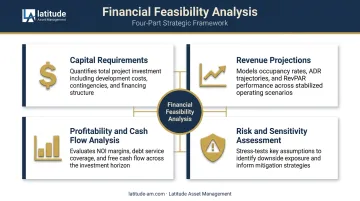
For hotel investments specifically, all four elements must account for both real estate fundamentals and hospitality operating dynamics. Getting either side wrong produces a model that looks clean on paper but breaks down in execution.
Financial Feasibility vs. Other Feasibility Study Types
A complete feasibility study typically covers four dimensions:
| Type | Core Question |
|---|---|
| Financial | Can it generate acceptable returns? |
| Technical | Can it be built and operated? |
| Market | Is there sufficient demand? |
| Legal/Regulatory | Can it meet all compliance requirements? |
Financial feasibility is the most determinative layer. A technically sound project with strong market demand still fails if the numbers don't work. That's why it's typically completed before committing capital to any other dimension of the study.
Key Methods of Financial Feasibility Analysis
No single metric tells the complete story. Professional analysts apply multiple methods together to evaluate different dimensions of a project's financial performance. The choice and weighting of methods also shifts depending on investment type and hold horizon.
Net Present Value (NPV)
NPV measures the difference between the present value of projected cash inflows and the total upfront investment, adjusted for the time value of money.
The formula:
NPV = Σ [Cash Flow_t / (1 + r)^t] − Initial Investment
Where r is the discount rate and t is the time period.
Decision rule: A positive NPV means the project creates value above the required rate of return. A negative NPV means it destroys value.
Setting the right discount rate for hotel investments matters. It typically reflects the weighted cost of capital, market risk premium, and an asset-class risk adjustment for hospitality's operational volatility. Using a rate that's too low artificially inflates NPV and leads investors toward deals that don't actually clear the return bar.
Internal Rate of Return (IRR)
IRR is the discount rate at which a project's NPV equals zero, representing the expected annualized return on the investment.
Investors compare IRR against their hurdle rate: if IRR exceeds the hurdle rate, the project clears the return threshold. HVS's 2025 observations show levered equity yields of 14.5% for full-service/luxury hotels, 16.2% for select-service/extended-stay, and 18.1% for limited-service hotels, a meaningful spread that reflects risk and return differences across service classes.
These figures represent levered equity yields observed in HVS's valuation work and should be understood as market reference points, not universal hurdle rate standards.
Payback Period
Payback period measures the time required to recover the initial investment from net cash flows.
It's useful for quick liquidity assessment, especially for investors who prioritize capital recovery speed. Its limitation: it ignores the time value of money and discards any cash flows generated beyond the recovery point.
For hotel projects with development plus stabilization timelines, payback periods extend accordingly. A ground-up development reaching stabilization in Year 3 will carry a materially longer payback than acquiring a stabilized asset with existing cash flow.
Sensitivity Analysis
Those limitations in simpler metrics are precisely why sensitivity analysis matters. It stress-tests the model by varying key assumptions, one at a time or in combination, to understand how each variable moves NPV, IRR, and cash flow outcomes.
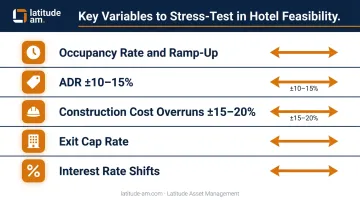
For hotel investments, the highest-impact variables to stress-test include:
- Occupancy rate and ramp-up timeline
- Average daily rate (ADR) — typically tested at ±10–15%
- Construction or renovation cost overruns — typically tested at ±15–20%
- Exit capitalization rate assumptions
- Interest rate shifts affecting debt service
For cross-border investments in Latin America, the Caribbean, or Mexico, sensitivity testing must also address currency movements, local inflation, and demand volatility scenarios. A standard U.S. domestic model won't capture these variables, but each can substantially alter projected returns.
How to Conduct a Financial Feasibility Analysis: Step by Step
A financial feasibility analysis is most reliable when it follows a sequential process. Jumping straight to spreadsheet calculations before establishing sound inputs produces outputs that look precise but rest on shaky foundations.
Step 1: Define the Investment Objective and Scope
Start by clarifying what you're evaluating:
- Stabilized acquisition — existing cash flow, lower execution risk, faster payback
- Value-add repositioning — operational upside, brand conversion potential, higher IRR target
- Ground-up development — longest timeline, highest risk, typically highest return expectation
- Brand conversion — moderate capital, significant revenue upside if brand selection is right
Identify the financial targets the investment must meet: minimum IRR, target hold period, required cash-on-cash return, and any debt service coverage requirements the lender will impose. These thresholds frame every subsequent modeling decision.
Step 2: Gather Market and Financial Inputs
Quality inputs determine quality outputs. This stage requires:
- Competitive market data — STR reports, comp set performance, market demand segmentation by segment (transient, group, contract)
- Acquisition or construction cost estimates — realistic, not aspirational
- Financing terms — current lender appetite, LTV ratios, interest rates. Note that hotel lenders currently require 1.30x–1.50x DSCR, meaning the property's NOI must comfortably cover debt obligations even under moderate stress
- Transaction comparables — recent sales in the market at a per-key basis
For hotel investments in markets where STR data is limited—Colombia, the Dominican Republic, smaller Caribbean islands—building credible revenue assumptions requires on-the-ground market intelligence and local operator relationships, not just published benchmarks.
Step 3: Build Revenue and Operating Projections
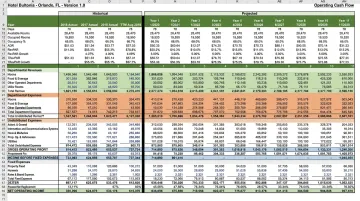
Construct a multi-year revenue model working from occupancy and ADR assumptions upward:
- Set Year 1 occupancy and ADR based on competitive positioning during ramp-up (not stabilized market averages)
- Build RevPAR trajectory year-by-year to a stabilized state—often Year 3 for select-service, potentially longer for full-service or development projects
- Layer in all revenue streams: rooms, F&B, meeting/events, ancillary
- Apply all operating cost categories across four main lines:
- Departmental expenses and undistributed overhead
- Management fees: 2–4% of total revenue (base fee)
- FF&E reserves: 3–5% of total revenue
- Franchise royalties where applicable
Common mistakes at this stage:
- Using stabilized market occupancy in Year 1 instead of a realistic ramp assumption
- Omitting FF&E reserves entirely, which can absorb 3–5% of revenue annually
- Underestimating brand/franchise fee stacks—Marriott's Fairfield franchise, for example, carries a 5.5% royalty on gross room sales plus a program-services contribution of 3.85%, per the 2024 FDD
Step 4: Apply Financial Analysis Methods
The projected cash flows from Step 3 feed directly into the NPV, IRR, and payback calculations described earlier.
Build both an unlevered model (asset-level performance before financing) and a levered model (equity return after debt service):
- Lenders evaluate the asset-level model to confirm debt coverage
- Equity investors evaluate the levered model to assess whether the return justifies the risk they're taking
These two views of the same project often tell different stories—and both need to be understood before committing capital.
Step 5: Run Sensitivity and Scenario Analysis
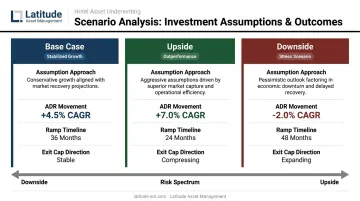
Build at least three scenarios:
| Scenario | Assumption Approach |
|---|---|
| Base Case | Most probable outcome based on market data |
| Upside | Favorable ADR growth, ahead-of-schedule ramp, tighter exit cap |
| Downside | ADR stressed 10–15% lower, extended ramp, cost overrun of 15–20%, wider exit cap |
The downside scenario is the most important. It tells investors whether the deal still preserves capital—or whether a single bad assumption causes permanent loss.
The spread between upside and downside reveals which assumptions carry the most risk—and where due diligence effort should concentrate.
Step 6: Interpret Results and Make a Go/No-Go Decision
Translate the outputs into a clear recommendation. A "go" decision typically requires:
- Positive NPV at the required discount rate
- IRR above the investor's hurdle rate
- Acceptable payback period relative to the hold target
- A downside scenario that still preserves equity
The analysis should also flag structural deal issues: insufficient debt coverage ratios, excessive sensitivity to a single assumption (like ADR), or a capital structure that leaves no margin for error. These don't necessarily kill a deal—but they require renegotiation or restructuring before proceeding.
Hotel Investment Financial Feasibility Analysis: A Practical Example
To illustrate how the process works in practice, consider a hypothetical 120-key select-service hotel acquisition in a growing secondary market in the Americas (acquisition price: ~$18M, light renovation budget: ~$2M, 3-year stabilization timeline). The figures below are illustrative — intended to demonstrate the process, not represent actual deal data.
Revenue projection build:
- Year 1: Conservative occupancy of ~62% with ADR reflecting the comp set during ramp-up, producing modest RevPAR below the stabilized competitive set average
- Year 2: Occupancy climbs as the property gains market share, ADR moves toward the competitive set midpoint
- Year 3 (Stabilized): Occupancy reaches ~72–75%, ADR at or slightly above competitive set average, with RevPAR representing meaningful improvement over Year 1
Total revenue grows from roughly $3.5M in Year 1 to approximately $5.2M by Year 3, driven primarily by rooms revenue with modest ancillary contribution.
Key financial metrics (illustrative):
Using a discount rate appropriate for select-service levered equity risk in this market:
- NPV: Positive, indicating value creation above the required return threshold
- IRR: Above the 16% benchmark for select-service levered equity, clearing the investor's hurdle rate
- Payback period: Year 5–6, reflecting the ramp-up timeline typical of a value-add acquisition
Two common mistakes that distort this picture:
Using stabilized market ADR and occupancy from Day 1 — This inflates projected returns materially. A realistic ramp-up showing Year 1 occupancy 10–12 points below stabilized can reduce IRR by several percentage points.
Omitting brand/flag costs from the operating model — Franchise royalties, program fees, and PIP requirements represent a meaningful NOI drag. Missing these line items can overstate returns by 150–250 basis points or more.
What sensitivity analysis reveals:
When ADR is stressed down by 10% and the stabilization timeline is extended by 12 months, IRR compresses noticeably — potentially falling below the investor's hurdle rate. Payback extends by 12–18 months. In this scenario, the deal may still preserve capital but no longer delivers the target return.
The stressed scenario still serves a purpose. It tells the investor exactly what needs to be renegotiated (acquisition price, renovation scope, or financing terms) to make the deal work at an acceptable return.
How Latitude Asset Management Can Help
Latitude Asset Management works with hotel owners, developers, and investors who need rigorous financial feasibility analysis before committing capital to acquisitions, repositioning projects, or new developments across the Americas.
Latitude's approach combines institutional financial discipline with real-world hospitality operating expertise — a pairing that most advisory firms can't offer from within a single team.
On the financial side, Javier Revelo, CFA, leads disciplined underwriting, scenario analysis, and capital structure evaluation. His background spans institutional investment management, corporate treasury, and hospitality analytics — producing financial models that reflect both analytical rigor and commercial operating reality.
On the operational side, Haizar Baiz (CEO, Cornell-certified hotel investment and asset management professional) brings 18+ years of experience across hotel operations, real estate, and finance. Every RevPAR ramp assumption, expense ratio, and stabilization timeline in Latitude's feasibility work is validated against actual property-level performance data, not theoretical benchmarks.
Latitude's cross-border structure extends this depth into specific markets. Regional partners Germán Ongay (Mexico), Olmedo Herrera (Colombia), and Simon Lagardera (Caribbean) contribute ground-level insight that shapes how feasibility models are built — accounting for local demand dynamics, currency considerations, brand penetration, regulatory factors, and transaction comparables that vary significantly by geography.
Latitude supports investors across the full feasibility process:
- Initial market assessment and comp set analysis
- Financial modeling and scenario testing (levered and unlevered)
- Go/no-go recommendations and deal structuring guidance
- Post-decision support through operator selection, brand negotiation, and ongoing asset management

The output is a feasibility analysis built to withstand scrutiny — whether the next step is a capital committee, a lender, or a partnership negotiation.
Frequently Asked Questions
What is the meaning of financial feasibility analysis?
Financial feasibility analysis is a structured pre-investment evaluation of whether a proposed project can generate sufficient revenues to cover all costs, service any debt, and deliver acceptable returns to investors. Conducted before capital is committed, it converts market assumptions and operating projections into data-driven conclusions about whether a deal is viable.
What are the four elements of a financial feasibility analysis?
The four core elements are: (1) initial capital requirements, (2) revenue and cash flow projections, (3) profitability metrics including NPV, IRR, payback period, and break-even analysis, and (4) risk and sensitivity assessment. All four must be evaluated together—no single element tells the complete story.
What are the 4 types of feasibility study?
The four types are: financial (can it generate returns?), technical (can it be built and operated?), market (is there sufficient demand?), and legal/regulatory (can it meet all compliance requirements?). Financial feasibility is typically the most critical for investment decision-making. Financial feasibility is typically the most critical for investment decision-making: even strong market demand cannot save a project with an unworkable capital structure.
What financial metrics matter most in a hotel investment feasibility study?
Hotel investment feasibility relies most heavily on NPV, IRR, and payback period at the deal level, combined with hospitality-specific operating metrics: RevPAR, occupancy ramp timeline, NOI margin, and debt service coverage ratio. Lenders currently require 1.30x–1.50x DSCR as a baseline. Any model that doesn't clear that threshold won't attract financing, regardless of projected returns.
How is a financial feasibility analysis different from a business plan?
A financial feasibility analysis is a pre-commitment evaluation tool that determines whether a project should proceed (focused on viability and risk). A business plan is an execution roadmap that assumes viability and details how to implement the project. Feasibility analysis informs whether to write the business plan in the first place.
When should a hotel investor conduct a financial feasibility analysis?
A financial feasibility analysis should be conducted before any binding commitments are made: ideally during early due diligence for an acquisition, or at the project conception stage for new developments. It should also be revisited if key assumptions change materially during the transaction process, such as a significant shift in financing terms or market conditions.