Introduction
Hotel labor costs rose 11.2% per available room in 2024 — and that's one pressure among many. Compressed margins, shifting demand patterns, and brand agreements that rarely favor the owner have made disciplined advisory support a baseline requirement, not a premium add-on.
For owners, developers, and investors operating across the hotel lifecycle, the question is no longer whether to engage experienced consultants. It's knowing which engagement model fits the situation and where it will generate the most measurable return.
This guide covers what hotel and restaurant consulting is, the four primary engagement models owners and investors should understand, the frameworks that guide effective engagements, and the high-value moments where consulting delivers the clearest ROI.
Key Takeaways
- Consulting models range from project-based engagements to full asset management advisory — and choosing the right model shapes outcomes as much as the advice
- Effective consulting addresses the full property lifecycle: acquisition, operations, repositioning, and exit
- ROI from consulting peaks at inflection points — pre-acquisition, turnaround, brand transition, or expansion
- The strongest partners bring institutional finance discipline and hands-on operational credibility, not just strategy decks
What Is Hotel & Restaurant Consulting?
Hotel and restaurant consulting is a specialized advisory practice that helps owners, developers, and investors improve performance, protect capital, and create value across the property lifecycle.
What separates it from general management consulting is grounding in operational realities most strategy firms rarely address: occupancy dynamics, brand standards, F&B margin structures, labor models, and capital planning tied to specific asset types.
Two Distinct Dimensions
The practice spans two distinct but interconnected disciplines:
- Operational consulting — focuses on day-to-day performance: service quality, cost structure, labor efficiency, and brand compliance
- Investment-oriented consulting — focuses on asset strategy: market feasibility, acquisition analysis, repositioning, hold-versus-sell decisions, and return optimization
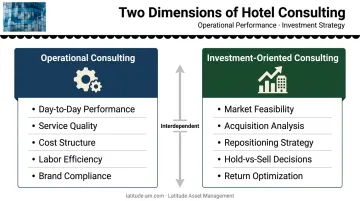
As Cornell's eCornell hotel asset management curriculum notes, the asset manager's goal is strategically overseeing hotel operations to meet the owner's investment objectives — covering revenue and expense benchmarking, management-contract oversight, capital-expenditure planning, and refinancing risk analysis. When both dimensions are integrated, owners get cleaner capital decisions, fewer operator conflicts, and a clearer framework for hold-versus-sell analysis.
Who Benefits Most
Not just distressed properties. The owners who extract the most value from consulting include:
- Investors evaluating acquisitions before capital is committed
- Developers in pre-opening or brand selection phases
- Owners managing multi-asset portfolios across geographies
- Operators navigating brand transitions or market shifts
- Lenders managing REO and distressed asset situations
Hotel & Restaurant Consulting Business Models
Consulting is not one-size-fits-all. The engagement model should match the owner's situation, timeline, and goals. Four primary structures define how hotel and restaurant consulting is delivered.
Project-Based Consulting
Project-based engagements are time-bound and objective-specific: a pre-acquisition assessment, a feasibility study, a brand conversion analysis, or a performance diagnostic. These work best when an owner needs a defined answer to a defined question and does not require ongoing advisory involvement.
A market feasibility engagement, for example, typically includes the core components HVS identifies for testing hotel feasibility before committing capital:
- Demand analysis and competitive set positioning
- Occupancy and ADR projections
- 5- to 10-year NOI forecast
- Discounted-cash-flow valuation
Retainer-Based Advisory
Retainer models create ongoing relationships where a consulting team provides regular strategic guidance, performance review, and decision support — monthly or quarterly. The advantage is continuity: institutional memory, pattern recognition across reporting cycles, and faster response when issues surface.
For owners managing active portfolios, retainer advisory prevents the gap that project-based consulting creates between engagements — the period when questions arise but no advisor is current on the asset.
Embedded Operational Consulting
Embedded consulting is a deeper, hands-on model where consultants work directly alongside ownership or management teams to implement change — not just recommend it.
This model is appropriate in:
- Turnaround situations requiring immediate operational intervention
- New hotel openings where stabilized performance timelines are at risk
- Post-acquisition integration during the critical first 90–180 days
- Periods of significant operational complexity, such as a brand transition
At Latitude Asset Management, this embedded approach reflects a core operating philosophy — the firm's operations leadership, including team members with decades of General Manager experience across Latin America, works on the ground alongside ownership through opening, renovation, and transition cycles rather than advising remotely.
Asset Management Advisory Model
The most comprehensive form of hotel consulting is where the consultant acts as the owner's representative — overseeing operators, tracking performance against investment goals, holding management companies accountable, and protecting capital across the full ownership cycle.
As HVS frames it, the operator handles day-to-day operations and rate execution. The asset manager's mandate is distinct:
- Protects the owner's financial interests
- Sets strategic direction and performance targets
- Monitors and holds the operator accountable
- Plans capital expenditures across the ownership cycle
- Evaluates hold, sell, and rebranding decisions
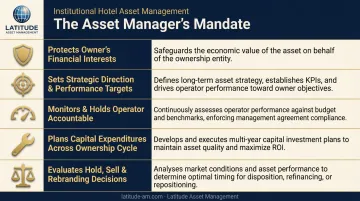
Asset managers work for the owner — their loyalty runs to capital, not to the brand or the management company.
Key Consulting Frameworks and Best Practices
Effective hotel and restaurant consulting is guided by structured frameworks that create consistency, focus, and measurable outcomes. Understanding these frameworks helps owners evaluate the rigor of a consulting partner.
The 5 C's of Hotel Consulting
The 5 C's function as a diagnostic lens for evaluating a hotel's strategic position across five interconnected dimensions:
| Dimension | What It Surfaces |
|---|---|
| Concept | Is the property positioned appropriately for the market it serves? |
| Customers | Who is the guest, what do they value, and is the property capturing the right segments? |
| Competition | How does the property rank within its competitive set — and is the comp set correctly defined? |
| Costs | Where is margin being eroded and is the cost structure sustainable? |
| Capital | Is the asset appropriately capitalized for its current phase and future needs? |
Each dimension surfaces a distinct category of risk or opportunity. The framework's value is in prioritizing where intervention is most urgent — so resources concentrate on highest-impact issues rather than spreading across every problem at once.
The 4 Pillars Approach
The 4 Pillars framework organizes consulting work into four interconnected domains:
- Revenue Generation — pricing strategy, distribution mix, demand forecasting
- Cost Control — labor efficiency, F&B cost ratios, departmental expense management
- Guest Experience — service standards, brand compliance, reputation management
- Asset Value — capital planning, repositioning strategy, return optimization
The framework prevents siloed thinking. A decision to reduce labor in one department affects service quality scores, which affects pricing power, which affects asset value.
Diagnostic-First Methodology
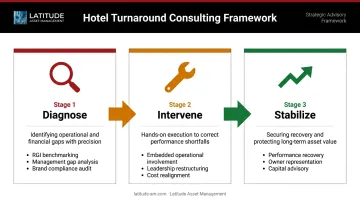
Every effective hotel consulting engagement begins with a structured diagnostic phase before any recommendations are made. This typically includes:
- Financial review — P&L analysis, cost benchmarking, revenue composition
- Operational assessment — labor models, service delivery, brand compliance gaps
- Competitive benchmarking — RevPAR Index analysis against the defined comp set
- Leadership alignment — understanding ownership's investment thesis and constraints
Consultants who skip this phase prescribe solutions for the wrong problems. The diagnostic is where the most consequential consulting work happens — it establishes which interventions will actually move the needle before any recommendations are written.
Performance KPI Frameworks
Core KPIs anchor hotel consulting engagements as diagnostic signals, not just reporting metrics:
| KPI | 2024 U.S. Benchmark | Diagnostic Use |
|---|---|---|
| RevPAR | $99.94 (+1.8%) | Revenue efficiency vs. market |
| ADR | $158.67 (+1.7%) | Pricing power and rate strategy |
| Occupancy | 63.0% | Demand capture vs. supply |
| GOPPAR | $73.60 (+3.2%) | Total profitability per available room |
| EBITDA Margin | 28.4% | Bottom-line operational efficiency |
| Labor Cost/PAR | $72.44 (+11.2%) | Largest controllable cost driver |
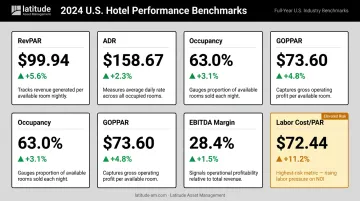
Source: CoStar/STR 2024 U.S. hotel performance data
For F&B-intensive properties, CBRE's 2025 data shows that among full-service, resort, and convention hotels, F&B profit margins ran at 29.1% — with labor representing 59.4% of departmental expenses and cost of goods sold at 24.0%.
Consultants use these metrics to identify specific intervention points — not to produce dashboards.
Core Service Areas Where Hotel & Restaurant Consultants Drive Value
Regardless of engagement model, hotel and restaurant consulting consistently clusters around four high-impact service areas.
Revenue Optimization and Asset Repositioning
Revenue management consulting covers pricing strategy, distribution channel mix, and demand forecasting. At its most impactful, this work intersects with repositioning that changes a hotel's competitive set or brand affiliation.
Brand conversion is one of the highest-ROI interventions available to hotel owners. A Cornell University study of 260 U.S. hotels that changed brands from 1996 through 2010 found average effects of occupancy +6.31%, RevPAR +4.43%, and annual gross operating profit +$163,000. Outcomes varied by conversion direction and brand fit — which is precisely why independent consulting support during the brand selection process matters.
Financial Analysis and Investment Structuring
Most operational consultants stop short of institutional finance discipline. The financial consulting layer fills that gap directly.
The financial consulting layer includes:
- Acquisition underwriting and assumption stress-testing
- Capital structure evaluation and debt sizing
- Hold-versus-sell analysis across market cycle scenarios
- Ongoing performance benchmarking against the investment thesis
Latitude Asset Management's Financial Analysis and Research Advisor, Javier Revelo, is a CFA charterholder whose background spans institutional investment management, corporate treasury, and hospitality analytics. That background allows him to translate investment strategy into actionable hotel performance decisions — not just report on results after the fact.
Operations, Brand Standards, and Compliance
Operational gaps are the first place investor returns erode. They're also where problems tend to go undetected longest — surfacing in the financials only after the damage is done.
Operational consulting ensures that properties meet brand standards, maintain consistency across multiple locations, and operate within efficient labor and cost models. For franchised assets, brand compliance is a non-negotiable investment protection issue: non-compliance can trigger PIPs, franchise termination, or forced capital deployment that was not in the original underwriting.
Franchise Strategy and Brand Negotiation
Franchise selection, brand negotiation, franchise agreement review, and PIP analysis require advisors who understand both the brand system and the owner's financial constraints.
Latitude's team brings that dual perspective from both sides of the table:
- Anthony Del Gaudio spent 14 years at Hyatt, 19 years at Loews, and three years at IHG, operating from inside brand organizations
- Germán Ongay served as Regional Vice President of Sales and Franchise Development for IHG Hotels & Resorts in Mexico, conducting franchise negotiations from the brand side
Advisors with this institutional brand experience know where terms are negotiable and where PIPs carry flexibility — distinctions owners without experienced representation routinely miss.
When Hotel & Restaurant Consulting Delivers the Greatest ROI
Consulting creates the most measurable value at specific moments in the ownership cycle — not as a continuous background function.
Pre-Acquisition and Feasibility
The pre-acquisition phase is where the entire return profile of an investment is set in motion. Consulting at this stage includes market feasibility, competitive analysis, operator evaluation, brand suitability assessment, and acquisition underwriting.
HVS's technical due-diligence framework examines structural, mechanical, and architectural components; identifies immediate repairs and future capital needs; evaluates replacement reserves; and develops total project budgets. This work surfaces risks that are far less expensive to identify before closing than to correct after.
The principle that guides Latitude's acquisition work: in hotel investing, performance doesn't begin on opening day. It begins at acquisition.
Turnarounds and Underperforming Assets
The RevPAR Index (RGI) measures a property's RevPAR against its competitive market average. An index below 100 means the property is underperforming its fair share. Many hotel assets operate below this threshold. The causes are consistent across markets:
- Management underperformance against competitive benchmarks
- Brand compliance failures triggering fee exposure or flag risk
- Operational structures misaligned with the market they're competing in
Turnaround engagements require embedded operational involvement — not periodic advisory. Latitude's Distressed & Special Situations practice addresses underperforming assets, lender-controlled properties, and REO situations, combining full operating leadership with owner representation and capital advisory to stabilize and recover performance.
Brand Transitions, Renovations, and New Openings
High-disruption periods (brand conversions, PIP-driven renovations, new hotel openings, or concept launches) carry compounding risk when managed without structured consulting oversight.
HVS notes that stabilized occupancy is typically reached in the third or fourth year of hotel operation. Delays in reaching stabilization, or ramp-up periods that underperform projections, directly compound capital risk for investors. Latitude manages brand and operator transitions through a structured 90–180-day handover process that covers:
- RFP management and brand/operator selection
- Due diligence and contract negotiation
- Operational continuity planning through stabilization
Executed well, these transitions protect ramp-up timelines and preserve the investment thesis underwritten at acquisition.
How to Choose the Right Hotel & Restaurant Consulting Partner
The quality of the consulting partner matters as much as the engagement model. Three criteria help owners and investors evaluate fit.
Hospitality-Specific Credentials and Operating Experience
Consultants who have worked inside hotel brands, operated properties, and managed owner relationships bring a fundamentally different perspective than general strategy consultants. Credentials like Cornell's Hotel Real Estate Investments and Asset Management Certificate — a six-course, 48-hour professional program covering hotel-investment financial analysis, franchise agreements, and asset-management strategy — signal that rigor, as does CFA charterholder status for investment-oriented engagements.
Alignment of Incentives and Transparency
Look for partners whose success is tied to the owner's outcomes — not firms incentivized to extend engagements or recommend capital deployment that isn't warranted. The clearest signal: fee structures that reward results, not billable hours. Latitude's stated philosophy — "We succeed when our partners succeed" — is reflected in performance-oriented engagements rather than open-ended retainers.
Regional Fluency and Cross-Border Capability
For owners with assets across multiple markets or countries — particularly across the Americas — consulting partners need genuine local knowledge, established brand and operator relationships in each market, and the cultural fluency to execute on the ground. Latitude's team applies all three criteria in practice:
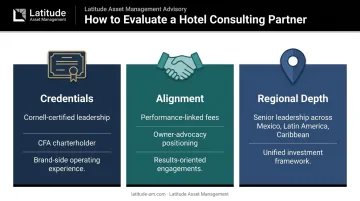
- Credentials: Cornell-certified leadership and a CFA charterholder for financial analysis
- Alignment: Performance-linked engagements with explicit owner-advocacy positioning
- Regional depth: Dedicated senior leadership in Mexico (Germán Ongay), Latin America/Colombia (Olmedo Herrera), and the Caribbean (Simon Lagardera), connected through a unified institutional investment framework
CEO Haizar Baiz's 18+ years spanning brand representation, big-box hotel operations, and investor advocacy — alongside senior advisors with direct brand-side tenure at Hyatt, Loews, and IHG — means the team has sat on every side of the negotiating table.
Frequently Asked Questions
What are the key consulting frameworks like the 5 C's, the 4 Pillars, and the Rule of 3?
These are structured diagnostic and prioritization tools that hotel and restaurant consultants use to evaluate performance gaps, organize improvement initiatives, and maintain execution focus across a property or portfolio. The article above covers each framework in detail, including how consultants use them to sequence and prioritize interventions.
What is the difference between hotel asset management and hotel consulting?
Hotel consulting is typically time-bound or project-based advisory focused on specific performance or strategic goals. Hotel asset management is an ongoing fiduciary function — the asset manager represents the owner's interests, monitors the operator, and manages performance across the full investment lifecycle. It is closer to ownership representation than advisory work.
When should a hotel owner hire a consultant versus a management company?
A management company operates the hotel day-to-day. A consultant or asset manager represents the owner's interests — and the two are not mutually exclusive. Many sophisticated owners use asset management oversight specifically to hold their management company accountable and ensure operator priorities stay aligned with ownership objectives.
How do hotel and restaurant consulting fees typically work?
Fee structures vary by model: project-based engagements are typically fixed-fee, retainer advisory is billed monthly or quarterly, and embedded or asset management models may combine a base fee with performance incentives. Owners should ensure the fee structure aligns the consultant's incentives with actual outcomes.
What are the most common reasons hotel consulting engagements fail to deliver results?
The three most common failure modes are:
- Insufficient diagnostic rigor upfront — solving the wrong problem entirely
- Strategy delivered without execution support to implement it
- Recommendations misaligned with the owner's actual investment constraints or risk tolerance
How do I measure the ROI of hotel and restaurant consulting?
Measure ROI across financial metrics (RevPAR improvement, GOPPAR growth, cost reduction), operational metrics (labor efficiency, brand compliance scores), and strategic outcomes (asset value appreciation, successful brand transitions, improved investor returns). Establishing a clear baseline before the engagement begins is essential; without one, attributing results to the consulting work becomes nearly impossible.