

Introduction
Many sophisticated investors face a genuine dilemma: they want meaningful market exposure, but pure equity volatility feels unacceptable — especially near retirement or in uncertain macro conditions. Traditional bonds, meanwhile, offer predictability but little growth potential when rates are low.
Structured investments were engineered to sit between these two extremes. Rather than choosing between a stock and a bond, investors can access instruments that deliver defined outcomes:
- Principal protection paired with market upside
- Enhanced yield with partial downside cushioning
- Leveraged participation with a hard floor on losses
According to Structured Retail Products, U.S. structured note gross sales reached $149.4 billion in 2024 — up 46% year over year — signaling that demand for defined-outcome investing is anything but niche.
This guide covers what structured investments are, how they work mechanically, the main product types, their genuine benefits and risks, and the investor profiles where they make the most sense.
Key Takeaways
- Structured investments pair a fixed-income component with derivatives linked to a reference asset — an index, stock, commodity, or currency
- They are customizable across four dimensions: payment type, protection level, term length, and underlying asset
- Core benefits include downside protection, return enhancement, and portfolio diversification
- Designed as buy-and-hold instruments: early exits typically mean selling at a discount
- Suitability depends entirely on investor goals, risk tolerance, and liquidity needs
What Are Structured Investments?
A structured investment is a prepackaged financial instrument that combines a fixed-income component — typically a bond or certificate of deposit — with one or more derivatives linked to a reference asset. That reference asset might be an equity index, a commodity, a currency pair, or an interest rate benchmark. The result is a product with a specific, engineered payoff profile.
The core purpose is outcome engineering. Instead of accepting whatever a bond pays or wherever a stock goes, investors can pursue defined scenarios: return your principal regardless of what the market does, or double your gains up to a cap if the index rises modestly. Neither of those payoff structures exists naturally in standard securities.
Two Primary Forms
| Product | Backing | FDIC Coverage |
|---|---|---|
| Market-linked notes | Issuing institution's creditworthiness | No |
| Market-linked CDs (MLCDs) | Bank deposit | Yes, up to $250,000 per depositor, per insured bank, per ownership category |
Both forms link investor returns to an underlying asset's performance rather than paying traditional interest. The key distinction is credit backing: notes depend entirely on the issuer's solvency, while MLCDs carry FDIC deposit insurance within applicable limits.
That credit distinction also carries legal weight. The SEC notes that structured notes are securities — many are SEC-registered, though some are issued under exemptions. MLCDs are bank deposits, not securities. These are legally distinct instruments with different regulatory treatment, disclosure requirements, and investor protections.
Understanding that distinction matters before evaluating whether a structured investment fits a given portfolio — and before assessing the risks that come with each form.
How Do Structured Investments Work?
Most structured investments share a two-component architecture:
- A zero-coupon bond or fixed-income instrument — this preserves the bulk of the principal, compounding to par value over the investment term to return the investor's original capital at maturity
- A derivative (typically an option) — this provides the potential to earn returns based on the performance of the reference asset
These two pieces work in tandem to produce the product's stated payoff.
A Simple Principal-Protected Example
An investor pays $1,000 at issuance. The fixed-income component is sized so it grows to exactly $1,000 by maturity, regardless of market conditions. The remaining dollars purchase a call option on an equity index. If the index rises, the option pays off and the investor receives their principal plus gains. If the market falls and the option expires worthless, they receive their $1,000 back.
A Leveraged (Non-Protected) Example
A note might double the investor's return — up to a 10% cap — if the underlying index rises moderately. If the index falls, the investor participates in those losses without any buffer. That risk transfer to the investor is the structural trade-off that makes enhanced upside possible.
Four Core Design Elements
Issuers use these levers to tailor products to investor objectives:
- Payment type — lump-sum at maturity or periodic coupon payments during the term
- Protection level — full, partial/buffered, or contingent (detailed below)
- Term length — commonly 1–5 years, though terms can extend longer; some include early call features
- Underlying asset — the reference whose performance drives the return calculation
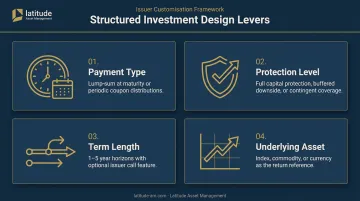
Protection level is the single design element with the greatest impact on downside exposure. Three distinct structures exist, each with a different risk-return tradeoff:
Protection Levels Explained
| Protection Type | How It Works | Key Risk |
|---|---|---|
| Full protection | Principal returned at maturity regardless of underlying asset performance | Issuer credit risk only |
| Partial/buffer | Absorbs the first X% of losses; investor bears losses beyond the buffer | Losses beyond buffer pass through |
| Contingent | Protected unless underlying asset falls past a set threshold; then losses become one-for-one | Barrier breach wipes out protection |
Contingent protection structures often offer the highest upside potential — but the protection disappears entirely if the underlying crosses the barrier, which can produce significant losses in severe downturns.
Types of Structured Investments
Structured Notes
Structured notes are the most common form of structured investment — debt securities issued by investment banks that combine a bond component with an embedded derivative linked to an equity index, single stock, commodity, or currency. Structural features can be layered in to match specific market views:
- Barriers — define the threshold at which principal protection activates or expires
- Buffers — absorb a set percentage of downside loss before the investor is affected
- Caps — limit maximum upside return over the term
- Participation rates — determine what share of the underlying's gain the investor receives
A real-world example: Barclays issued an equity-basket note in 2024 with 100% participation in the underlying basket's gains, capped at a 31% maximum return over the term — a specific, defined outcome tied to actual filed pricing supplements.
Market-Linked CDs (MLCDs)
MLCDs are bank deposit obligations whose returns at maturity are tied to an underlying index. They offer FDIC insurance coverage up to $250,000 per depositor, per insured bank, per ownership category — but that coverage applies to qualifying principal deposits, not contingent interest not yet accrued. Upside potential is typically more limited than a comparably structured note.
Equity-Linked Notes (ELNs)
ELNs are hybrid debt instruments whose final payment references a stock, equity basket, or equity index. The OCC has characterized equity-linked structured notes as more closely resembling debt than equity. They can offer periodic fixed coupons alongside equity-linked upside at maturity — useful for investors who want equity exposure with some built-in income.
A Note on Alternatives: Buffered ETFs
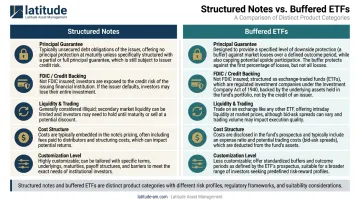
Buffered ETFs aren't structured notes, but they're increasingly compared to them — and worth distinguishing. They've emerged as a more liquid alternative offering similar defined-outcome profiles. Morningstar reports buffer ETF assets grew from just over $5 billion at end-2020 to nearly $50 billion by February 2025. Unlike structured notes, they trade on exchanges with intraday pricing and no lockup periods — but they carry no issuer principal guarantee or FDIC backing. They're a different product category, not an equivalent substitute.
Benefits and Risks of Structured Investments
Key Benefits
Structured investments appeal to a specific type of investor: one who wants market exposure without unlimited downside. The three most cited advantages are:
- Downside protection — Buffers, barriers, and full principal protection limit exposure to market losses. A retiree who needs portfolio stability but doesn't want to exit equities entirely finds this tradeoff appealing.
- Return enhancement — Leveraged participation rates can credit 1.5x the index return up to a cap, or pay an above-market coupon contingent on the index staying above a threshold — potentially outperforming a conventional bond in specific scenarios.
- Portfolio diversification — These products provide access to commodity indices, currency baskets, emerging market benchmarks, or specific factor exposures that standard securities don't reach efficiently, which can reduce overall portfolio correlation.
Key Risks to Understand
The same features that make structured investments attractive also introduce specific risks that are easy to underestimate:
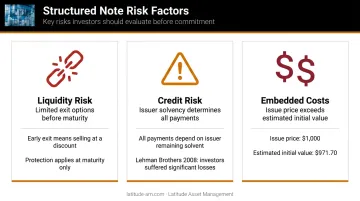
- Liquidity risk — FINRA is explicit that structured notes generally lack a secondary market. Selling before maturity usually means selling back to the issuer at a discount — potentially realizing a loss even on a principal-protected product, since that protection only applies at maturity.
- Credit risk — Every payment, including return of principal, depends on the issuer's solvency. After Lehman Brothers collapsed in 2008, Reuters documented significant investor losses in Hong Kong, Singapore, and Indonesia from Lehman-linked structured notes. FDIC insurance on MLCDs does not apply to structured notes.
- Embedded costs — The SEC notes that the issue price typically exceeds the product's estimated initial value because it incorporates selling, structuring, and hedging costs. In Barclays' 2024 equity-basket filing, a $1,000 issue price corresponded to a $971.70 estimated initial value — a disclosed gap, but one that's easy to overlook.
Tax treatment adds a separate layer of complexity. Some notes qualify as contingent payment debt instruments (CPDIs), requiring investors to report imputed annual income even without receiving cash distributions. Treatment varies by offering document, so review it before committing capital.
When Do Structured Investments Make Sense?
Structured investments aren't for everyone, and suitability matters. The investor profile best aligned with these products typically has:
- A clearly defined market view (bullish, bearish, or range-bound)
- A medium-term investment horizon — typically 1–5 years — they can commit to fully
- Sufficient liquidity elsewhere in their portfolio so they won't need to exit early
- A preference for defined outcomes over open-ended market participation
That profile points to several concrete use cases where structured products deliver the most value:
- Seeking downside protection in a late-cycle or volatile market environment
- Enhancing yield when conventional fixed-income rates are unattractive
- Gaining equity exposure without accepting uncapped drawdown risk
- Managing sequence-of-returns risk without fully exiting growth assets — particularly relevant for retirees and near-retirees
Investors building portfolios across multiple asset classes often find that structured investments fill a gap that neither bonds nor equities can fill on their own — particularly when seeking defined-outcome fixed-income exposure alongside less predictable, operationally driven real assets.
Consider institutional investors and family offices with exposure to hospitality real estate. Hotel investments generate operationally driven, variable returns tied to market cycles and asset-level performance. Structured notes can complement that with contractual, defined-outcome exposure — balancing a portfolio's overall predictability profile.
Firms like Latitude Asset Management, which advises on hotel investment strategy across the Americas, see this dynamic directly. Latitude's CFA-credentialed financial advisory team evaluates capital structure decisions of exactly this kind when guiding clients through portfolio construction and acquisition strategy.
Structured investments work best as purpose-built tools: useful when the investor has a specific outcome to target, and less appropriate when flexibility or liquidity is the priority.
Frequently Asked Questions
What is a structured investment?
A structured investment is a prepackaged financial instrument combining a debt security (bond or CD) with derivatives linked to a reference asset. The combination produces a specific risk-return profile — such as principal protection with market upside, or enhanced yield with partial downside cushioning — that neither component achieves alone.
Is it good to invest in structured products?
Structured products suit investors with specific risk-return objectives, a defined market view, and the ability to hold to maturity. They're not appropriate for all investors due to their complexity, illiquidity, and issuer credit exposure. Individual suitability assessment is required before investing.
What minimum investment is typically required for structured products?
Minimums vary by product type and distribution channel. Retail structured notes often start at $1,000–$10,000 through brokerage platforms, while institutional tranches and privately placed notes typically require $100,000 or more. Accredited investors may access a broader range of structures, including those with enhanced customization or less common underlying assets.
What is the difference between a structured note and a market-linked CD?
A structured note is backed solely by the issuing institution's creditworthiness — if the issuer fails, recovery is uncertain. A market-linked CD carries FDIC insurance up to $250,000 per depositor, per insured bank, per ownership category, offering stronger principal safety, though typically with more limited upside potential.
Are structured investments liquid?
Generally, no. These instruments are designed as buy-and-hold products. Selling before maturity usually means transacting back to the issuer at a discount that may not reflect the embedded protections' full value — and those protections only apply if you hold to maturity.
What are the main risks of structured investments?
Three primary risks to understand before investing:
- Liquidity risk: Early exit typically means selling at a discount, with no guarantee of recovering embedded protections
- Credit risk: Principal protection depends entirely on issuer solvency — not FDIC coverage
- Cost and complexity risk: Embedded fees reduce the issue price, and tax treatment under CPDI rules can be complex