Introduction
Every hotel acquisition decision rests on a financial forecast — and on how honestly the risks threatening that forecast are evaluated. Without a structured approach, investors are pricing uncertainty without measuring it.
Financial forecasting projects future revenues, expenses, and cash flows. Risk analysis identifies and quantifies what could push those projections off course. Together, they form the analytical backbone of every credible hotel investment decision, from initial underwriting to exit.
This guide covers:
- The four building blocks of a hotel financial forecast
- Core risk types every investor must understand
- The main forecasting methods and when to use each
- How risk is quantified in practice
- How these frameworks apply specifically to hotel assets across the Americas
Key Takeaways
- Financial forecasting is built on four connected components: sales, income, cash flow, and balance sheet projections
- Risk analysis structures uncertainty — giving investors a framework to prepare, stress-test, and respond
- The four core financial risk types are market, credit, liquidity, and operational risk
- Quantitative and qualitative forecasting methods work best when used together
- Hotel investments demand specialized forecasting that accounts for occupancy cycles, brand dependencies, and cross-border risk
The Four Building Blocks of Financial Forecasting
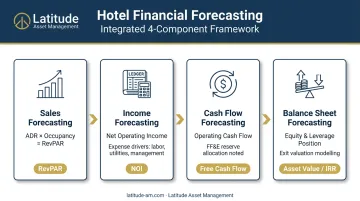
Financial forecasting works as an integrated system where each component feeds into the next. Understanding the sequence helps investors evaluate the reliability of any projection they receive — and identify where assumptions may be weakest.
Sales Forecasting
Sales forecasting is the foundation of the entire model. In a hotel context, this means projecting:
- Room revenue — ADR multiplied by occupancy, the core driver of property performance
- F&B revenue — food and beverage performance across outlets, banquets, and catering
- Ancillary revenue — spa, parking, resort fees, and other secondary income streams
STR reported U.S. hotel performance at 63.0% occupancy, $155.62 ADR, and $97.97 RevPAR for 2023 — but these aggregate figures mask significant variation by segment and market.
Assumptions about competitive set positioning, demand generators, and seasonal cycles directly shape every downstream projection. A miscalibrated occupancy figure doesn't stay contained — it skews revenue, expenses, debt coverage, and exit valuation simultaneously.
Income Forecasting
Once revenue is estimated, income forecasting measures all operating expenses against those revenues to project net operating income (NOI).
Key cost drivers in hospitality include:
- Labor — typically around 30% of total hotel revenue, according to USALI guidance
- Management fees — base fees of 2%–3% of total revenue, with incentive fees on top
- Brand royalties and franchise charges — contract-specific, but a material fixed cost
- Undistributed expenses — marketing, utilities, property operations, and administrative costs
CBRE reported that in 2024, U.S. hotel labor costs rose 4.8% while expenses above GOP rose 4.1% — meaning revenue growth alone did not capture the pressure on owner cash flow. An expense model that misses this compression can significantly overstate what an investor actually takes home.
Cash Flow Forecasting
Cash flow forecasting translates projected income into actual cash movement. A hotel can appear profitable on paper while generating insufficient cash to service debt, fund capital expenditures, or maintain FF&E reserves.
In hotel investments, timing is everything:
- Cyclical demand creates seasonal cash flow gaps
- CapEx cycles require large, lumpy reserve deployments
- Debt service obligations are fixed regardless of occupancy
HVS guidance places the FF&E reserve at 4%–5% of revenue — a recurring cash outflow that must be modeled separately from operating income to avoid overstating distributable cash.
Balance Sheet Forecasting
Balance sheet forecasting integrates the outputs from sales, income, and cash flow projections into a forward-looking picture of assets, liabilities, and equity. For hotel investors, this determines:
- Equity value at various points across the hold period
- Leverage ratios and compliance with debt covenants
- Exit assumptions — what the asset will be worth at disposition based on projected NOI and prevailing cap rates
This is where the full investment thesis either holds together or unravels. A covenant breach triggered by an overleveraged structure — or an exit valuation that assumes a cap rate compression that never materializes — typically traces back to a balance sheet model that wasn't stress-tested before closing.
Key Financial Risk Types Every Investor Should Know
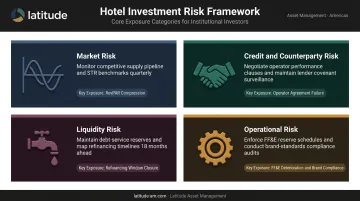
Before forecasting can be stress-tested, investors must understand the categories of risk that threaten those projections. Each type demands a distinct identification approach — and a different response when conditions shift.
Market Risk
Market risk is exposure to changes in demand, pricing power, competitive dynamics, and consumer behavior. In hotel investment, this includes:
- Shifts in travel demand driven by economic cycles or external shocks
- New supply entering a submarket and compressing achievable occupancy
- Competitor brand repositioning that narrows the ADR gap
CBRE's Q1 2026 U.S. data illustrates the mechanics clearly: supply rose 0.6%, demand rose 2.0%, and RevPAR grew 3.8% — showing that the relationship between supply growth and demand growth determines occupancy pressure. When that relationship reverses, RevPAR contracts fast.
Market risk is also market-specific. CBRE reported 58.7% occupancy in Mexico and 64.8% in Costa Rica in early 2025, while U.S. RevPAR growth through mid-2025 ran at just 0.4%. A single Americas-wide demand assumption misses these divergences entirely.
Credit and Counterparty Risk
Credit risk is the potential for financial loss when a borrower, operator, or counterparty fails to meet their obligations. In hospitality, this applies across multiple relationships:
- Operator agreements — management contracts where operator performance is not guaranteed
- Franchise arrangements — brand relationships that carry fee obligations even during downturns
- Capital stack counterparties — lenders, mezzanine providers, and co-investors
Weak contractual protections in management agreements — where performance benchmarks are absent, termination triggers are limited, or cure provisions are vague — leave investors exposed to prolonged underperformance with limited recourse. The risk is structural, embedded in the agreement architecture before operations even begin.
Liquidity Risk
Liquidity risk is the inability to access or convert assets to cash when needed. Hotel assets are particularly exposed during distressed cycles, when three liquidity constraints often hit simultaneously:
- Refinancing windows close as lenders pull back
- Asset sales take longer than anticipated in thin transaction markets
- Operating cash reserves deplete as occupancy falls
The 2020 disruption illustrates the severity: U.S. hotel transaction volume fell 90% in Q2 2020 and totaled only $12 billion for the full year, compared to $24 billion in 2025 as markets recovered. Capital structures without adequate reserves or refinancing flexibility don't survive those windows.
Operational Risk
Operational risk covers losses stemming from internal process failures, people, systems, or external events. In hotel assets, the most common sources include:
- Management execution failures — operators who underdeliver against investment objectives
- FF&E deterioration — deferred maintenance that impairs brand standards and guest satisfaction
- Labor disruptions — workforce instability in labor-intensive operating environments
- Brand compliance failures — PIP non-compliance that can trigger franchise termination
Operational risk often erodes value gradually, with performance degradation appearing in NOI and guest scores well before it surfaces in financial statements. Active asset management — regular reporting reviews, operator accountability meetings, and on-site oversight — is the primary mechanism for catching deterioration early.
Main Methods of Financial Forecasting
Forecasting methods fall into two broad categories: quantitative and qualitative. Sophisticated investors use both. The right blend depends on data availability, market maturity, and the specific asset being evaluated.
Quantitative Methods
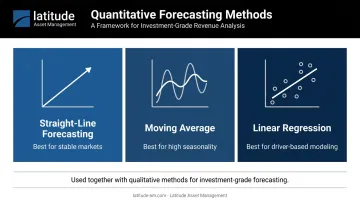
Quantitative forecasting relies on historical data and mathematical relationships. Three techniques are most commonly applied in hotel investment:
- Straight-line forecasting — assumes consistent historical growth continues forward; useful for stable, mature markets but can mislead during cycle turns
- Moving average — smooths short-term volatility by averaging performance across multiple prior periods; helps reduce noise in markets with high seasonal variability
- Linear regression — identifies the statistical relationship between an independent driver variable and a financial outcome; for example, modeling how historical demand growth in a submarket correlates with RevPAR movement to project forward performance
HVS's standard feasibility approach quantifies local room-night demand, allocates it across the competitive set based on relative positioning, and projects NOI across 5–10 years for DCF valuation — treating historical data as inputs to a market-positioning process, not a standalone trend line.
Qualitative Methods
Qualitative forecasting relies on judgment rather than historical data alone. It becomes essential when:
- A new market or asset type is being evaluated with limited track record
- Historical patterns have been disrupted by structural market changes
- Reliable data is sparse, as is often the case in emerging markets across Latin America and the Caribbean
Common qualitative approaches include:
- Market research — competitive surveys, demand generator analysis, and lodging supply pipeline reviews
- Expert opinion — insights from operators, brand representatives, and local market specialists
- Delphi method — iterative expert consensus building, where specialists refine projections through structured rounds of feedback
Latitude Asset Management's regional partners — including Olmedo Herrera in Colombia and Simon Lagardera in the Caribbean — provide this on-the-ground intelligence in markets where formal benchmarking data is limited or lagged.
Combining Both Approaches
Best practice in hotel investment forecasting is to anchor projections in quantitative data, then pressure-test those assumptions using qualitative judgment from operators, asset managers, and regional experts.
At Latitude, this translates to Javier Revelo, CFA, leading data-anchored financial modeling, applying scenario analysis and underwriting rigor, while regional partners contribute local market intelligence that validates or challenges the underlying assumptions.
Neither layer works as well without the other. Quantitative models built on faulty market assumptions are precise but wrong; qualitative judgment without analytical structure is directionally useful but not investment-grade.
How Risk Is Quantified and Analyzed
Identifying risk categories is only the first step. The goal is to convert qualitative uncertainty into structured, comparable numbers that can actually inform decisions.
Sensitivity Analysis
Sensitivity analysis tests how a forecast output changes when one key assumption is adjusted at a time. Common examples in hotel underwriting:
- Occupancy drops 500 basis points from the base case
- ADR grows at 1% annually instead of the projected 3%
- Interest rates rise 50bps, increasing debt service costs
- Labor costs increase 5% above projections
The output reveals which variables the investment thesis is most exposed to — and where due diligence energy should be concentrated. If a 300-basis-point occupancy shortfall breaks the debt service coverage ratio, that variable deserves more underwriting scrutiny than one where even a large adverse move leaves returns intact.
Latitude's underwriting philosophy treats assumption-setting as the most consequential step: at acquisition, assumptions are locked in and risks are either priced or missed. Sensitivity analysis is how that pricing discipline gets validated before capital is committed.
Scenario Analysis and Monte Carlo Simulation
Scenario analysis builds best-case, base-case, and worst-case projections by adjusting multiple assumptions simultaneously — reflecting the reality that adverse outcomes tend to cluster, not arrive one at a time.
A hotel downside scenario might combine:
- Occupancy 8 points below base
- ADR flat rather than growing
- Refinancing at a higher spread than underwritten
- CapEx overruns from deferred PIP work
Monte Carlo simulation extends this further, using software to run thousands of probabilistic combinations across all input variables and generate a distribution of possible outcomes — rather than three discrete scenarios. This approach gives investors a clearer picture of the range of realistic outcomes and where the probability mass sits.
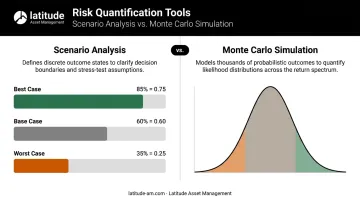
That distribution matters: it shifts the conversation from "what's our base case?" to "what's the realistic floor?" — which is where capital preservation decisions actually get made. HVS's public feasibility work applies DCF sensitivity analysis across multiple discount-rate and cap-rate assumptions, reflecting how deeply embedded these tools are in institutional hotel underwriting.
Applying Financial Forecasting and Risk Analysis to Hotel Investments
Hotel assets are not generic real estate. They are operating businesses with daily pricing, labor intensity, brand dependencies, and occupancy volatility. Financial forecasting in hospitality requires integrating operational performance data with real estate and capital market assumptions — a combination that pure financial models or pure operational assessments cannot handle alone.
ULI has noted that hotels are more of an operating business than most real estate forms — room inventory reprices and expires daily, and value depends on operating revenue, departmental costs, management execution, brand obligations, and recurring FF&E needs rather than just long-term rent rolls.
Cross-border investing adds additional layers of complexity:
- Currency fluctuation affecting both operating performance and USD-denominated returns
- Macroeconomic divergence across markets — Mexico, Colombia, the Caribbean, and the U.S. do not move in sync
- Regulatory and legal risk that varies significantly by jurisdiction
- Demand cycle timing that may be ahead of or behind the U.S. cycle
Navigating that complexity requires both institutional financial rigor and on-the-ground market knowledge. Latitude Asset Management combines both: Javier Revelo, CFA, leads acquisition underwriting and scenario analysis. Regional partners — Germán Ongay in Mexico, Olmedo Herrera in Colombia, and Simon Lagardera in the Caribbean — provide the local intelligence that validates financial assumptions in markets where data is relationship-driven and less transparent than U.S. counterparts.
Forecasting discipline doesn't stop at closing. During the hold period, actual performance must be measured against projections on a regular basis:
- Variances identified and explained — not explained away
- Models updated to reflect changing market conditions and operational realities
- Operators held accountable to performance benchmarks embedded in management agreements
- Strategic corrections made before small deviations compound into material value erosion
Latitude's asset management practice is built around this ongoing oversight function — acting as the owner's proxy throughout the hold period to ensure operators deliver results aligned with investment objectives and that capital is deployed intelligently as conditions evolve.
Frequently Asked Questions
What is financial forecasting and risk analysis?
Financial forecasting estimates future revenues, expenses, and cash flows for a business or investment. Risk analysis identifies and measures the factors that could cause those projections to go wrong. Together, they replace guesswork with structure — supporting more confident investment and operational decisions.
What are the main methods of financial forecasting?
Two broad categories exist. Quantitative methods — straight-line projection, moving average, and linear regression — draw on historical data and mathematical relationships. Qualitative methods, such as expert opinion, market research, and the Delphi technique, rely on informed judgment. In practice, most professionals combine both.
What are the 4 types of financial risk?
The four primary categories are market risk (demand and pricing volatility), credit risk (counterparty default), liquidity risk (inability to access cash when needed), and operational risk (failures in people, processes, or systems). Each requires a different mitigation approach.
How does financial forecasting differ from budgeting?
Budgeting is a fixed plan for allocating resources over a fiscal year. Financial forecasting is a dynamic, forward-looking process that continuously updates projections as new data becomes available. Forecasts feed and inform budgets — but they are not the same thing.
What is sensitivity analysis in financial forecasting?
Sensitivity analysis isolates one variable at a time to measure how changes in that assumption affect the overall financial outcome. It reveals which inputs carry the most risk to a projection, helping analysts focus due diligence and stress-testing where it matters most.
How do hotel investors use financial forecasting and risk analysis?
Hotel investors use forecasting to project RevPAR, NOI, and cash flows across a hold period. Risk analysis then stress-tests those projections against scenarios such as demand downturns, rising debt costs, or operator underperformance. This process supports disciplined acquisition underwriting and more informed asset management decisions throughout the ownership cycle.