Introduction
The hotel RFP — Request for Proposal — is the formal mechanism through which buyers like event planners, corporate travel managers, and organizations solicit competing proposals from hotels for guest room blocks, meeting space, and related services.
Most writing on hotel RFPs focuses on the buyer's perspective: how planners write better RFPs, how to negotiate concessions, how to compare proposals. The hotel side gets far less attention, even though responding to RFPs is one of the primary ways hotels generate reliable, advance-committed group and corporate revenue.
Cvent reports that $16.5 billion of group business was sourced through its Supplier Network in 2024, with sourced room nights increasing 16% year over year. That's not a niche sales channel. For hotel owners and asset managers, the RFP process is a revenue-critical function that directly affects occupancy, ADR, RevPAR, and distribution cost — yet most properties have no structured approach for improving their win rates or evaluating where proposals fall short.
This guide covers the RFP process from the hotel's perspective — how it works, what separates competitive responses from forgettable ones, and where most properties leave group revenue on the table.
Key Takeaways
- A hotel RFP is a formal buyer request for a tailored proposal — and competing hotels bidding for the same business is what gives buyers leverage.
- Group and corporate RFP business delivers advance-committed revenue, reducing OTA dependency and stabilizing occupancy.
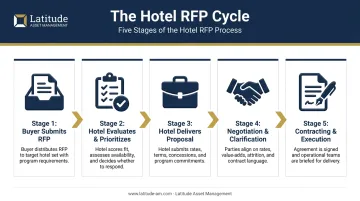
- Five stages define the process: submission, evaluation, proposal, negotiation, and contracting.
- Response speed and proposal personalization are the two factors hotels control most — and both directly affect win rates.
- Tracking RFP win rates alongside RevPAR and ADR gives owners and asset managers a sharper read on true asset performance.
What Is the Hotel RFP Process?
The hotel RFP process is the formal cycle through which a buyer submits a standardized request to one or more hotels. The hotel then evaluates that request, responds with a tailored proposal, and both parties negotiate and finalize terms before contracting.
RFPs are used for three primary purposes:
- Group room blocks — typically 10 or more rooms per night for a defined event period
- Meeting and event space — conference rooms, ballrooms, pre-function areas, and related A/V or F&B services
- Corporate transient programs — negotiated annual rate agreements for individual business travelers
RFP vs. RFQ: A Practical Distinction
An RFQ (Request for Quotation) asks for a price on a well-defined, standardized service with minimal customization. An RFP invites a hotel to propose a complete solution tailored to the buyer's specific event or program requirements — room counts, dates, F&B needs, space configurations, and contract terms all open to negotiation.
Two Main RFP Types Hotels Encounter
| Type | Buyer | Purpose | Contract Duration |
|---|---|---|---|
| Meetings & Events RFP | Event planners | Source a venue for a conference, retreat, or social event | Single event |
| Corporate Transient RFP | Travel managers / TMCs | Establish negotiated rate programs for business travelers | Annual |
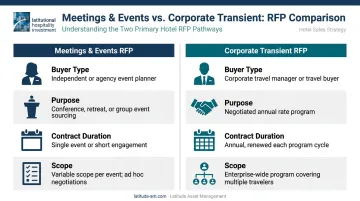
Both types follow similar structural stages, but the differences in timeline, volume commitment, and pricing scope directly shape how a hotel should allocate sales resources and prioritize its response.
Why the Hotel RFP Process Matters for Owners and Asset Managers
Most hotel owners understand that group business is valuable. Fewer track it with the rigor it deserves.
According to CoStar/STR's 2024 U.S. data, group demand grew 2.9% while transient demand grew only 2.0%. More notably, group ADR rose 3.5% while transient ADR was essentially flat. That divergence matters: group business contracted through the RFP process is growing faster in both volume and rate than the transient segment.
For a concrete portfolio benchmark, Host Hotels reported that group business represented 34% of room sales across 76 comparable properties in 2025. That's not an industry-wide average, but it illustrates how significantly group revenue can anchor a hotel's revenue base for a major lodging owner.
The Competitive Pressure Hotels Face
Buyers typically send the same RFP to multiple properties simultaneously. Amadeus's MeetingBroker data indicates that at least 10 hotels may receive the same RFP through platforms like Cvent. In that environment, a hotel that responds slowly, sends a generic proposal, or fails to address the buyer's stated requirements loses business — even when its pricing is competitive.
The cost of that loss isn't just one booking. Group and corporate accounts often repeat annually.
Distribution Cost: The Overlooked Argument
Business won through direct RFP contracts typically carries lower acquisition cost than OTA bookings. OTA commissions generally range from 15% to 25% of room revenue, according to Skift's analysis of historical industry ranges — with some contracts reaching 30%. Direct RFP contracts don't carry those commissions.
For hotel owners focused on net operating income, a well-functioning RFP program isn't just a sales activity. It's a distribution strategy.
The Asset Management Angle
That distribution cost argument has a direct NOI implication — which makes group sales infrastructure an asset management concern, not just a sales one.
Hotel owners and asset managers should evaluate whether their property's group sales capabilities — staffing, response tools, proposal quality, and pricing calibration — are competitive. This is especially relevant during ownership transitions, rebranding, or turnaround situations where rebuilding group revenue from a low base is a priority.
Firms like Latitude Asset Management review revenue strategy and operator accountability as part of asset management engagements, precisely because these gaps surface most often when ownership or operations have recently changed.
How the Hotel RFP Process Works: A Step-by-Step Breakdown
The RFP cycle has five distinct stages. From the hotel's side, each stage carries specific responsibilities and decision points.
Step 1: The Buyer Submits the RFP
A well-formed RFP typically includes:
- Organization and event overview
- Specific dates and any flexibility window
- Room block breakdown by night and room type
- Meeting space and A/V requirements
- F&B needs and budget parameters
- Submission deadline and decision timeline
RFPs arrive through platforms like Cvent or Lanyon, by direct email, and occasionally through brand-managed sourcing channels. Completeness varies. Hotel sales teams need to act on the information provided — and proactively clarify gaps — even when the RFP is incomplete.
Step 2: The Hotel Evaluates and Prioritizes the Request
Not every RFP deserves an equal response. Hotels with a defined triage process evaluate:
- Date fit against current availability and forecasted demand
- Revenue potential — room nights, F&B minimums, meeting room rental fees
- Lead source quality and buyer's history, if available
- Strategic value of the account (repeat potential, market segment fit)
Properties without a defined qualification process respond slower and less accurately — and miss more business as a result. The triage step also includes the decision to decline or refer to a sister property, which is a strategic choice, not a default.
Step 3: The Hotel Prepares and Delivers a Customized Proposal
A strong hotel RFP response includes:
- A personalized proposal that directly addresses the buyer's stated requirements
- Clear pricing: room rates, meeting room fees, F&B minimums
- Comp room ratio and concessions offered (waived Wi-Fi, flexible attrition, complimentary parking, upgrades)
- Property capacity details, tech infrastructure, and F&B capabilities
- A defined deadline for acceptance to create urgency
Hotels that submit templated, non-customized responses routinely lose bids to competitors offering similar — or higher — rates.
Step 4: Negotiation and Clarification
After proposals are received, buyers shortlist two or three properties and enter negotiation. The variables in play typically include rate, attrition percentage, cutoff dates, cancellation terms, and concessions.
Understanding the buyer's actual priorities is what separates strong negotiators from weak ones. A buyer prioritizing flexibility may accept a higher rate in exchange for softer attrition terms. A hotel that identifies this dynamic and makes a targeted concession wins more often than one offering across-the-board discounts.
Step 5: Contracting and Post-Award Execution
Once terms are agreed, the negotiation closes and moves into documentation. The finalized contract locks in:
- Room rates and room block commitment
- Attrition clause (the percentage of the block the buyer commits to fill)
- Cutoff dates and billing terms
- Cancellation policies and penalties
This document is the hotel's revenue protection mechanism. Asset managers should ensure their properties use standardized, enforceable contract templates that reflect current market norms — not templates that haven't been updated in several ownership cycles.
Key Factors That Affect Hotel RFP Outcomes
Response Speed
Amadeus's MeetingBroker data indicates that 72% of first responders win the business — a finding based on submissions and responses generated through the platform. Separately, a Cvent survey of more than 600 UK and European planners found that 83% expected hotel RFP responses within four days or less.
The practical implication: delayed responses give competitors time to establish a relationship with the buyer before you do. On sourcing platforms that timestamp responses, late replies are visually apparent to planners.
Proposal Quality and Personalization
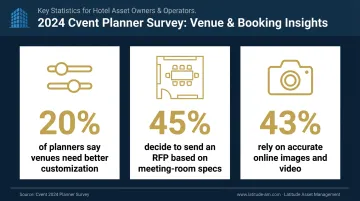
A 2024 Cvent planner survey highlights where hotels most often fall short:
- 20% of planners said venues could improve customization to support faster decision-making
- 45% decide whether to send an RFP based on meeting-room specifications
- 43% rely on accurate online images and video when evaluating properties
Tailored responses — ones that reference the buyer's event type, attendee profile, and stated priorities — consistently outperform boilerplate. Connecting sales and catering systems with RFP tools lets teams pull relevant property details into each response without rebuilding from scratch.
Competitive Pricing Strategy
Rate is rarely the sole deciding factor. Buyers evaluate total program value:
- Room rate
- F&B minimums
- Ancillary fees (resort fees, parking, Wi-Fi)
- Concessions and flexibility terms
A 2025 GBTA-Cvent survey of 278 corporate travel managers found that 53% at least sometimes include free breakfast in negotiated programs, and 50% include free cancellation or waived cancellation fees. These aren't unusual asks — they're standard negotiating points that hotel revenue managers and asset managers should account for in their pricing strategy.
Property Fit and Availability
An RFP can be perfectly responded to and still lost because the hotel's space, dates, or service capabilities don't genuinely match the buyer's requirements. Hotels that communicate their product strengths clearly — meeting room capacity, tech infrastructure, F&B capabilities — help buyers self-qualify before submitting, which raises conversion rates on the proposals that actually advance.
Common Mistakes in Hotel RFP Management
Treating It as a Reactive Process
Many hotel sales teams respond only to inbound RFPs and don't maintain systematic outreach to previous RFP respondents, corporate accounts, or recurring group clients. Group business tends to repeat. A hotel that won a conference in 2023 has a meaningful advantage when that same organization starts sourcing for 2025 — but only if someone on the sales team maintained the relationship.
Confusing Volume with Value
A hotel that wins RFPs at below-threshold rates, with excessive attrition relief and heavy concessions, can displace higher-value transient demand and reduce overall profitability. Hotel owners should review group business contribution margins — not just room night totals — when evaluating RFP performance. HSMAI defines displacement analysis as comparing competing pieces of business to determine which generates the most value — for example, a 200-room group at a discounted rate may yield less than 150 transient nights at rack rate. That analysis should inform every group acceptance decision, not just the largest ones.
Treating Contract Signing as the Finish Line
Many hotel teams treat "winning the RFP" as the conclusion of the process, when the contract negotiation is where the financial terms of the deal are actually set. Attrition clauses, cutoff dates, and cancellation penalties are routinely under-negotiated — and when group pickup falls short of contracted commitment, that gap translates directly into lost revenue with no structural recourse. Weak attrition clauses and vague cancellation terms are among the most common sources of group business underperformance that show up in asset reviews.
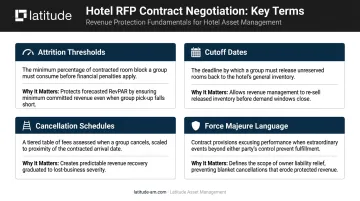
Key contract terms that require active negotiation:
- Attrition thresholds — the minimum pickup percentage before penalties apply
- Cutoff dates — how far in advance the hotel can release unbooked rooms
- Cancellation schedules — tiered fees tied to proximity to arrival date
- Force majeure language — which circumstances excuse the group from financial obligation
Frequently Asked Questions
What is a hotel RFP?
A hotel RFP (Request for Proposal) is a formal document submitted by a buyer — such as an event planner, corporate travel manager, or organization — to one or more hotels, requesting a tailored proposal covering room rates, room block size, meeting space, and contract terms. Sending to multiple hotels simultaneously creates competition that gives buyers leverage on price and concessions.
Who issues an RFP to a hotel?
RFPs are typically issued by:
- Event planners sourcing venues for conferences, meetings, or social events
- Corporate travel managers and TMCs establishing annual negotiated rate programs
- Government agencies and associations sourcing group accommodations
- Hotel owners or developers seeking operator or brand proposals
What is the difference between an RFP and an RFQ?
An RFQ (Request for Quotation) is used when a buyer needs a price for a well-defined, standardized product with little customization. An RFP invites vendors to propose a complete, tailored solution. In the hotel context, an RFP allows the buyer to describe event-specific requirements and invites the hotel to respond with a customized proposal that addresses those needs.
What should a hotel include in its RFP response?
A strong hotel RFP response should include:
- A personalized proposal directly addressing the buyer's event requirements
- A clear pricing structure: room rates, F&B minimums, and meeting room fees
- Comp room ratio and concessions offered
- Relevant property details: capacity, A/V capabilities, and accessibility
- A defined acceptance deadline to create urgency
What is attrition in a hotel RFP contract?
Attrition is the percentage of a contracted room block the buyer commits to fill. If a buyer contracts 50 rooms with an 80% attrition clause and only 35 are booked, the buyer may owe the hotel for the 5-room shortfall. Attrition clauses protect the hotel against revenue loss when group pickup falls short.
How does the RFP process affect a hotel's overall revenue performance?
Group and corporate business secured through RFPs builds base occupancy, reduces reliance on high-cost OTA distribution, and — when properly contracted — generates predictable advance revenue. Owners and asset managers should track RFP win rates and group revenue contribution alongside RevPAR and ADR.