Introduction
Hotel general manager roles attract serious competition. The BLS projects roughly 5,400 lodging manager openings annually through 2034, and AHLA found that 71% of surveyed hotels had vacancies they couldn't fill. Even so, a weak resume gets passed over — because the staffing shortage doesn't lower the bar for senior leadership roles.
Most GMs struggle to translate strong operational records into compelling resume language. Hiring managers — and increasingly, ownership groups and asset managers — need to see operational impact, financial accountability, and measurable results. A resume full of job duties won't get there. One built around proof will.
This guide covers everything a hotel GM needs to build a competitive resume in 2026:
- A full annotated sample resume
- Format and section guidance
- How to write metric-driven bullet points
- Skills, certifications, and what actually matters
- What hotel investors and asset managers look for, and how to frame your resume for that audience
Hotel General Manager Resume Example for 2026
Below is a full sample resume for a fictional but realistic hotel GM with 12 years of progressive experience.
MARCUS DELEON Hotel General Manager | Full-Service & Resort Operations Miami, FL | (305) 555-0182 | mdeleon@email.com | linkedin.com/in/marcusdeleon
PROFESSIONAL SUMMARY
Full-service hotel general manager with 12 years of progressive leadership across branded and independent properties ranging from 180 to 340 rooms. Expertise in P&L ownership, revenue management, and cross-functional team development. Increased RevPAR index from 94 to 108 within 18 months at a 280-room upper-upscale property by restructuring pricing strategy and closing key corporate accounts.
WORK EXPERIENCE
General Manager The Meridian Hotel & Spa — Miami, FL | Jan 2020 – Present 280-room upper-upscale independent; $22M annual revenue; 140-person team
- Grew RGI from 94 to 108 over 18 months using IDeaS revenue management platform to optimize dynamic pricing across OTA and direct channels
- Increased GOP margin from 28% to 34% through labor schedule restructuring and F&B cost controls, adding $1.3M in bottom-line contribution
- Raised TripAdvisor ranking from #18 to #6 in the Miami Beach market by implementing a structured service recovery program and Medallia-tracked guest feedback loop
- Led $3.2M PIP renovation from planning through completion, delivering on time and 4% under budget while maintaining 78% occupancy during construction
General Manager Courtyard by Marriott — Fort Lauderdale, FL | Mar 2016 – Dec 2019 185-room select-service; $9.8M annual revenue; 65-person team
- Reduced labor cost as a percentage of revenue from 38% to 33% by cross-training front desk and housekeeping teams and implementing demand-based scheduling
- Achieved brand Quality Assurance score of 94 (top 10% of portfolio) two consecutive years through SOP development and bi-weekly department head training
- Grew occupancy from 71% to 79% during a market softening period by converting three new corporate accounts and partnering with local event venues on group business
Assistant General Manager Hampton Inn — Coral Springs, FL | Jun 2013 – Feb 2016 120-room limited-service; $5.1M annual revenue
- Supported revenue management, front desk operations, and housekeeping for a 120-room property during GM vacancy period of six months, maintaining 76% occupancy
- Reduced guest complaint response time from 48 hours to under 4 hours by establishing a structured service recovery protocol
SKILLS
Hotel Operations: OPERA PMS, HotSOS, ALICE, SOP development, preventive maintenance planning, brand standards compliance
Financial Management: P&L ownership, budgeting and forecasting, labor cost modeling, GOP margin optimization, revenue management
Guest Experience: Medallia, NPS tracking, TripAdvisor management, service recovery programs
CERTIFICATIONS
- Certified Hotel Administrator (CHA) — AHLEI
- Certified Revenue Management Executive (CRME) — HSMAI
- ServSafe Manager Certification
EDUCATION
Bachelor of Science in Hospitality Management Florida International University — 2013
What Makes This Resume Work
Here's what each section does well:
- Opens with scope (12 years, 180–340 rooms), names two competencies, and closes with one quantified result — no vague adjectives in the summary.
- Experience bullets follow a consistent formula: action verb + tool or method + measurable outcome. "Grew RGI from 94 to 108 using IDeaS" works for an HR screener and an asset manager alike.
- The one-line italicized property note (rooms, revenue, team size) before each job's bullets gives hiring managers immediate scale reference.
- Three distinct skill categories prevent a dumped keyword list and make ATS scanning easier.

What This Resume Avoids
Every weak resume pattern below gets cut:
- "Responsible for managing hotel operations" — this says nothing
- Metrics without context (e.g., "increased revenue by 12%" with no baseline, timeframe, or property type)
- A generic summary that could apply to any property or brand
A Note for Assistant GM and Entry-Level Candidates
The same structure applies at earlier career stages. Adapt it with three targeted adjustments:
- Replace the professional summary with a resume objective focused on transferable skills and career direction
- Expand the education section with relevant coursework
- Detail internship or department head experience where GM-level responsibilities were assumed
How to Choose the Right Format and Sections
Format: Reverse-Chronological, Every Time
For any GM with five or more years of progressive hospitality leadership, reverse-chronological is the correct format. It immediately shows career progression — expanding property scope, growing team size, increasing revenue responsibility. Hybrid or functional formats obscure that narrative and raise flags with experienced recruiters.
Core Sections (In Order)
Every hotel GM resume must include these sections:
- Header — Name, tailored job title, city, phone, email, LinkedIn URL
- Professional Summary — 3 sentences maximum
- Work Experience — Reverse chronological with property context notes
- Skills — Grouped by category
- Education — Degree, institution, year only
- Certifications — Placed above education if more current or role-critical
Optional sections that differentiate candidates:
- Languages spoken
- Professional Affiliations (AHLA, HSMAI memberships)
- Industry Awards (brand recognition, TripAdvisor Certificates of Excellence)
- Key Projects (renovations, brand conversions, hotel openings)
On the header specifically: Mirror the job title line to the posting. "Hotel General Manager | Full-Service Hospitality Operations" performs better with ATS systems than just "General Manager." Include your LinkedIn URL — it lets recruiters verify experience and tenure quickly.
Getting your header right is only part of the equation. ATS systems filter resumes before a human ever sees them, so the language and structure throughout your document matters just as much.
ATS Optimization
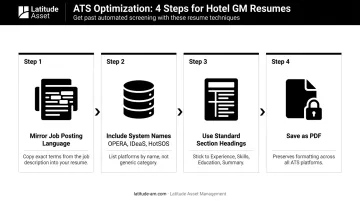
Many hotel ownership groups and management companies use applicant tracking systems. To pass initial screening:
- Mirror exact language from the job posting — if they say "OPERA PMS," don't write "Oracle hospitality software"
- Include specific system names: OPERA, Mews, IDeaS, Duetto, HotSOS, ALICE
- Use conventional section headings (Work Experience, Skills, Certifications — not creative alternatives)
- Save as PDF to preserve formatting
Length and Formatting Rules
- One page for most GMs with fewer than 15 years of experience
- Two pages only for multi-property portfolio managers, senior directors, or candidates with extensive credentials that add value
- Fonts: Arial or Calibri, 10–12pt body text
- Consistent bullet style throughout
- Ample white space between sections — dense resumes get skimmed, not read
How to Write a Standout Summary and Work Experience Section
The Summary Formula
Open with years of experience and property type. Name one or two core competencies. Close with one quantified achievement.
Strong: "Full-service hotel general manager with 12 years of experience across branded and independent properties. Expertise in P&L ownership and revenue management. Increased GOP margin from 28% to 34% at a 280-room upper-upscale property over 24 months."
Weak: "Dynamic and results-driven hospitality professional with extensive experience in hotel management and a passion for guest satisfaction."
The weak version could describe anyone. The strong version proves scope, competency, and impact before the reader reaches a single bullet point.
An objective statement is only appropriate for candidates without direct GM experience — those transitioning from assistant GM or department head roles. In that case, lead with transferable competencies and state clearly where you're headed.
Structuring Work Experience Entries
Each role should include:
- Job title
- Hotel name and location
- Dates (month and year — not just year)
- One-line property context note in italics (rooms, brand affiliation, annual revenue, team size)
- 4–6 metric-driven bullet points
That context note is a critical differentiator. "Led revenue management strategy" reads very differently for a 90-room limited-service property than for a 400-room full-service resort. Give hiring managers (and ownership groups) the frame before the numbers.
The Bullet Point Formula
Structure: Strong action verb + tool or system used + what was built or fixed + measurable result
Three weak-to-strong rewrites:
| Topic | Weak | Strong |
|---|---|---|
| Revenue | "Managed hotel revenue" | "Implemented dynamic pricing through IDeaS, growing RevPAR index from 91 to 103 over 12 months against a 5-hotel competitive set" |
| Guest Satisfaction | "Improved guest scores" | "Deployed Medallia-tracked service recovery protocol, raising NPS from 42 to 61 over two quarters at a 220-room full-service property" |
| Cost Control | "Reduced operating costs" | "Restructured housekeeping labor model using demand-based scheduling, reducing labor cost as a percentage of revenue from 37% to 32% without impacting QA scores" |
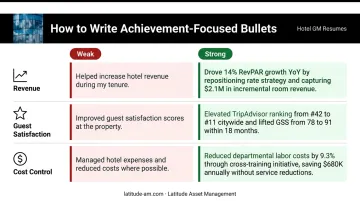
Achievement-focused resumes consistently outperform responsibility lists in hospitality hiring. The reason is simple: baseline, result, timeframe, and property context give recruiters everything they need to benchmark you against the role.
Demonstrating Career Progression
If you were promoted within the same company, list it under one employer entry with separate date ranges and distinct bullet sets. A documented progression from assistant GM to GM (or department head to GM) is one of the strongest signals a resume can send. It shows that someone who already knew your gaps and your performance still chose to promote you — that carries weight with recruiters and ownership groups alike.
Tailoring to Property Type
Luxury resort role — emphasize:
- VIP guest relations and AAA rating improvements
- Premium F&B performance metrics
- Service training programs and brand compliance
- Revenue sophistication (ownership groups at this tier expect both)
Select-service or economy role — emphasize:
- Lean operations and labor efficiency
- Cost-per-occupied-room management
- Brand QA scores
- Margin discipline (a $100 ADR property runs on an entirely different operating model than a $300 ADR one — make that clear)
Skills and Certifications That Hotel GM Resumes Need
Hard Skills by Category
Select 10–15 from across these groups. Every skill you list should have at least one supporting bullet in your experience section.
Hotel Operations
- OPERA PMS, Mews, ALICE, HotSOS
- Preventive maintenance planning
- SOP development and brand standards compliance
Financial Management
- P&L ownership and budget management
- Revenue management and forecasting
- Labor cost modeling
- GOP margin optimization
- Capital expenditure oversight
Guest Experience
- Medallia, NPS tracking
- TripAdvisor reputation management
- Service recovery program design
- Brand quality assurance audits
Once you've identified your strongest skills, certifications are what give them institutional weight on the page.
Certifications Worth Listing
| Credential | Issuer | Best For |
|---|---|---|
| Certified Hotel Administrator (CHA) | AHLEI | Senior GMs — broadest leadership recognition |
| Certified Revenue Management Executive (CRME) | HSMAI | GMs with strong commercial/revenue focus |
| Certified Hospitality Revenue Manager (CHRM) | AHLEI | Revenue-oriented GMs earlier in career |
| ServSafe Manager Certification | ServSafe/NRA | GMs overseeing F&B and food safety compliance |
Place certifications above education when they are more current or more directly relevant to the role than your degree. A CHA earned in 2023 outweighs a hospitality degree from 2008 in owner-side hiring decisions.
On Soft Skills
Don't list soft skills as a standalone section. "Strong communicator" and "natural leader" are meaningless without proof. Instead, demonstrate them through bullets: a retention rate, a staff engagement improvement, a successful culture shift during a brand transition. Hiring managers are skeptical of unsupported claims, and ownership groups are even less forgiving of them.
What Hotel Owners and Asset Managers Look for in a GM Resume
This is where most GM resumes fall short — and where the strongest candidates pull ahead.
Today's hotel GMs are often evaluated not just by HR but directly by ownership groups, private equity sponsors, and professional asset management firms. These stakeholders have a fundamentally different priority than a screener: they want to know whether a GM will run their asset with the same discipline they'd apply themselves — on-site, every day.
Firms like Latitude Asset Management — a hotel investment and asset management firm operating across the Americas — work directly with hotel owners to evaluate property leadership and operational performance. That investor-side perspective shapes what a compelling GM resume actually looks like when it reaches an ownership committee.
Frame Results in Investment Terms
An HR department evaluates competencies. An ownership group evaluates returns. The same experience can be framed either way — only one version resonates with asset managers.
HR framing: "Managed hotel operations and improved financial performance"
Investor framing: "Increased GOP margin from 28% to 34% over 24 months through labor restructuring and F&B optimization, adding $1.3M in bottom-line contribution at a $22M revenue property"
Ownership groups respond to GMs who demonstrate stewardship of capital. That means your resume should reference:
- Total revenue under management
- GOP margins and GOPPAR contributions
- RevPAR index performance relative to competitive set (RGI)
- Budget variance — how close you came to, or exceeded, underwritten assumptions
- Capital projects completed on time and within budget
The Metrics Asset Managers Actually Use
Those investment-framed bullet points matter because ownership groups are analyzing specific performance indicators — not just occupancy numbers and guest scores.
According to CBRE, 94% of surveyed U.S. hotel investors planned to maintain or expand their hotel portfolios in 2025 — which means active owners are actively evaluating operating leadership. The metrics they use aren't just occupancy and guest scores:
- RGI (Revenue Generation Index) — RevPAR versus competitive set. Moving RGI from 96 to 104 tells an asset manager you grew market share.
- MPI and ARI — occupancy and rate performance relative to comp set
- GOPPAR — gross operating profit per available room, which connects revenue strategy to profit conversion
- Flow-through percentage — how much revenue growth converts to GOP
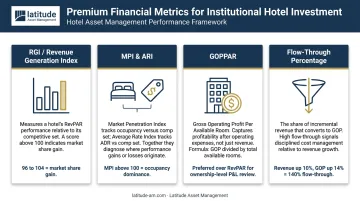
If your resume shows strong RevPAR growth alongside declining GOP margin, a sophisticated ownership group will notice. Show both sides of the equation.
Turnaround and Capital Project Experience
GMs who have stabilized a distressed property, managed through a receivership, navigated a brand conversion, or led a PIP from planning to reopening hold particular appeal to asset managers. These experiences demonstrate that a GM can protect asset value when markets soften or operations underperform — exactly the judgment ownership groups are hiring for.
Don't bury this experience. Feature it with specifics:
- The property condition at the point you took over
- Timeline from intervention to stabilization
- Financial outcome — margin recovery, RevPAR improvement, or sale-ready positioning
Cross-Cultural Fluency Across the Americas
For GMs targeting properties in the U.S., Mexico, Caribbean, or Latin America, language skills and regional market experience are increasingly meaningful differentiators. Markets across the Americas vary considerably in regulatory environments, labor structures, and demand dynamics — and ownership groups operating in those regions know it.
A GM who speaks Spanish fluently, has managed through a brand transition in a Latin American market, or understands the nuances of local labor compliance in the Caribbean brings practical knowledge that credentials alone can't convey. List language proficiency clearly and cite specific international assignments by market and scope.
Education and Additional Sections Worth Including
Education Section Format
For experienced GMs, keep it simple:
- Degree name
- Institution
- Graduation year
That's it. Relevant coursework and GPA apply only to candidates with fewer than five years of experience. Preferred degree backgrounds include:
- B.S. in Hospitality Management or Hotel Administration
- B.S. in Business Administration
- MBA with hospitality focus (relevant but not required)
Cornell's Nolan School of Hotel Administration — the only hospitality school within an Ivy League university — is well recognized by ownership groups and management companies. Cornell's General Managers Program has operated for more than 30 years and targets active hotel GMs and immediate successors. If you hold a Cornell credential, list it prominently in your certifications section.
Additional Sections That Differentiate
Languages carry real weight in international and resort markets. List proficiency level clearly: conversational, professional working, or native/bilingual.
Professional Affiliations such as AHLA and HSMAI signal ongoing industry engagement, not just historical employment.
Industry Awards — brand recognition awards, TripAdvisor Certificates of Excellence, property-level honors — provide third-party validation that a resume alone can't replicate.
Key Projects works well as a dedicated section for candidates with complex project experience but limited employer history. Major renovations, brand conversions, and hotel openings (from planning through stabilized operations) deserve their own space.
On hobbies: skip them unless they're directly hospitality-relevant. "Avid traveler" adds nothing to a hotel GM's resume. These four sections, used selectively, do.
Frequently Asked Questions
What does a hotel general manager do on a resume?
A hotel GM's resume should capture their oversight of all hotel departments — rooms, F&B, sales, finance, and HR — with emphasis on quantified outcomes. That means revenue growth, guest satisfaction improvements, GOP margin changes, and cost reductions. Duties describe the role. Results on a GM resume prove whether someone actually performed it.
What are the 5 P's of hotel management?
No single authoritative framework defines a universal "5 P's of hotel management." What major hospitality bodies like AHLEI and Cornell do identify are core GM competencies: people leadership, product quality, pricing strategy, promotion and distribution, and operational positioning. Each is best shown through metric-backed experience — not by citing the framework itself.
What are the 8 skills hotel managers should have?
BLS and Cornell identify eight core GM competencies: leadership, financial management, revenue optimization, guest relations, operations management, communication, problem-solving, and staff development. The strongest resumes don't list these as soft skills — they back each one with specific, quantified bullet points in the experience section.
Should a hotel general manager resume be one page or two pages?
One page is standard for most GM candidates. Two pages are acceptable only for senior GMs managing multi-property portfolios, director-level candidates with extensive credentials, or executives with major project histories that genuinely require the additional space.
What certifications should a hotel general manager include on their resume?
The top credentials are the Certified Hotel Administrator (CHA) from AHLEI, the Certified Revenue Management Executive (CRME) from HSMAI, and ServSafe Manager Certification for F&B-responsible GMs. These signal credibility to both HR teams and ownership groups, with the CHA carrying the broadest recognition for senior hotel leadership roles.
How do you write a hotel general manager resume with no direct GM experience?
Use a resume objective instead of a summary, and lead with transferable accomplishments from assistant GM, department head, or senior operations roles. Quantify results — occupancy managed, team size led, revenue impacted — that demonstrate readiness for the GM role. A property context note for each role still applies, even at a supporting level.