Introduction
If you're evaluating a Cornell hospitality certificate, the credential carries real weight in hotel investment and operations circles. Through eCornell, Cornell's School of Hotel Administration now delivers its certificate programs to working professionals worldwide — no campus required.
This guide covers what you need to make that evaluation: how the programs work, which certificates exist, who they're designed for, and how to match one to your career goals.
Whether you're a revenue manager sharpening commercial skills or a hotel investor building a structured framework for underwriting and asset management, there's a program worth a close look.
One point upfront: these are non-degree, continuing education credentials. They carry Cornell's name and academic rigor — but they're not the same as Cornell's on-campus degree programs. That distinction matters, and we'll address it throughout. By the end, you'll know whether a Cornell certificate fits your role and which program to pursue.
Key Takeaways
- Cornell hospitality certificates are delivered online through eCornell, built by Cornell's School of Hotel Administration faculty
- Programs span hotel investment, asset management, revenue management, food & beverage, marketing, and leadership
- The certificates are recognized across hospitality, hotel investment, and real estate circles — particularly at mid-to-senior professional levels
- Most certificates take 2–6 months to complete, designed around a working professional's schedule at roughly 3–5 hours per week
What Is eCornell and How Do Cornell Hospitality Certificates Work?
eCornell is Cornell University's online learning and executive education unit. It collaborates with Cornell's schools and colleges to develop professional certificate programs, with the appropriate Cornell school issuing the credential upon completion.
The Format
Courses run with fixed start and end dates but are otherwise asynchronous — no mandatory login times, no synchronous class sessions in most programs. Learners work through video lectures, readings, case studies, quizzes, and facilitated discussions on their own schedule.
Typical time commitment: 3–5 hours per week, with cohorts of up to 35 professionals. Total student effort across a certificate program generally ranges from 40 to 100+ hours.
What You Receive
An eCornell certificate is a non-credit, continuing education credential issued by Cornell University. Key details to understand:
- Carries no academic credit and is not equivalent to a Cornell degree
- No formal application required for most programs
- Professional experience is recommended but rarely enforced as a prerequisite
eCornell vs. Cornell's Degree Programs
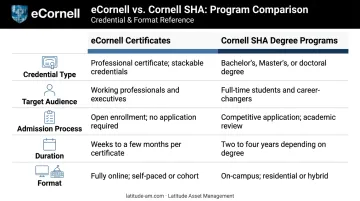
| eCornell Certificates | Cornell SHA Degree Programs | |
|---|---|---|
| Credential | Professional certificate (non-credit) | Academic degree |
| Audience | Working professionals | Full-time students |
| Admission | No formal application for most programs | Competitive admissions |
| Duration | 2–6 months typically | 2–4 years |
| Format | Online, asynchronous | On-campus |
The two pathways serve entirely different needs. eCornell certificates are designed for working professionals seeking applied, career-stage credentials — not academic credit toward a Cornell degree.
Overview of Cornell Hospitality Certificate Programs
eCornell's hospitality catalog is broader than most people realize. The current portfolio includes over 20 certificates spanning general management, finance, food & beverage, marketing, revenue, leadership, and even wine and beverage education.
The major professional programs most relevant to hotel industry practitioners fall into five categories:
Hotel Revenue Management
Who it's for: Revenue managers and directors, GMs, sales and marketing analysts, front-desk managers, and anyone with financial responsibility over room inventory.
Core topics include:
- Revenue management foundations and forecasting
- Availability controls and overbooking management
- Pricing strategy and distribution channels
An advanced version — Advanced Hospitality Revenue Management: Pricing and Demand Strategies — exists for those with prior revenue management experience. It's one of eCornell's most-enrolled hospitality programs.
Food & Beverage Management
Who it's for: GMs, restaurateurs, managed-service contractors, caterers, event managers, and F&B directors.
Core topics include:
- Income statements, operating data, and menu optimization
- Supply chain management and guest loyalty
- Team leadership and electives covering beverages, new openings, and special events
The curriculum targets those accountable for F&B profitability, not just service execution.
Hospitality Digital Marketing
Who it's for: Marketers, operations professionals, GMs, and revenue managers responsible for demand generation or brand performance.
Core topics include:
- Brand strategy across digital media and channel integration
- Customer and market analysis, content, and engagement
- Online reputation management and measuring digital performance
Hospitality Leadership and Broader Management Programs
For senior operators and aspiring GMs, two programs stand out. The Hospitality Leadership certificate runs 5 courses over roughly 3 months. The Hospitality Management 360 is the catalog's most comprehensive offering — 18 courses across 9 months covering operations, foodservice, revenue, service, and leadership.
Note: The General Managers Program is a hybrid format requiring a five-day on-campus capstone in Ithaca. It's not a fully online credential.
Inside the Hotel Real Estate Investments & Asset Management Certificate
This is the certificate most directly relevant to hotel owners, investors, lenders, and asset managers — and it's worth examining in detail.
What Makes It Different
Most hospitality certificates focus on operations or revenue. This one is built around the owner's side of the deal: how to evaluate hotel investments, structure capital, manage assets through a holding period, and maximize risk-adjusted returns. The curriculum covers finance and governance — not operations.
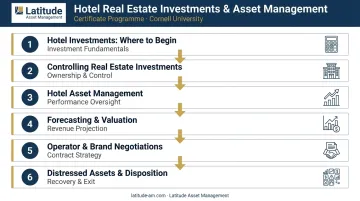
The Six-Course Curriculum
The program covers:
- Financial Analysis of Hotel Investments — ROI and ROE, mortgage sizing, franchise conversion economics, management-contract analysis, and owner/operator/lender objectives
- Control of Hotel Real Estate — ownership structures, leases, hotel management agreements, brand decisions, negotiation, and conflict between owners and managers
- Developing an Asset Management Strategy — strategic vision, portfolio role, hold-versus-sell analysis, and performance goals
- Achieving Hotel Asset Management Objectives — capital expenditure, refinancing, risk management, and strategies to improve long-term asset value
- Valuing Hotel Investments Through Effective Forecasting — occupancy, ADR, and cash-flow forecasting; market studies; income-based valuation
- Valuing Hotel Intellectual Property and Structuring the Capital Stack — brand and franchise value, mortgage features, debt and equity structures, private equity distributions, and public and private capital markets
Learning Outcomes
By completion, participants should be able to:
- Underwrite hotel acquisitions with confidence
- Assess management agreements and franchise contracts
- Evaluate capital expenditure decisions within a hold strategy
- Build asset management plans grounded in financial discipline
The program uses Excel models, competitive-set comparisons, and hotel valuation software developed with HVS International.
Faculty and Industry Credibility
The certificate is anchored by Jan deRoos, Associate Professor Emeritus and HVS Professor Emeritus of Hotel Finance and Real Estate at Cornell's Nolan School. The program carries 60 BOMI Continuing Professional Development credits, and HVS International's involvement in developing the valuation tools ensures the methodology reflects how active appraisers and investors actually approach hotel valuation.
A Real-World Example
Haizar Baiz, CEO and Head of Asset Management at Latitude Asset Management, holds this Cornell certification. His work spans hotel operations, real estate investment, and cross-border asset management across the Americas.
The credential is a visible part of how Latitude engages hotel owners, investors, and lenders — it demonstrates a structured, analytical framework for owner-side decision-making, backed by 18+ years of hands-on experience across the hotel lifecycle.
Who Should Pursue a Cornell Hospitality Certificate?
The Right Fit
Cornell hospitality certificates work best for:
- Mid-to-senior hospitality professionals looking to formalize expertise or close specific knowledge gaps
- Hotel investors and owners who want a structured framework for evaluating performance, negotiating operator agreements, and applying financial rigor to their portfolios
- Asset managers and developer representatives seeking to build credibility with institutional partners
- Commercial leaders in revenue, marketing, or F&B who want a recognized credential to complement their operational experience
For hotel investors specifically, the Real Estate Investments & Asset Management certificate is the most direct fit. It addresses the exact questions owners face: Is my operator performing? How do I evaluate this management agreement? What's my asset worth, and when should I sell?
Who Should Look Elsewhere
These programs may not be the right choice if you are:
- Seeking a full hospitality degree or academic credit
- Early in your career and needing foundational operational training
- Looking for in-person programs with heavy networking components
- Not yet in a role where the certificate content is directly applicable
The certificates assume professional context. Without it, the curriculum is difficult to apply and the concepts won't land the way they're designed to.
Career Value and Industry Recognition
Cornell's Nolan School of Hotel Administration was ranked 6th globally by CEOWORLD Magazine in its 2026 hospitality school rankings, with a score of 94.21. That ranking applies to the school itself — not to any specific eCornell certificate — but it's the institutional standing that gives the certificates their weight.
In practical terms, eCornell certificates are recognized across hospitality, hotel investment, and real estate circles. Their credibility is strongest among:
- Asset management and ownership groups
- Hotel investment advisory and brokerage firms
- Institutional investors and private equity in lodging real estate
- Development companies and lenders evaluating hotel projects
eCornell's own data claims its learners are 1.5x more likely to be promoted and 64% less likely to leave their jobs, citing Guild NPS research. Those figures apply broadly to all eCornell learners and don't break out hospitality-specific outcomes, so treat them as directional rather than definitive.
For professionals in hotel investment and asset management, demonstrating formal analytical rigor alongside operational experience is increasingly a differentiator in owner-side roles. The credential signals a structured, disciplined approach to underwriting, asset oversight, and performance analysis.

Firms like Latitude Asset Management, where the asset management team holds Cornell certification, apply that framework directly to owner engagements — translating institutional discipline into on-the-ground execution across hotel portfolios.
How to Enroll and What to Expect
The Enrollment Process
Registration is handled directly through the eCornell website. Steps are minimal:
- Browse the hospitality certificate catalog and identify the program aligned with your role
- Select your preferred start date (most programs offer rolling cohort starts)
- Complete registration and payment online — no formal application or academic prerequisites required for most programs
- Begin coursework on your scheduled start date
Pricing
Current listed prices for major hospitality certificates are approximately:
- Hotel Revenue Management — ~$3,750
- Food & Beverage Management — ~$3,750
- Hospitality Digital Marketing — ~$3,750
- Hospitality Leadership — ~$3,750
- Hotel Real Estate Investments & Asset Management — ~$3,900
Prices change and promotions apply periodically, so verify current tuition directly on the eCornell program page before committing.
Payment options include full prepayment (the lower-cost route) or monthly installment payments by credit card — no credit check required.
What the Experience Looks Like
- Format: Online, asynchronous within scheduled cohorts
- Weekly time commitment: 3–5 hours
- Completion timeline: Most hospitality certificates take 2–6 months; the Hotel Real Estate certificate is structured for approximately 3 months
- Activities: Video and text lectures, readings, case studies, quizzes, discussion forums, and practical projects
- Upon completion: Cornell University issues a professional certificate in the program area
Frequently Asked Questions
How much does a Cornell hospitality certificate (eCornell) cost?
Tuition varies by program — most hospitality certificates have been listed between $3,750 and $3,900, with the Hospitality Management 360 program priced higher. Verify current pricing at ecornell.cornell.edu before enrolling, as costs and promotions change; monthly installment options are available with no credit check required.
Are Cornell (eCornell) hospitality certificates recognized?
Yes. eCornell certificates carry Cornell University's name and are recognized across hospitality, hotel investment, and real estate. Recognition is strongest in asset management, hotel development, and institutional investment circles, where pairing operational experience with formal analytical credentials sets candidates apart.
Is Cornell University a top school for hospitality management?
Cornell's Nolan School of Hotel Administration is consistently ranked among the top hospitality schools worldwide — 6th globally by CEOWORLD Magazine in 2024. That reputation underpins eCornell's professional certificates and explains why they carry real weight with industry professionals.
What is the difference between an eCornell certificate and a Cornell degree in hospitality?
eCornell certificates are non-degree, continuing education credentials for working professionals, issued without academic credit. Cornell's School of Hotel Administration offers undergraduate and graduate degree programs requiring full-time enrollment and competitive admissions — a fundamentally different commitment and credential type.
How long does it take to complete a Cornell hospitality certificate?
Most eCornell hospitality certificates take 2–6 months to complete, depending on the program — the Hotel Real Estate Investments & Asset Management certificate is structured for roughly 3 months, typically requiring 3–5 hours per week.
Can I take Cornell hospitality courses while working full-time?
Yes — eCornell programs are built for working professionals. Courses are asynchronous with fixed cohort dates but no required login times, meaning you complete modules on your own schedule within each course period. Most participants manage coursework alongside full-time roles without significant disruption.