Introduction
A hotel franchise agreement is one of the most consequential documents an owner will ever sign. These commitments commonly run about 20 years — with some brands like Hampton by Hilton using 22-year terms for new construction — and they lock in financial obligations, brand standards, and operational requirements from day one.
Many owners assume these are take-it-or-leave-it contracts. They're not — but what's negotiable is narrower than most people expect, and how much flexibility a brand extends depends on preparation, leverage, and how well the owner executes the process.
A well-prepared owner — backed by market data, clear priorities, and advisors with real brand-side experience — typically walks away with material concessions on the terms that move the financial needle most.
What follows is a practical breakdown of what's actually negotiable, how to build leverage before you sit down, and the mistakes that cost owners the most before negotiations even get started.
Key Takeaways
- Hotel franchise agreements are negotiable — but only on specific provisions, and only before signing
- Your leverage depends on property scale, market importance, portfolio size, and the brand's regional growth priorities
- The highest-value negotiation targets: PIP timing, territory protections, key money, opening deadlines, and cure periods
- Royalty rates and brand fund assessments are effectively fixed; focus your capital on provisions that actually move
- Hotel-specific advisors — not just franchise attorneys — know which provisions brands will actually concede, and that knowledge drives better outcomes
What to Know Before You Negotiate a Hotel Franchise Agreement
Hotel franchise agreements are structurally different from retail or restaurant franchise agreements. They layer in FF&E reserve requirements, PIP obligations, loyalty program integration, brand contribution programs, and territory restrictions defined by geographic radius or competitive set — each requiring a different negotiating approach.
The FDD and Your Disclosure Window
In the U.S., the FTC's Franchise Rule requires franchisors to deliver the current Franchise Disclosure Document (FDD) at least 14 calendar days before a prospect signs any binding agreement or makes any payment. A separate 7-calendar-day period applies when the franchisor unilaterally and materially revises the proposed agreement — but this clock does not restart when changes result from franchisee-initiated negotiations.
Fourteen states maintain franchise-specific registration or notice regimes, including California, New York, Illinois, Maryland, Minnesota, and Washington. Owners should confirm both federal and state-level requirements for their deal location.
Outside the U.S., disclosure rules vary significantly:
| Market | Pre-Contract Requirement |
|---|---|
| Mexico | Specified disclosure at least 30 business days before signing (2026 regulations) |
| Colombia | No franchise-specific statute; general good-faith principles apply |
| Dominican Republic | Disclosure recommended, but no prescribed timing or format |
| Puerto Rico | Federal FTC rule applies — 14 calendar days |
How Modifications Actually Work
Once disclosure obligations are satisfied, the focus shifts to how changes actually get documented. Franchise agreements are form documents — franchisors don't rewrite them clause by clause. Agreed changes are captured through riders or addenda attached to the standard form. Owners should work with legal counsel to draft concise, precise proposed modifications before reaching the table. Any change discussed verbally or left "in progress" at signing carries no weight.
What's Fixed vs. What's Open
Before entering any discussion, owners need a clear mental map of the terrain:
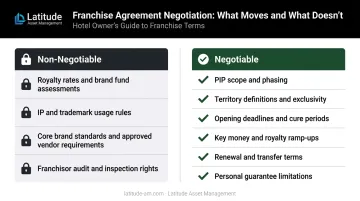
Effectively non-negotiable:
- Royalty rates and brand fund assessments
- IP and trademark usage rules
- Core brand standards and approved vendor requirements
- Franchisor audit and inspection rights
Potentially negotiable:
- PIP scope and phasing
- Territory definitions and exclusivity
- Opening deadlines and cure periods
- Key money and royalty ramp-ups
- Renewal and transfer terms
- Personal guarantee limitations
How to Negotiate a Hotel Franchise Agreement: Step by Step
Step 1: Review the FDD and Franchise Agreement Before Engaging the Brand
The FDD review period is the strategic starting point. Owners who enter brand discussions without a full picture of their financial obligations negotiate blind.
Focus your review on:
- Total fee stack — initial fees, royalties, marketing and loyalty assessments, technology fees. HVS modeled 77 brands and found average total franchise costs of 10.8% of rooms revenue, covering far more than royalty alone
- PIP requirements triggered at signing, transfer, or renewal
- Territory definitions and any existing carve-outs
- Default, cure period, and termination provisions
- Renewal rights and what the renewal agreement defaults to
Individual brand FDDs show meaningful fee variation. Hampton by Hilton's 2025 FDD shows a 6% royalty on gross rooms revenue, a 4% program services fee, and a 4.75% loyalty assessment on eligible folios, each calculated on a different revenue base. Marriott's Autograph Collection carries a 5% royalty with its own program services and loyalty structures.
These figures can't be added directly. Reviewing each FDD in full reveals the true cost of affiliation before negotiations begin.
Step 2: Define What You Actually Need to Negotiate
This is where most owners make their first mistake. Submitting a long list of changes to standard commercial terms signals poor brand fit, not negotiating strength. Brands are evaluating prospective franchisees throughout this process.
Frame the negotiation as a short, well-justified list of modifications tied to business logic. Legitimate categories of asks for hotel owners include:
- PIP phasing or cost relief tied to cash flow timing
- Key money or royalty ramp-up in early operating years
- Extended opening deadlines with realistic construction milestones
- Territory scope or right-of-first-refusal on adjacent segments
- Personal guarantee limitations or carve-outs
- Cure period extensions for technical defaults
- Enhanced pre-opening support commitments
Two or three well-supported asks land better than eight. Prioritize ruthlessly.
Step 3: Build Your Negotiating Leverage Package
Leverage in a hotel franchise negotiation isn't just about who you are — it's about what the brand needs from you.
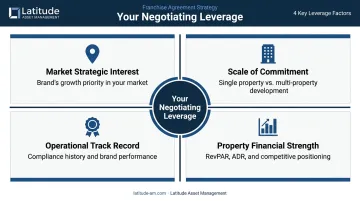
Key leverage factors:
- The franchisor's strategic interest in your specific market or property
- Scale of commitment (single property vs. multi-property development agreement)
- Your operational track record and compliance history
- The property's competitive positioning and projected financial performance
Owners should arrive with a financial model, market comp set analysis, and projected RevPAR/ADR that demonstrate the property's value to the brand. Both Hampton's and Marriott's FDDs explicitly identify system growth, number of affiliated hotels, and multi-unit circumstances as factors that may support fee adjustments — meaning portfolio-scale commitments open doors that single-property discussions don't.
Building this positioning package is where outside advisors add the most value. Firms like Latitude Asset Management bring market intelligence, financial modeling, and brand relationship insight developed from direct brand-side experience at Hyatt, Loews, and IHG — helping owners walk into negotiations with a credible, well-structured case.
Step 4: Submit a Focused Rider or Request Letter
Don't submit changes as a redlined franchise agreement. The standard mechanism is a formal written rider or addendum, drafted by legal counsel, concise, legally precise, and accompanied by clear rationale for each requested modification.
Avoid:
- Vague asks without business justification
- Challenges to royalty rates or brand fund contributions
- Requests that signal compliance risk (seeking to reduce brand standard requirements)
- Anything that reads as an adversarial position rather than a business case
The goal is to present as a credible, aligned partner making a targeted request — not as a buyer looking for maximum leverage.
Step 5: Negotiate Development Agreement Terms Separately
For multi-unit or portfolio commitments, the development agreement is typically more flexible than the franchise agreement itself. Opening timelines, site approval processes, and territorial development rights are all more moveable in this document.
This flexibility matters most in cross-border markets. In Latin America, the Caribbean, and Mexico — where the hotel construction pipeline grew 6% year-over-year in Q1 2026 with early-planning projects up 12% — owners should push hard on realistic development schedules. Local permitting timelines, construction cycles, and market entry risk are structural realities brands in these markets understand. The development agreement is the right place to address them.
Key Hotel Franchise Agreement Terms That Are (and Aren't) Negotiable
Non-Negotiable Terms
Brands protect these provisions consistently, regardless of owner size or leverage:
- Royalty rates and brand fund assessments — modifying them for one owner creates system-wide inequity and legal exposure. No credible brand makes exceptions here
- IP, trademark, and brand standards compliance (these define the product guests purchase and are non-negotiable)
- Audit and inspection rights — non-negotiable across every major flag
- Approved vendor lists and technology platforms (pushing back on these signals misalignment with the brand's consistency model and rarely goes anywhere)
Negotiable Terms
Territory Hotel franchise territories are typically defined by geographic radius or competitive set exclusion. Owners can push for:
- Clearer exclusivity terms with defined boundaries
- Right-of-first-refusal on adjoining territories or adjacent brand segments
- Carve-out protections for specific market segments or property types
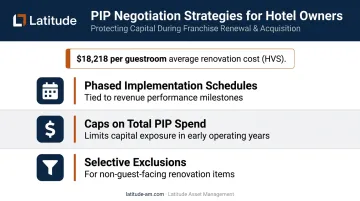
PIP Timing and Scope This is one of the highest-value negotiation points. Property Improvement Plans triggered at signing or transfer represent significant capital exposure — HVS cited $18,218 per guestroom as the 2019 average for guestroom renovation alone. CoStar reporting confirms that phased implementation around cash flow and low-demand periods is a documented accommodation brands have made. Owners can negotiate:
- Phased implementation schedules tied to revenue performance
- Caps on total PIP spend in early operating years
- Selective exclusions for non-guest-facing renovation items
Key Money and Opening Support When a brand is chasing pipeline growth in an underrepresented territory, financial contributions and royalty ramp-ups are worth requesting. Both Hilton (300+ operating CALA hotels across 35 countries) and IHG (nearly 400 open and pipeline properties across Mexico, Latin America, and the Caribbean) carry active regional growth mandates. That expansion pressure is negotiating leverage for owners in those markets.
Renewal, Transfer, and Exit Terms Well-precedented requests include:
- Renewal rights that don't revert entirely to the then-current standard form
- Transfer fee modifications for ownership transitions
- Extended cure periods for technical defaults
- Early termination provisions with clearer triggers
Common Mistakes to Avoid
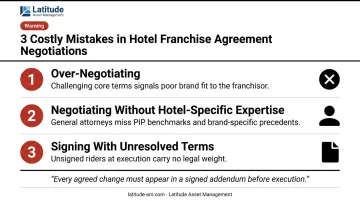
Three patterns consistently derail hotel franchise negotiations — often at the worst possible moment.
Over-negotiating. Brands evaluate prospective franchisees during the negotiation itself. An owner who challenges core commercial terms or submits sweeping redlines signals poor fit. Keep the ask list short and strategically focused — brands notice when owners pick the right battles.
Negotiating without hotel-specific expertise. General franchise attorneys unfamiliar with hotel brand dynamics miss negotiable terms that experienced advisors identify immediately — PIP cost benchmarks, key money norms, territorial carve-outs, and brand-specific precedents. Latitude Asset Management's team includes former brand executives from Hyatt, IHG, and Loews who understand how brand teams evaluate deals internally and where they have room to move.
Signing with unresolved terms. Once the franchise agreement is executed, virtually nothing can be renegotiated. Owners who sign under time pressure — with riders still "in discussion" — typically find those concessions were never formalized. Every agreed change must appear in a signed addendum before execution. No exceptions.
Frequently Asked Questions
Can you negotiate a franchise agreement?
Yes. Most changes occur through a formal rider or addendum process rather than alterations to the base form. How much a franchisor will modify depends on their growth priorities, the owner's leverage, and which provisions are being requested : commercial terms move rarely, while operational and relational provisions move more often.
What is the 70/30 rule in franchise negotiations?
The "70/30 rule" is a general principle — not a formally recognized industry benchmark — suggesting franchisors hold firm on roughly 70% of the agreement. The non-negotiable portion consistently covers commercial terms (royalties, brand fund, standards compliance), while the negotiable zone focuses on operational provisions like PIP timing, territory, and opening deadlines.
What is the 7-day rule for franchise agreements?
The FTC's current franchise rule requires franchisors to deliver the FDD at least 14 calendar days before signing, not 7. A separate 7-calendar-day period applies only when a franchisor unilaterally and materially revises the proposed agreement; it does not apply to franchisee-initiated negotiations. Older state statutes may reference 7 days, but the federal 14-day requirement governs most U.S. transactions.
What hotel franchise agreement terms carry the highest financial impact?
PIP requirements, the combined royalty and brand assessment fee stack (which HVS found averages 10.8% of rooms revenue across 77 brands), key money eligibility, and renewal terms carry the greatest long-term financial consequences. PIP scope at transfer and renewal terms that revert to current standard form are particularly consequential for investors with a defined exit horizon.
How long does it take to negotiate a hotel franchise agreement?
No industry benchmark exists for negotiation duration. Single-property negotiations with a focused rider typically resolve within several weeks to a few months, depending on brand review cycles. Multi-property development agreements take longer given the added complexity of territorial development rights and opening schedule provisions.
Do I need an asset manager to negotiate a hotel franchise agreement?
A franchise attorney handles the legal documentation. A hotel asset manager brings market positioning data, brand relationship experience, and financial modeling that strengthens the owner's negotiating case : inputs legal counsel doesn't typically provide. For complex, cross-border, or multi-property deals, that combination is particularly valuable. The two roles are complementary, not interchangeable.