
This guide explains what strategic portfolio management (SPM) means specifically for hotel asset ownership — not as a software category or corporate IT function, but as an investment discipline that connects individual asset decisions to portfolio-wide objectives across the Americas and beyond.
Key Takeaways
- SPM in hotel investing means aligning capital allocation, asset strategy, and operations across all properties toward shared investor objectives
- A well-managed portfolio requires clear asset segmentation, defined roles for each property, and consistent performance benchmarking
- Implementation follows a structured sequence: portfolio audit → goal-setting → capital prioritization → performance monitoring → rebalancing
- Cross-border and multi-brand portfolios demand regional expertise that generic frameworks cannot provide
- Strong asset management partners connect operations, real estate, and finance — closing the gaps that erode returns over time
What Is Strategic Portfolio Management in Hotel Investing?
Strategic portfolio management is a structured, top-down approach to overseeing a collection of hotel assets. It involves making deliberate decisions about which properties to acquire, hold, reposition, or exit — based on how each contributes to the investor's overall return objectives and risk tolerance.
This is distinct from property management or day-to-day operations. SPM operates at the ownership and investment level, evaluating each asset not in isolation but as part of a larger portfolio with shared capital, interdependencies, and unified goals.
SPM vs. Traditional Asset Management
Traditional asset management asks: How is this hotel performing? Strategic portfolio management asks harder questions:
- Is this asset still aligned with our portfolio thesis?
- Is capital better deployed elsewhere?
- Does this property strengthen or dilute our overall risk-adjusted return profile?
These questions share the same DNA as enterprise-level SPM. Forrester's 2017 Wave report described the discipline as delivering "seamless traceability from strategy through execution," with unified planning and feedback loops for funding and prioritization. The same principles apply directly to hotel portfolio ownership:
- Strategic alignment between assets and investment thesis
- Resource prioritization across competing capital needs
- Continuous performance review at the portfolio level
- Adaptive decision-making as market conditions shift
Who Drives SPM in a Hotel Context?
SPM is driven by asset managers, investment committees, and portfolio-level advisors — not operators. It requires practitioners who can read both the financial structure and the operational reality of each asset simultaneously. That dual fluency — across capital markets and hotel operations — is what separates portfolio-level advisory from conventional investment oversight.
Key Components of a Strategic Hotel Portfolio
Asset Segmentation and Role Definition
Every property should have a clearly defined role:
- Core — stable income, lower risk, predictable cash flows
- Value-add — repositioning opportunity, operational improvement upside
- Opportunistic — higher risk, higher return, development or turnaround scenarios
Mixing these categories without intent produces an incoherent strategy. A core asset managed with opportunistic-level capital deployment will underperform. An opportunistic asset managed with core-level caution will never realize its upside.
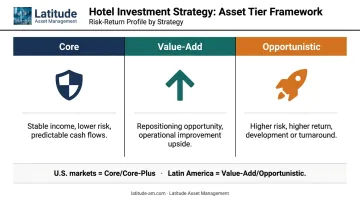
Geographic context matters here too: U.S. hotel markets tend to suit core and core-plus strategies given their stability and liquidity, while Latin American markets align better with value-add and opportunistic approaches due to growth arbitrage and favorable entry pricing.
Brand and Market Diversification
Strategic portfolios balance:
- Geographic exposure — across markets with different demand cycles (U.S., Mexico, Caribbean, Colombia, Brazil)
- Brand affiliation — franchise vs. independent vs. soft brand, each with different capital requirements, fee structures, and exit liquidity profiles
- Demand drivers — leisure, corporate, and group travel respond differently to economic cycles
CBRE's study of 50 U.S. hotel brands found that only 30% generated above-average RevPAR growth from 2018–2023, down from 52% in the prior five-year period. Brand selection is a strategic financial decision — not a marketing one.
Capital Allocation Framework
SPM requires a defined process for allocating capital across assets — for renovations, PIP compliance, repositioning, or acquisitions — based on:
- Projected return on investment
- Asset lifecycle stage
- Strategic fit with portfolio goals
A multi-year capital plan sequences investments by priority, phasing, and risk profile rather than distributing resources reactively or evenly across properties.
Operating Model Alignment
Capital decisions don't exist in isolation — they depend on who is running the asset and how. Each hotel's management structure — owner-operated, third-party managed, or franchised — must align with the investor's level of involvement and strategic intent.
Misalignment between operating model and ownership objective is one of the most common sources of value leakage in hotel portfolios. A franchised asset with minimal owner oversight may drift on brand compliance; a third-party managed asset without clear performance accountability can erode NOI steadily over years.
Performance Benchmarking
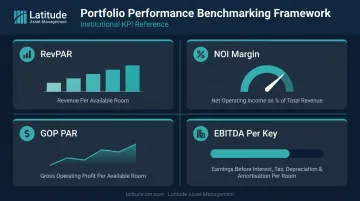
SPM requires consistent KPIs across all assets — RevPAR, NOI margin, GOP PAR, EBITDA per key — so underperformers can be identified, root causes diagnosed, and corrective action taken at the portfolio level rather than treated as isolated operational issues.
Why Strategic Portfolio Management Matters for Hotel Investors
Hotel Volatility Makes Static Strategies Dangerous
Hotel assets are among the most cyclically sensitive real estate categories. STR data shows that U.S. RevPAR fell 16.7% in 2009 — the largest single-year decline on record at the time. In 2020, occupancy collapsed to 44% and RevPAR dropped 47.5%, erasing years of gains in a matter of months.
Investors without a portfolio-level strategy tend to:
- Over-concentrate in certain markets or property types
- Miss early signals of underperformance
- Make capital allocation decisions reactively, after problems compound
SPM builds in continuous evaluation so that risk exposure is understood and managed before a crisis reveals it.
Capital Misallocation: The Cost of No Framework
Limited capital deployed without a strategic framework tends to flow toward the most visible or most recent problem — not the highest-value opportunity. Bain's 2024 research found that 88% of business transformations fail to achieve their original ambitions — often because execution capacity is overloaded and resources are misaligned with strategic priorities.
In hotel portfolio terms, this plays out as renovation budgets that go to the wrong properties, operator relationships that persist past their useful life, and acquisitions that dilute rather than strengthen the portfolio.
Value Creation vs. Value Preservation
There's a meaningful difference between hotel owners who protect the status quo and those who actively drive value creation. SPM enables the latter by creating clear action plans at each phase of the ownership lifecycle:
- Strategic repositioning to capture demand shifts or close competitive gaps
- Brand and operator renegotiations when existing agreements no longer serve ownership
- Targeted capital improvements timed to maximize return before refinancing or exit

Holding assets isn't the goal. Advancing each one toward its highest-value outcome is.
How to Implement Strategic Portfolio Management Across Hotel Assets
1. Conduct a Full Portfolio Audit
Map the current state of every asset: ownership structure, brand affiliation, management contract terms, physical condition, competitive positioning, and financial performance relative to market benchmarks.
This baseline reveals misalignments, underperformers, and hidden opportunities before any strategic decisions are made. Assets that look healthy in isolation may be underperforming against their competitive set, or consuming capital that would generate better returns elsewhere.
That picture of where capital is working — and where it isn't — is what makes objective-setting meaningful rather than aspirational.
2. Set Portfolio-Level Objectives
Define what success looks like at the portfolio level:
- Target IRR and income stability requirements
- Geographic diversification goals
- Exit horizon by asset class or geography
- Risk tolerance across the core/value-add/opportunistic spectrum
Without shared objectives, individual asset decisions default to short-term optimization. Each property ends up managed in isolation, pulling in different directions.
3. Prioritize Capital and Resources
With objectives set, allocate capital to initiatives (renovations, repositioning, acquisitions, or selective dispositions) based on their projected contribution to portfolio-level returns. Build a multi-year capital plan that:
- Sequences investments by priority, phasing, and risk profile
- Accounts for brand PIP requirements and asset lifecycle stage
- Directs capital where it earns the highest return, not where it's easiest to justify
4. Monitor Performance Continuously
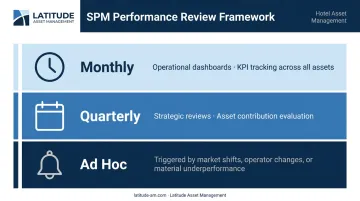
Implement a performance monitoring framework with defined reporting cadences:
- Monthly: Operational dashboards tracking KPIs across all assets in consistent format
- Quarterly: Strategic reviews evaluating each asset's contribution to portfolio objectives
- Ad hoc: Off-cycle reviews triggered by market shifts, operator changes, or material underperformance
Flag variances early. Underperformance compounds — what looks like a soft quarter can become a structural problem if the root cause isn't addressed at the operator, brand, or ownership level.
5. Rebalance and Adapt
Market conditions shift, operators underperform, and assets reach natural exit points. Build a structured process for regular portfolio rebalancing — including hold/sell/reposition analysis — so the portfolio stays aligned with investor objectives across changing market cycles and hold-period realities.
Common Challenges in Hotel Portfolio Management
Market volatility and demand cycles: Hotel cash flows are highly sensitive to macroeconomic conditions. The 2009 and 2020 downturns each wiped out years of RevPAR growth within months. Static portfolio strategies have no mechanism to respond before damage compounds.
Cross-border complexity: Managing properties across the U.S., Mexico, the Caribbean, and Latin America means navigating different regulatory environments, tax structures, brand penetration levels, and labor markets. Currency and political risk require local expertise layered on top of institutional discipline — not generic frameworks applied across markets.
Operator and brand misalignment: Poorly negotiated management contracts and franchise agreements can erode returns even from well-located, well-capitalized assets. Weak termination provisions, incentive structures that favor operator continuity over owner performance, and unenforced brand compliance requirements are all common sources of value leakage that SPM is specifically designed to identify and address.
Working with a Strategic Hotel Asset Management Partner
The right hotel asset management partner brings more than financial modeling. Look for:
- Hands-on operational experience — executives who have run hotels, not just modeled them
- Regional market knowledge in key target geographies: Mexico, the Caribbean, and Latin America
- Established relationships with brands and operators that translate into stronger contract terms
- A clear owner's advocacy role throughout the full investment lifecycle
Latitude Asset Management brings this combination across the Americas. The firm's team includes Cornell-certified hotel investment professionals, a CFA charterholder leading financial analysis and scenario modeling, and former brand executives with decades of experience at Hyatt, Loews, and IHG. Regional partners embedded in Mexico, the Caribbean, and Colombia add the local depth that cross-border portfolios require.

That combination matters because hotel performance problems rarely stay in one lane. When a branded property underperforms, the answer may sit in operator contract terms, market positioning, capital allocation, or all three. A partner with depth across those areas can identify the real issue — and move on it.
Frequently Asked Questions
What is strategy and portfolio management?
Strategy is the high-level direction an investor or organization sets for itself. Portfolio management is the structured process of selecting, prioritizing, and overseeing a collection of assets to achieve that strategy. In hotel investing, this means aligning asset-level decisions — acquisitions, capital allocation, operator oversight — with investor-defined return objectives across the full portfolio.
What are the 4 types of portfolio management?
Active management seeks to outperform a benchmark through selection and timing; passive tracks a benchmark with minimal changes. Separately, discretionary managers execute transactions under prior authorization, while non-discretionary managers advise but leave final decisions to the client. These are two independent dimensions — not four mutually exclusive types.
What is the 70/20/10 strategy in portfolio management?
The 70/20/10 framework allocates capital across risk tiers: 70% to core/stable assets, 20% to value-add opportunities, and 10% to higher-risk bets. Hotel investors apply similar logic to balance income stability with growth — though no hotel-specific standard version exists.
What are the 5 P's of strategic management?
Mintzberg's framework identifies five P's: Plan, Ploy, Pattern, Position, and Perspective. Each applies directly to hotel portfolio management — from defining your investment thesis (Plan) to building a consistent capital allocation track record (Pattern).
How does strategic portfolio management differ from regular asset management for hotels?
Regular asset management focuses on maximizing performance at the individual property level. Strategic portfolio management operates at the ownership level — evaluating how each asset contributes to portfolio-wide objectives, risk profile, and capital allocation priorities. SPM asks whether a property belongs in the portfolio at all, not just whether it's running well.
How often should hotel investors review their strategic portfolio?
At minimum, quarterly operational reviews and annual strategic portfolio reviews. Additional off-cycle reviews should be triggered by major market shifts, operator changes, brand renegotiations, or significant capital events. Tying your review cadence to material developments, not just the calendar, keeps strategic decisions grounded in current conditions.