Introduction
Most hotel investments don't fail because of bad locations or weak markets. They fail because no one is watching closely enough.
Operations run daily. Budgets get approved. Management agreements get signed. Without a consistent process to verify that everything is performing as intended, financial leakage compounds quietly, compliance gaps widen, and returns fall short of what the underwriting projected. Operational oversight exists to close that gap.
Operational oversight is the structured discipline that connects ownership intent to operational reality. It ensures that what's supposed to happen is actually happening, and that deviations get caught before they become crises.
This guide covers:
- What operational oversight means (and what it isn't)
- The five core components of an effective framework
- How to build a practical oversight strategy
- The KPIs that make oversight measurable
- What oversight looks like in a real hotel investment context
What Is Operational Oversight?
Operational oversight is the continuous, structured process of monitoring, evaluating, and guiding an organization's operations to ensure they remain aligned with strategic goals, comply with relevant standards, and produce intended outcomes.
The word continuous matters. Oversight is not a quarterly check-in or an annual audit. It's an ongoing function — one that requires an independent or elevated vantage point, separate from day-to-day execution.
What Operational Oversight Is Not
Two confusions come up consistently.
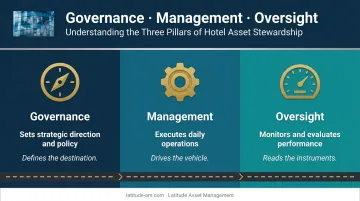
Oversight is not governance. Governance sets the direction — board-level decisions, strategic policies, investment mandates. Oversight ensures those directives are actually being carried out across daily operations. Both are necessary; neither substitutes for the other.
Oversight is not management. Management executes: it runs operations, manages staff, and fulfills daily functions. Oversight evaluates whether execution is working and identifies where it needs correction. As Cornell's eCornell hotel asset management program describes it, the asset manager's role is to strategically oversee operations against the owner's investment objectives — not to run them.
Understanding where each function begins and ends is what allows ownership groups, boards, and asset managers to hold operators accountable without undermining them.
| Function | Primary Role | Relationship to Operations |
|---|---|---|
| Governance | Sets strategic direction and policy | Defines the destination |
| Management | Executes daily operations | Drives the vehicle |
| Oversight | Monitors and evaluates performance | Reads the instruments |
Key Components of an Operational Oversight Framework
Effective oversight isn't a single tool or meeting. It's a layered system where five components work together. Weaken any one of them and the whole structure develops blind spots.
Governance and Accountability Structures
Oversight begins with clarity on who is responsible for what. Without named accountability, monitoring loses its teeth — findings surface, but no one owns the response or drives resolution.
Governance structures define:
- Who holds decision-making authority at each level
- What requires escalation vs. what can be resolved locally
- How reporting lines connect ownership, management, and oversight functions
In hotel investment, ISHC notes that most Hotel Management Agreements give the operator exclusive authority to run the property — meaning the owner's oversight depends almost entirely on negotiated contractual rights: information rights, approval rights, performance tests, and termination provisions. Governance isn't abstract; it's the contract.
Policies, Procedures, and Standards
Without defined standards, there's no benchmark — and without a benchmark, monitoring produces observations rather than findings. Policies give oversight something concrete to evaluate against.
Well-documented, regularly updated policies:
- Give operational teams clear expectations to execute against
- Give oversight functions a measurable baseline for evaluation
- Require review when regulations change, business conditions shift, or new management agreements take effect
Monitoring, Reporting, and Data Visibility
Dashboards, performance reports, and variance analyses are where oversight moves from intention to practice — the mechanisms that let leadership identify deviations before they compound.
HVS's documented asset management scope includes monthly financial analysis and review of material budget variances — establishing a cadence that catches issues within the reporting cycle rather than after the quarter closes.
Three decisions shape whether this works in practice:
- What data points actually signal performance or risk
- At what frequency reports need to reach decision-makers
- Who holds review responsibility and escalation authority
Risk Identification and Management
Strong oversight frameworks don't wait for problems to surface. They build proactive risk review into the operational cycle — identifying financial, regulatory, reputational, and operational risks before they escalate.
This includes:
- Regular risk assessments tied to business conditions
- Defined escalation protocols when risks exceed acceptable thresholds
- Distinction between risks that can be absorbed locally and those requiring ownership-level decisions
Compliance and Regulatory Adherence
Compliance is not a checkbox event. In multi-jurisdictional businesses — hotel investors operating across the U.S., Mexico, and the Caribbean, for example — complexity multiplies fast. Labor law, environmental obligations, brand standards, and franchise requirements vary by market and demand ongoing monitoring, not one-time review.
Effective compliance oversight:
- Builds checks into operational routines rather than treating audits as isolated events
- Maintains audit-ready documentation across all operating jurisdictions
- Ensures staff at every level understand their obligations and reporting requirements
How to Build an Effective Operational Oversight Strategy
Having the right components matters. Putting them to work — consistently, in the right order — is where most oversight frameworks either hold or break down. The steps below provide a practical sequence for building oversight that actually drives decisions.
Step 1: Define Oversight Objectives Tied to Business Goals
Before designing any monitoring system, answer: what are you protecting or optimizing?
- Financial performance against underwriting assumptions?
- Regulatory compliance across multiple jurisdictions?
- Operator performance relative to agreed benchmarks?
- Asset value ahead of a planned disposition?
Oversight objectives that aren't tied to specific business goals tend to drift toward generic reporting — producing data that no one acts on.
Step 2: Assign Ownership and Build Accountability
Every oversight function needs a named owner — an individual or team responsible for monitoring a specific area, escalating issues, and reporting outcomes.
Without named ownership, oversight becomes diffused across teams. Everyone assumes someone else is watching — and that assumption holds until a financial shortfall or compliance breach makes the gap impossible to ignore.
Step 3: Establish Monitoring Cadences and Reporting Rhythms
Not all data requires the same frequency. A practical approach:
| Risk Level | Monitoring Cadence |
|---|---|
| High-risk operational data | Real-time or daily |
| Financial performance | Monthly |
| Strategic KPI review | Quarterly |
| Framework and policy review | Annual (or triggered by change) |
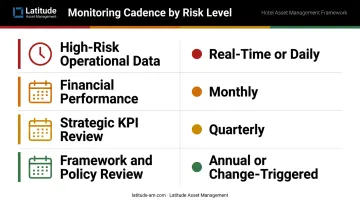
Irregular reporting creates blind spots. Consistency matters more than sophistication.
Step 4: Integrate Fit-for-Purpose Technology
Modern oversight depends on tools that aggregate data and surface meaningful signals. The right tools depend on the industry and scale:
- Hotel investors rely on competitive benchmarking platforms (such as STR Benchmark) for market positioning data
- ERP and property management systems provide operational visibility
- Business intelligence dashboards consolidate financial performance
Choose tools that match your operational scale. Complexity for its own sake creates noise, not visibility.
Step 5: Build Feedback Loops and Corrective Action Processes
Oversight only earns its value when it closes the loop. Findings from monitoring must:
- Feed directly into decisions, not accumulate in unread reports
- Generate corrective actions that are assigned and tracked to resolution
- Be reviewed for outcomes to confirm whether the intervention worked
This cycle — monitor, find, correct, verify — is what separates oversight from surveillance. When this loop runs consistently, improvement stops being a separate project and starts being a byproduct of how the organization already operates.
Measuring Success: KPIs and Performance Metrics for Operational Oversight
Oversight needs to be measurable. Subjective assessments leave too much room for interpretation; KPIs establish an objective baseline for evaluating whether operations are performing as intended and whether the oversight system itself is working.
Operational Efficiency Metrics
These track how well the business is executing its core processes:
- Throughput and turnaround times
- Error rates and service recovery rates
- Resource utilization (labor hours, occupancy of support functions)
When tracked consistently, these metrics pinpoint exactly where operational drag is concentrated — and whether corrective interventions are moving the numbers.
Financial Performance Indicators
Financial KPIs are often the clearest signal of operational health. In hotel investment specifically, the metrics that matter most aren't just revenue-side:
STR's 2024 U.S. hotel data illustrates why: TRevPAR rose 7.2% in 2024, but GOPPAR rose only 3.2% and EBITDA PAR only 2.5%. Revenue grew; profit conversion didn't keep pace. Labor cost per available room reached $72.44, up 11.2%. Investors tracking only revenue would have missed the margin compression entirely.
Key hotel financial KPIs for investor oversight:
- RevPAR — revenue per available room, the primary top-line indicator
- RevPAR Index (RGI) — hotel RevPAR relative to competitive set (100 = parity)
- GOPPAR — gross operating profit per available room
- EBITDA PAR — profit after fixed charges, per available room
- GOP margin — CoStar benchmarks suggest 25–35% for full-service hotels, 40–50% for select-service
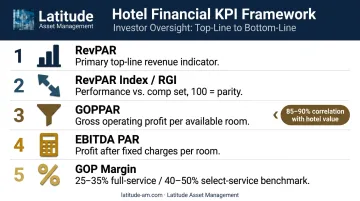
HVS research notes that GOPPAR has an 85–90% correlation with hotel value, compared with approximately 70–75% for RevPAR — making profit-based monitoring the stronger investment signal.
Compliance and Risk Metrics
Profit metrics tell you how much value is being created; compliance metrics tell you how much is at risk of being lost. Compliance can be tracked through measurable indicators:
- Audit findings (open vs. resolved)
- Regulatory incident rates
- Policy adherence scores
- Unresolved risk items by category and age
The trend matters as much as the snapshot. A rising count of unresolved audit findings, even in a profitable operation, signals that structural exposure is building.
Stakeholder and Performance Feedback Metrics
Financial data alone misses signals that qualitative metrics catch earlier:
- Guest satisfaction scores and review trends
- Employee feedback and turnover rates
- Operator performance reviews against agreed benchmarks
In split ownership structures, where the asset owner and operator are separate parties, regular feedback loops between both sides are built into effective oversight — not layered on top of it as an afterthought.
Common Challenges in Operational Oversight and How to Address Them
Resource Constraints and Competing Priorities
The most common reason oversight breaks down: the team is too busy running operations to monitor them. Oversight gets deprioritized in favor of execution demands.
The fix is structural, not motivational. Oversight roles and reporting cadences must be protected commitments — scheduled, owned, and non-negotiable — not optional meetings that get rescheduled when operations get busy.
Complexity in Multi-Location or Multi-Jurisdictional Operations
Oversight becomes far more complex when assets span multiple properties, markets, or regulatory environments. Labor law in Mexico differs from the U.S.; environmental requirements in Caribbean tourism markets involve distinct frameworks; brand compliance obligations vary by flag.
For investors operating across the Americas, this complexity demands:
- Standardized reporting formats that accommodate regional variation
- Centralized visibility tools that aggregate performance across geographies
- Regionally embedded expertise — partners who understand local regulatory and commercial environments, not just central teams applying uniform templates
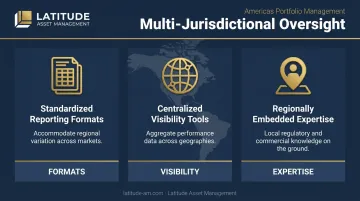
That last point is often the hardest to staff. Latitude Asset Management's regional structure illustrates one approach: Germán Ongay covers Mexico with 40+ years of in-market experience, Olmedo Herrera leads Latin American operations from Colombia, and Simon Lagardera handles Caribbean engagement. Each brings on-the-ground regulatory and market knowledge that a single central office cannot replicate.
Cultural Resistance and Lack of Buy-In
Even the best-designed oversight system runs into friction if operational teams see it as surveillance rather than support. That perception is more common than most investors expect, and it quietly undermines reporting quality and cooperation.
Shifting that dynamic requires:
- Framing oversight as a performance enabler, not a compliance burden
- Involving operational teams in defining the standards they'll be measured against
- Sharing oversight findings transparently — so teams see the insights, not just the consequences
The goal is a feedback loop, not a report card. Teams that trust the process contribute to it — and that contribution makes the data more accurate and the interventions more effective.
Operational Oversight in Hotel Investments: What It Really Looks Like
In hotel investment, operational oversight has a structural challenge built in: the owner and the operator are typically different parties. The investor owns the asset; a management company runs it. This separation, formalized in a Hotel Management Agreement, creates an inherent oversight gap that must be actively managed.
ISHC notes that the operator generally controls hotel operations under the HMA, with the owner's control rights depending on negotiated provisions: information rights, approval rights, performance tests, and termination remedies. With nearly 50% of branded hotels globally managed by third parties, this oversight gap is the norm, not the exception.
What Hotel Operational Oversight Actually Covers
Effective oversight in this context is not passive review. It includes:
- Monthly financial statement analysis — comparing actual results against budget, flagging material variances
- RevPAR index monitoring — tracking competitive positioning against the property's comp set
- Brand standard compliance — verifying the operator is meeting franchise and flag obligations
- Capital expenditure oversight — ensuring reinvestment decisions align with asset value objectives
- Operator management quality — evaluating whether the management team is executing with the discipline and capability the investment requires
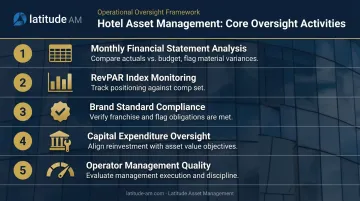
These activities are how investors verify that their asset is being managed in their interest, not merely occupied and operated.
The Role of a Professional Asset Manager in Operational Oversight
For hotel investors managing multiple properties or deploying capital across the Americas, engaging a specialized hotel asset management firm provides the structured, ongoing oversight that internal teams rarely have the bandwidth or hospitality expertise to execute.
Latitude Asset Management defines its oversight role explicitly as acting as the owner's proxy: positioned between the investor and the operator, holding the management company accountable to the ownership's investment objectives. This is active, on-the-ground accountability, not advisory from a distance. The scope covers performance management, capital planning oversight, and operator accountability at every asset.
That credibility starts with the team executing it:
- Haizar Baiz (CEO): 18+ years across hotel operations, brand representation, and investor advocacy across the Americas
- Anthony Del Gaudio (Chief Business Development Officer): 35 years spanning Hyatt, Loews, and IHG, with deep expertise in asset repositioning and multi-property portfolio management
When an asset manager walks into an operator review with that background, the conversation is different. Accountability is specific, and performance gaps are harder to rationalize away.
That's what structured oversight actually delivers: clear visibility into what's happening at each asset, measured against what ownership committed to when the investment was made.
Frequently Asked Questions
What is the meaning of operational oversight?
Operational oversight is the structured, ongoing process of monitoring and evaluating an organization's operations to ensure they align with strategic goals, comply with relevant standards, and perform as intended. It encompasses both internal controls and accountability mechanisms, and sits between governance (which sets direction) and management (which executes).
What's the difference between governance and oversight?
Governance sets the rules, direction, and policies — typically at the leadership or board level. Oversight ensures those rules are being followed in practice across daily operations. Both are necessary, but they operate at different levels: governance defines intent, oversight verifies execution.
What is administrative and operational oversight?
Administrative oversight focuses on compliance with policies, procedures, and regulatory requirements. Operational oversight focuses on the efficiency, performance, and alignment of day-to-day business processes. Effective oversight programs address both — regulatory adherence without operational performance monitoring leaves significant gaps.
Who is responsible for operational oversight in a business?
Responsibility is shared across levels. Senior leadership sets the oversight framework; middle management monitors execution within their functions. In complex ownership structures (such as hotel investments with third-party operators), a dedicated asset manager is often engaged to provide independent monitoring on behalf of the owner.
What are the key components of an effective operational oversight framework?
The five core pillars are: governance and accountability structures, defined policies and standards, monitoring and reporting systems, risk identification and management, and compliance mechanisms. All five must function together — gaps in any single component create blind spots across the whole framework.
How does operational oversight differ from day-to-day management?
Management executes tasks and runs operations. Oversight evaluates whether execution is working, identifies gaps, and drives corrective action. Effective oversight requires an independent vantage point separate from daily operational responsibilities, which is why hotel owners with third-party operators typically engage a dedicated asset management function.