
Introduction
Hotel development, renovation, and brand conversion projects involve dozens of moving parts — architects, general contractors, brand technical teams, local regulators, franchise executives, and lenders — all running on parallel tracks.
Most hotel owners aren't equipped to manage every decision, review every pay application, and attend every coordination meeting at once. That's where an owner's representative comes in: a professional hired to act as the owner's eyes, ears, and voice throughout the project.
This guide covers what an owner's representative agreement is, what it should include, how owner's reps are compensated, and what hotel owners specifically need to know before signing one.
Getting the agreement right matters from day one. A poorly structured contract leads to scope creep, unclear authority, and costly disputes. A well-drafted agreement defines the rep's authority, deliverables, and accountability before the project starts — and holds up through every phase that follows.
Key Takeaways:
- An owner's rep agreement defines who protects the owner's interests and how, across all project phases
- Authority limits, scope, compensation, and dispute resolution must all be spelled out explicitly
- AIA C104-2024 provides the standard legal framework but requires hotel-specific customization
- Hotel projects add hospitality-specific complexity — brand reviews, PIPs, FF&E procurement — that generic templates don't address
- Compensation structures vary: lump sum, hourly, fee-plus-expenses, and percentage-of-cost are the four CMAA-recognized models
What Is an Owner's Representative Agreement?
An owner's representative agreement is a professional services contract between a property owner and a hired adviser responsible for overseeing and advocating for the owner's interests across all project phases — from planning and procurement through construction and closeout. It is also referred to as an owner's rep contract or OPM (owner's project manager) agreement.
What distinguishes this contract from an architect or contractor agreement is its focus. Architect agreements define what will be designed; contractor agreements define what will be built. The owner's rep agreement defines who will protect the owner's decision-making authority, budget control, and schedule oversight on their behalf.
The AIA C104-2024 Standard
The current industry reference document is AIA C104-2024, Standard Form of Agreement Between Owner and Owner's Representative, released by AIA as part of its Spring 2024 document update. It applies to projects of any size and any payment method.
A few critical points about C104-2024:
- It gives the representative an advisory role with limited authority — not direct authority over contractors or subcontractors
- AIA recommends attorney review before designating the owner's rep in other AIA agreements, as those forms may confer broader authority than C104 intends
- The document is industry-generic, with no hotel-specific provisions for brand compliance, PIPs, FF&E procurement, or pre-opening coordination
C104-2024 is a useful legal skeleton. For hotel projects, it must be supplemented with hospitality-specific exhibits and scope language that a standard construction template won't cover on its own.
Key Responsibilities of an Owner's Representative
The owner's rep does not manage construction directly. Their role is advisory and monitoring — attending meetings, reviewing submittals, tracking budgets, and surfacing issues before they escalate. This distinguishes the role from a construction manager-at-risk, who assumes direct authority over trades and construction performance responsibility.
Pre-Construction and Team Assembly
During project initiation, the owner's rep typically:
- Vets and recommends architects, general contractors, and specialty consultants
- Reviews competing bids on a comparable, apples-to-apples basis
- Flags past performance issues before contracts are executed
- Sets preliminary milestones and scheduling targets
Design-phase duties shift toward translation and review. The rep conveys the owner's goals to the design team, reviews drawings for budget and program alignment, evaluates value engineering alternatives, and attends governmental approval meetings on the owner's behalf.
Construction Monitoring and Budget Oversight
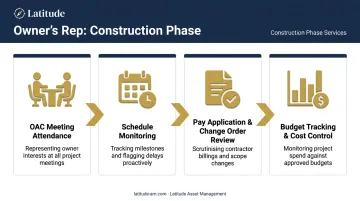
Active construction-phase duties include:
- Attending owner-architect-contractor (OAC) meetings
- Monitoring schedule adherence against established milestones
- Reviewing pay applications and change orders before owner approval
- Verifying that completed work meets contract specifications
Budget tracking is continuous. The owner's rep monitors project costs against the approved budget, flags overruns early, and provides objective analysis before the owner approves contractor invoices — reducing the risk of overbilling or unauthorized scope expansion.
CMAA's Owners Guide to Construction and Program Management identifies budget control, cost and schedule oversight, constructability review, and value engineering as core owner-side functions — all of which fall within the advisory owner's rep scope.
Project Closeout
Closeout is where many projects lose value due to incomplete follow-through. The owner's rep manages:
- Confirming project completion against contract documents
- Managing punch lists and tracking resolution
- Collecting warranties, as-built drawings, and subcontractor documentation
- Coordinating training or handover materials
For hotel projects, closeout connects directly to operational launch. Incomplete documentation or delayed handover can push opening timelines and create brand compliance gaps that are difficult to recover from.
What an Owner's Representative Agreement Should Include
Every project is different, but a comprehensive owner's representative agreement should address six core areas. Missing any of them creates risk.
Project Description and Scope of Services
The agreement must include a detailed project description — address, building type, intended use, and scale — combined with an explicit scope of services listing exactly what the owner's rep will and will not do.
Vague scope language is the most common source of disputes. The agreement should specify:
- Which project phases are covered
- Which meetings require attendance
- What reporting deliverables are expected and at what frequency
- What falls outside the engagement (exclusions matter as much as inclusions)
Authority and Decision-Making Limits
Authority limits determine who can commit the project — and to what. The agreement must define the owner's rep's authority ceiling: what decisions they can make independently versus which require the owner's written approval.
Common examples include:
- Approving change orders up to a defined dollar threshold
- Authorizing minor schedule adjustments within a defined range
- Executing submittals and RFI responses on the owner's behalf
AIA C104-2024 instructions explicitly limit the representative's authority and advise legal review before naming the rep in other AIA agreements. An authority matrix — documented in writing and shared across all project contracts — prevents costly misalignment.
Compensation, Term, and Reimbursables
These terms define the financial boundaries of the engagement and what happens when the project timeline shifts. The agreement should cover:
- The compensation structure and basis (addressed in detail below)
- Defined start and end dates for the engagement
- Extension provisions if the project timeline changes
- How reimbursable expenses are handled (travel, printing, third-party reports)
Termination, Suspension, and Dispute Resolution
Key provisions to address:
- Termination clauses should define notice requirements, payment for work completed through that date, and any wind-down period — treated as negotiated terms, not assumed benchmarks.
- Suspension terms are especially relevant for hotel projects subject to financing delays or brand approval timelines — define triggers, notice mechanics, payment consequences, and remobilization terms.
- Dispute resolution requires selecting a binding method — C104 lists arbitration, litigation, or alternatives. Arbitration offers privacy and flexibility; litigation provides formal appellate rights. The choice should align with the governing jurisdiction.
Insurance, Liability, and Indemnification
The agreement should specify required coverage types and limits:
- Professional liability (E&O) insurance — covers claims arising from errors, omissions, or wrongful acts in professional services
- Commercial general liability (CGL) — addresses third-party bodily injury and property damage risks
- Workers' compensation requirements for the rep's personnel
C104's public instructions do not prescribe dollar minimums for coverage. Set types, limits, deductibles, additional-insured requirements, and evidence requirements with insurance and legal counsel — not from general benchmarks.
Owner's Representative Fees and Compensation Structures
There is no single industry-standard rate for owner's representative fees. Compensation varies based on project size, complexity, duration, scope, and staffing requirements.
Common Compensation Models
CMAA's Owners Guide identifies four primary compensation approaches:
| Model | How It Works | Best For |
|---|---|---|
| Stipulated Sum / Lump Sum | Fixed fee for a defined scope | Clearly scoped, time-limited engagements |
| Hourly Billing Rates | Rates based on skill, experience, overhead, and profit per personnel tier | Advisory or early-stage engagements with evolving scope |
| Fee Plus Expenses | Fixed fee covering profit plus actual labor and reimbursable costs | Partially defined scopes |
| Percentage of Project Cost | Fee calculated as a percentage of total construction or project cost | Large capital projects with high scope complexity |
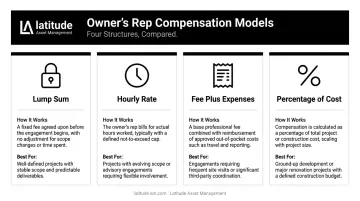
CMAA does not recommend the percentage-of-cost model as a default, characterizing it as arbitrary and potentially unrelated to actual effort. The more defensible approach is pricing from a defined staffing plan, project duration, and scope — then selecting the payment structure that best matches the engagement's predictability.
Additional and Supplemental Services
Fee structure is only part of the picture. How scope changes are handled — and billed — is equally important. Owner's rep agreements typically distinguish between:
- Basic Services: Core oversight, standard reporting, and OAC attendance covered within the base fee
- Supplemental Services: Separately billed when scope expands or the project extends beyond the original term
Hotel projects frequently trigger supplemental billing due to brand negotiation rounds, PIP scope changes, extended pre-opening timelines, or financing delays. These scenarios should be defined in the agreement upfront — not negotiated after the fact.
Owner's Representative Agreements in Hotel Projects: What's Different
Hotel projects add layers of complexity that standard commercial construction does not encounter. Each creates additional stakeholder coordination demands:
- Brand technical services (TS) reviews — brands like Hilton and IHG involve architecture, interiors, engineering, and construction oversight from their own technical teams, requiring coordination between the owner's rep and brand representatives at multiple project milestones
- PIP compliance: property improvement plans drive capital requirements that must be scoped, sequenced, and negotiated; CoStar identifies PIPs as central to property quality, competitiveness, and continued franchise affiliation
- FF&E procurement and installation monitoring: furniture, fixtures, and equipment procurement runs on a parallel timeline to construction and requires separate oversight
- Pre-opening coordination: JLL's analysis of pre-opening processes identifies positioning, commercial readiness, operating systems, and opening execution as distinct workstreams that must be defined before the owner's rep's construction closeout responsibilities end
- Liquor licensing, accessibility, and health code compliance: regulatory requirements specific to hospitality that extend beyond standard building permits
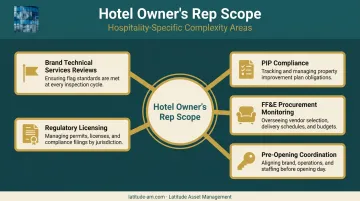
A generic AIA C104-2024 template addresses none of these. Hotel-specific owner's rep agreements require additional exhibits covering brand TS review oversight, PIP responsibility allocation, FF&E monitoring scope, operator interface protocols, and handover coordination to pre-opening teams.
For hotel investors and developers operating across the Americas, cross-border complexity compounds these issues. Varying local permitting timelines, labor regulations, brand-market dynamics, and currency considerations require an owner's rep with genuine regional knowledge — not generalist project managers unfamiliar with the market.
Latitude Asset Management is structured to fill this role. The firm acts as the owner's proxy across the full project lifecycle: from pre-opening planning and brand selection through construction oversight, operator transitions, and stabilized operations. Regional partners are embedded in each key market: Germán Ongay (former Regional VP of Franchise Development at IHG Mexico), Olmedo Herrera (operations lead for Latin America), and Simon Lagardera (Caribbean business development).
Brand technical reviews and PIP compliance are not scope additions for Latitude's team — they are baseline competencies. Chief Business Development Officer Anthony Del Gaudio brings 35+ years of direct brand-side experience at Hyatt, Loews, and IHG, which means the firm engages these processes from the inside out, not as an outside observer.
How to Choose the Right Owner's Representative for Your Hotel Project
Selecting the right owner's rep comes down to fit across four dimensions:
- Sector experience: Hospitality is not general commercial construction. The rep should have demonstrated experience with the specific project type (new build, conversion, renovation), the relevant brand or operator, and the regulatory environment of the project's jurisdiction.
- Regional knowledge: Cross-border projects require on-the-ground familiarity, not generalist coverage. Ask how the firm is specifically staffed in your project's market — not just whether they claim regional coverage.
- Authority and communication alignment: The rep's authority limits and reporting cadence must match the owner's decision-making style and risk tolerance. Misalignment here slows projects and creates costly friction.
- Team depth and bandwidth: Confirm the firm has capacity for the full project duration, not just the active construction phase. Identify who will actually manage the engagement — not just who pitched for it.
Once you've identified candidates who fit those criteria, the vetting process separates the qualified from the well-marketed:
- Request sample agreements and reporting templates — these reveal how structured the firm's process actually is
- Ask for references from comparable projects (same property type, same brand, similar geography)
- Verify credentials: Cornell hotel investment certifications signal hospitality-specific financial and operational training; CFA credentials indicate institutional-grade financial rigor for budget and change order analysis; CMAA's Certified Construction Manager (CCM) credential evidences construction management competence
- Confirm team depth — the firm that wins the engagement should be the firm that manages it
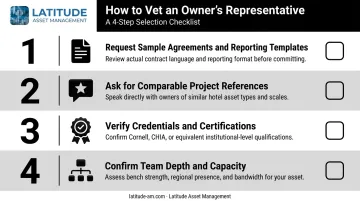
CMAA recommends Qualifications-Based Selection: rank firms on experience, technical approach, personnel qualifications, and references before negotiating scope and price. That sequence matters — evaluating qualifications before fee prevents selection based primarily on the lowest proposal rather than the best fit.
Frequently Asked Questions
How much does an owner's representative cost?
Owner's rep fees are structured as a lump sum, hourly rate, fee-plus-expenses arrangement, or percentage of project cost, with the right model depending on how well-defined the scope is at engagement. There is no universal benchmark; compensation should be priced from the staffing plan, project duration, and specific scope. See the compensation section above for a full breakdown of each model.
What are the responsibilities of the owner's representative?
The owner's rep advises across all project phases — monitoring schedule and budget, reviewing contracts and change orders, coordinating communication among project parties, and managing closeout. They advocate for the owner but do not manage construction directly; trade contracts remain with the owner or contractor, not the rep.
What should be included in an owner's representative agreement?
Six core areas: project description and scope of services, authority and decision-making limits, compensation structure and term, termination and suspension provisions, dispute resolution mechanism, and insurance and liability requirements. Missing any of these creates ambiguity that leads to disputes.
Is an owner's representative the same as a hotel asset manager?
They overlap in advocacy but differ in timeframe. An owner's rep is engaged for a specific development or renovation project. A hotel asset manager provides ongoing oversight of operational and financial performance post-opening. Some firms, including Latitude Asset Management, structure both services in an integrated engagement to provide continuity from development through stabilized operations.
When should a hotel owner hire an owner's representative?
Before pre-construction begins, ideally during site selection or brand negotiation. Engaging the rep early allows them to shape the project team, structure contracts favorably, and set budget baselines before decisions become fixed. Inheriting a project mid-stream limits the rep's ability to protect the owner's interests.
Can the owner's representative also serve as the hotel asset manager?
Yes, and this integration can offer genuine continuity from development through stabilization with a team that already knows the asset, the brand, and the operator. The agreement should clearly separate which services fall under owner's rep and which fall under asset management, to avoid fee overlap or accountability gaps.