
Introduction
The hotel general manager title sits at the top of property operations — one person accountable for every department, every guest interaction, and every dollar of profit or loss. Whether you're climbing toward the role or evaluating the operator running your asset, understanding what it actually takes matters.
This article covers education requirements by property type, realistic career progression, the skills that separate strong GMs from average ones, current salary benchmarks from the Bureau of Labor Statistics, and what owners and asset managers look for when holding GMs accountable.
Key Takeaways
- A bachelor's degree in Hospitality Management or Business Administration is the standard baseline at most mid-scale and full-service properties
- Most GMs progress through multiple departments over many years — there is no shortcut to the top role
- Financial literacy is non-negotiable — owners evaluate GMs on RevPAR growth, GOP margins, and budget accuracy
- The Certified Hotel General Manager (CHGM) credential from the International Hospitality Institute can strengthen a candidate's profile
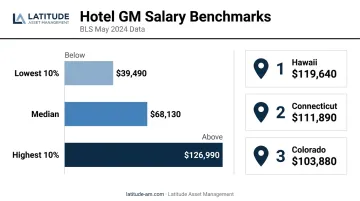
- Salary varies widely by property type and market — from below $39,490 to above $126,990 annually per BLS data
What Does a Hotel General Manager Do?
Understanding what a hotel general manager actually does clarifies why the role demands such a specific combination of education, experience, and temperament. The GM is the property's operating executive. Every department — front desk, housekeeping, food and beverage, sales, maintenance, and human resources — reports through this one role. At branded properties, the GM also answers to the flag's standards while remaining directly accountable to the owner or management company.
Core Day-to-Day Responsibilities
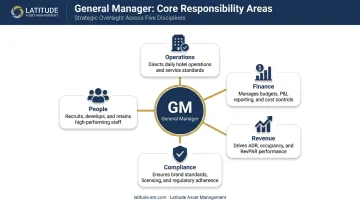
A current Marriott franchise GM posting outlines the scope clearly: setting service standards, managing department heads, leading revenue and sales partnerships, overseeing staffing, conducting property walks, managing budgets, and handling guest escalations. Broken down by function:
- Operations: Enforcing quality and cleanliness across all physical areas
- Finance: Managing departmental budgets and driving profitability
- People: Recruiting, mentoring, and engaging staff across all departments
- Revenue: Partnering with sales to grow market share and financial results
- Compliance: Ensuring health, safety, and brand standards are met
The role is effectively 24/7. GMs at full-service properties are routinely on-call beyond standard hours. At larger hotels, the staff scope can extend across hundreds of employees spanning multiple specialized departments.
Education Requirements for Hotel General Managers
Education requirements aren't one-size-fits-all. They vary significantly by property type and tier.
Education by Property Type
| Property Type | Typical Education Requirement |
|---|---|
| Limited-service | High school diploma plus lodging experience, or a certificate/associate degree |
| Mid-scale/select-service | Associate's or bachelor's degree preferred |
| Full-service | Bachelor's degree in hospitality or hotel management often expected |
| Luxury/large full-service | Bachelor's minimum; graduate study can deepen financial and leadership competency |
Source: BLS Occupational Outlook Handbook, Lodging Managers
Relevant Degree Fields
The most targeted programs are Hospitality Management and Hotel Administration, both explicitly recognized by the BLS as appropriate credentials. Cornell's B.S. in Hotel Administration, for example, integrates business, real estate, and finance content alongside hospitality-specific coursework, and requires 800 hours of work experience before graduation.
Common degree paths include:
- Hospitality Management or Hotel Administration — curriculum built around revenue management, F&B costing, and lodging law as core courses, not electives
- Business Administration or Operations Management — viable when paired with substantial hands-on hotel experience
- Graduate degrees — not universally required, but relevant for candidates targeting complex full-service or luxury properties where financial analysis and capital planning are central to the role
Professional Certifications
The Certified Hotel General Manager (CHGM) from the International Hospitality Institute is active and widely recognized. At $599, the self-paced online program covers budgeting, P&L statements, capital budgets, GAAP basics, rate and oversell strategy, and F&B cost control. Eligibility requires at least one year of hotel operations leadership experience. The credential is valid for five years.
For candidates without a graduate degree, the CHGM offers a structured way to demonstrate financial competency — particularly useful when targeting full-service properties where P&L ownership is a day-one expectation.
The Hotel GM Career Path: Step by Step
Most GMs don't start as GMs. The career path runs through frontline hotel operations, building the departmental fluency that makes a GM credible when managing and challenging department heads.
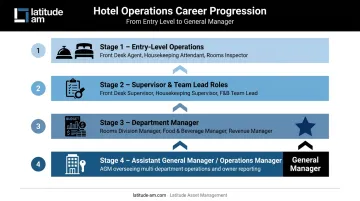
Stage 1: Entry-Level Operations
The starting point is typically a guest-facing or operations role:
- Front Desk Agent
- Night Auditor
- Food & Beverage line position
- Housekeeping team member
These roles matter because they build the operational instincts a GM needs to manage department heads credibly. A GM who has never run a front desk shift has a harder time holding a Front Office Manager accountable to service standards.
Stage 2: Supervisor and Team Lead Roles
From frontline positions, candidates move into early leadership:
- Shift Leader or Front Desk Supervisor
- F&B Supervisor
- Night Audit Lead or Revenue Coordinator
This stage develops cross-departmental awareness and early management experience — the foundation for department-level accountability.
Stage 3: Department Manager
This is where candidates prove financial accountability. Roles like Front Office Manager, F&B Manager, and Director of Sales require managing budgets, leading teams, and driving department-specific revenue outcomes. Owners and asset managers look for GMs who have already demonstrated financial ownership, not just operational oversight.
Stage 4: Assistant General Manager or Operations Manager
The final pre-GM stage. The AGM or Operations Manager oversees multiple departments simultaneously and begins owning property-wide P&L outcomes. This role is where candidates demonstrate they can manage the whole property — not just one function.
Timeline and Mobility
The progression is experience-dependent. Candidates who pursue relevant education, make strategic lateral moves across departments, and show willingness to relocate to new markets will typically progress faster than those who stay in one role or one property. According to the AHLA Foundation, more than half of hotel managers began in entry-level hotel positions — which reinforces that the path is open to candidates who commit to it early.
That progression doesn't have to stop at the property level. Experienced GMs who layer in owner-side skills — property economics, capital planning, valuation fundamentals, and investment analysis — open the door to hotel asset management, consulting, and investment advisory careers. For many operators, it's the natural next chapter after mastering the GM role.
Essential Skills That Set Great Hotel GMs Apart
Owners and asset managers evaluating GM candidates look beyond hospitality instincts. The GMs who consistently protect NOI and retain staff operate across three distinct skill domains — and weakness in any one of them shows up in performance reviews.
Operational and Leadership Skills
- Clear, consistent communication with diverse department teams
- Staff development and retention — especially in high-turnover environments
- Conflict resolution at both the staff and guest level
- Ability to hold department heads accountable without micromanaging
- Building a guest-first culture that sustains service standards between inspections
Financial and Analytical Skills
Financial literacy now separates strong GMs from average ones. CoStar/STR data showed that US hotel expenses above GOP rose 4.1% in 2024 — meaning cost discipline matters as much as revenue growth. That pressure has shifted what owners evaluate:
- Budget management and variance explanations
- RevPAR awareness and competitive set performance
- GOP margin control, not just top-line revenue
- Ability to read and act on monthly financial statements
- Forecast accuracy that ownership can plan around

Adaptive and Strategic Skills
- Problem-solving under operational pressure (staff shortages, system failures, guest crises)
- Managing the hotel's online reputation across review platforms
- Staying current with hospitality technology — mobile check-in, AI-assisted tools, distribution systems
- Understanding market trends and their effect on pricing strategy
Hotel General Manager Salary and Job Outlook
The BLS Occupational Outlook Handbook reports the following for Lodging Managers (SOC 11-9081) as of May 2024:
| Measure | Figure |
|---|---|
| Median annual wage | $68,130 |
| Lowest 10% | Below $39,490 |
| Highest 10% | Above $126,990 |
| Projected job growth (2024–2034) | 3% |
| Net new jobs projected | ~1,800 (52,000 to 53,800) |
| Average annual openings | ~5,400 |
These figures cover lodging managers broadly, not hotel GMs exclusively. Compensation at the property level varies significantly by market, brand tier, and property size. A live Courtyard by Marriott franchise GM posting offered a $90,000–$95,000 base with performance incentives up to 30%. Total compensation at branded properties can meaningfully exceed base salary when incentives are included.
Where a GM works shapes earnings just as much as where they work in the org chart. May 2023 OEWS data placed the highest annual mean wages for lodging managers in Hawaii ($119,640), Connecticut ($111,890), and Colorado ($103,880) — figures that reflect relative market positioning even if the specific rankings have since shifted.
The 3% growth projection is driven by travel recovery, active hotel development in key markets, and retirements creating openings in the current management cohort. For candidates building toward a GM role, that steady demand means consistent opportunities — particularly in high-growth markets and branded full-service properties.
What Hotel Owners and Investors Expect from a Strong GM
From an ownership standpoint, the GM's primary function is value creation. A well-run property whose GM doesn't understand the investment thesis is still an underperforming asset.
The Owner's Scorecard
Asset managers and institutional owners track performance across several dimensions:
| Metric | What It Measures |
|---|---|
| RevPAR growth | Room revenue productivity relative to market |
| RGI (Revenue Generation Index) | Hotel RevPAR vs. competitive set RevPAR |
| MPI (Market Penetration Index) | Hotel occupancy vs. competitive set occupancy |
| GOP / GOP margin | Whether revenue is converting into controllable profit |
| Budget and forecast accuracy | Whether ownership can trust cash-flow projections |
| CapEx and asset condition | Whether short-term results are coming at long-term cost |
A 2023 HAMA survey of 77 asset managers found that nearly 40% expected full-service hotels to exceed GOP budget by as much as 25%. Professional ownership groups set ambitious financial benchmarks, not just compliance thresholds.
Owner-Operator Alignment
The best GMs understand the investment thesis behind their property and operate accordingly. They know whether the owner is in an appreciation play, a cash-flow hold, or a repositioning phase — and they manage accordingly.
Asset managers bridge the gap between owners and GMs, holding operators accountable to performance benchmarks while providing market intelligence and strategic guidance. Firms like Latitude Asset Management work directly alongside hotel GMs, evaluating performance against ownership benchmarks, supporting capital planning decisions, and flagging operational risks before they erode asset value.
Branded vs. Independent GMs
The two contexts carry different accountability profiles:
- Branded/franchised GMs must balance franchisor standards with owner financial priorities, two sets of principals with sometimes competing demands. Strong asset management support helps navigate this tension.
- Independent hotel GMs have more operating flexibility but also carry more direct accountability for brand positioning, distribution strategy, and revenue optimization without a franchisor's systems behind them.
Investors evaluating either scenario look for the same core qualities: financial accountability, market awareness, team stability, and transparent reporting.
Frequently Asked Questions
What do you need to become a hotel general manager?
Candidates typically need a bachelor's degree in hospitality or business, progressive experience across multiple hotel departments, and strong financial and leadership skills. Professional certifications like the CHGM add a competitive edge, particularly for mid-scale and full-service properties.
How long does it take to become a general manager at a hotel?
The timeline is experience-dependent rather than fixed. Candidates who pursue relevant education, move across departments strategically, and show geographic flexibility generally progress faster. Entry at limited-service properties can happen sooner; full-service and luxury GMs typically need a longer track record.
How much does a GM of a hotel earn?
Per BLS May 2024 data, lodging managers earn a median of $68,130 annually, with the top 10% earning above $126,990. Salary varies by property tier, brand, and market — luxury full-service GMs in major markets typically earn well into six figures, plus performance bonuses.
What degree is best for becoming a hotel general manager?
A bachelor's degree in Hospitality Management or Hotel Administration is the most targeted path, with curriculum built directly around hotel operations. Business Administration or Operations Management degrees combined with hands-on industry experience are also common and respected routes.
Can you become a hotel general manager without a degree?
Yes, particularly at smaller independent or limited-service properties where experience can substitute for formal education. At mid-scale and full-service hotels, a bachelor's degree is increasingly expected, and candidates without one typically need a longer track record of progressive operational experience.
What is the difference between a hotel manager and a general manager?
A hotel manager typically oversees day-to-day operations within one or more departments. The general manager holds full accountability for the property: financial performance, strategic direction, all department heads, and direct reporting to the owner or management company.