
Introduction
Good instincts get investors into deals. Strategy is what keeps them solvent through full market cycles.
Every investor managing a collection of assets — whether a stock portfolio, a real estate fund, or a multi-property hotel portfolio — needs more than conviction. They need a structured plan that governs how capital is allocated, how risk is controlled, and how financial goals are pursued across the entire portfolio, not just property by property.
That plan is portfolio strategy.
This guide covers what portfolio strategy means, its core elements, common allocation frameworks, and a seven-step process for building one. It pays particular attention to hotel and real estate investment, where illiquidity, operational complexity, and market cyclicality make strategic discipline especially consequential.
Key Takeaways:
- Portfolio strategy is the overarching plan guiding capital allocation, risk management, and performance evaluation across a collection of assets
- Asset allocation is one of the strongest drivers of long-term performance, per the landmark Brinson, Hood, and Beebower study
- Common frameworks like 70/20/10 are starting points, not fixed rules; they must be adapted to each investor's goals and risk tolerance
- Hotel portfolio strategy demands diversification across asset type, geography, and lifecycle stage, not just property count
- Execution discipline and ongoing monitoring determine where most strategies succeed or fail
What Is Portfolio Strategy?
Portfolio strategy is the overarching plan an investor or organization uses to build, manage, and optimize a collection of assets over time. It encompasses goal-setting, risk tolerance, asset allocation, and performance evaluation.
The defining feature: it treats the portfolio as a whole, not as a series of individual bets.
That distinction matters. An investor might make a sound decision on a single property while inadvertently creating dangerous concentration risk across the portfolio. Strategy forces the bigger-picture view.
Strategy vs. Management
These two terms are related but distinct:
- Portfolio strategy is the plan — what to invest in, why, how much to allocate, and what the target risk-return profile looks like
- Portfolio management is the execution — implementing the plan, monitoring performance, and making adjustments over time
The CFA Institute describes the portfolio management process as moving through three stages: planning, execution, and feedback. Strategy lives in the planning stage and guides every subsequent decision. One without the other breaks down: a strategy that never gets executed stays theoretical, and execution without a strategy tends to drift.
Why It Matters
Without a deliberate strategy, investors are prone to reactive decisions, emotional bias, and concentration risk. Harry Markowitz's foundational 1952 work on portfolio selection demonstrated that combining imperfectly correlated assets can reduce portfolio variance without sacrificing expected return — the mathematical basis for diversification.
For hotel investors, this principle hits close to home. Two properties in different cities may still be highly correlated if they share the same feeder markets, demand drivers, and financing conditions. Geographic spread alone doesn't guarantee diversification.
Three core decisions sit at the heart of any portfolio strategy:
- What to invest in — asset selection
- How much to allocate — capital distribution across asset classes or risk categories
- When and how to adjust — rebalancing discipline over time
Key Elements of a Strong Portfolio Strategy
Investment Goals and Time Horizon
Every portfolio strategy begins with clear, measurable objectives. The objective determines everything downstream: which asset types are appropriate, how much risk is acceptable, and how frequently the portfolio should be reviewed. Common objectives include:
- Capital preservation — minimizing downside exposure, prioritizing liquidity
- Current income generation — targeting consistent cash flow from operations or distributions
- Long-term appreciation — accepting near-term volatility in exchange for higher upside over time
Time horizon matters just as much. A 20-year horizon supports illiquid, higher-upside positions that a five-year horizon cannot absorb. That gap in flexibility directly shapes how much risk a portfolio can responsibly carry.
Risk Tolerance and Risk-Adjusted Return
Risk tolerance reflects two things: the financial capacity to absorb losses and the psychological comfort with volatility. Both need honest assessment.
Equally important is evaluating risk-adjusted return : whether a higher return is actually proportionate to the risk required to achieve it. Two metrics are widely used:
- Sharpe ratio: Measures excess return (above the risk-free rate) per unit of total portfolio volatility. Useful for portfolios where all volatility matters.
- Treynor ratio: Measures excess return per unit of market risk (beta). More meaningful for already-diversified portfolios where the primary remaining risk is systematic.
For hotel portfolios, private appraisal-based valuations can smooth measured volatility, so neither metric should replace cash flow analysis, debt-service stress testing, and drawdown scenario planning.
Asset Allocation
Allocation (dividing capital across asset classes or risk categories) is one of the most powerful drivers of long-term portfolio performance. The landmark Brinson, Hood, and Beebower study, published in the Financial Analysts Journal in 1986, found that policy allocation explained an average of 93.6% of the variation in quarterly total returns across 91 large pension plans.
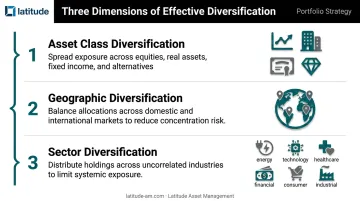
A critical note: this finding describes how much of the variation over time in a portfolio's returns is explained by its allocation policy Diversification means more than owning multiple assets. Effective diversification requires assets with low or negative correlation to each other, so losses in one area can be offset by stability or gains elsewhere.
Three dimensions matter:
- Asset class diversification — equities, fixed income, real estate, alternatives
- Geographic diversification — different markets with different demand drivers
- Sector diversification — different industries or property types
For hotel portfolios, this means diversifying across demand drivers (corporate, leisure, group) not just across cities.
Monitoring and Rebalancing
Markets move. Over time, the drift from asset price changes can significantly alter a portfolio's actual allocation versus its intended one , shifting the risk profile without any deliberate decision.
Vanguard's rebalancing research frames rebalancing primarily as risk control, not return maximization. For hotel portfolios, rebalancing is more complex than selling a fund. Repositioning an asset takes time, and illiquidity limits when transactions are practical.
That constraint makes predefined rebalancing triggers essential. Reactive decisions made under market pressure tend to lag behind the conditions that prompted them.
Common Portfolio Strategy Allocation Frameworks
Allocation frameworks give investors a starting structure for portfolio construction. They're useful as reference points, not rigid rules — the right framework depends on goals, risk tolerance, and time horizon.
The 70/20/10 Rule
This framework divides capital into three risk tiers:
- 70% — core or lower-risk investments (stable income-generating assets, diversified index funds)
- 20% — growth-oriented or moderate-risk opportunities
- 10% — higher-risk or speculative positions
Franklin Templeton uses a 70/20/10 structure in its multi-asset high-net-worth model portfolios. In a hotel context, these buckets can represent stabilized income-producing assets, value-add properties, and opportunistic or development plays, respectively.
Latitude Asset Management applies the same tiered logic across geographies. U.S. hotel assets typically serve core and core-plus roles, offering stability, liquidity, and efficient markets. Latin American hotels are positioned as value-add, opportunistic, and development plays, where stronger upside comes through operational improvement and pricing arbitrage.
The 60/20/20 Rule
This allocation redistributes the growth and alternative buckets more equally — 60% in core/stable assets, 20% each in two distinct risk or asset categories. It suits investors seeking meaningful participation in upside while maintaining a stable income base.
In hotel or real estate portfolios, the two 20% buckets might represent different asset types, geographic regions, or risk profiles — for example, one bucket in U.S. full-service hotels, another in Latin American value-add opportunities.
Other Notable Frameworks
| Framework | Structure | Key Logic |
|---|---|---|
| Ray Dalio's All Weather | Balanced across asset types | Designed to perform across rising/falling growth and inflation environments |
| Harry Browne's Permanent Portfolio | 25% each in stocks, bonds, gold, cash | Each sleeve addresses a different economic regime |
Neither translates directly to hotel portfolio construction. Their value lies in the regime-testing logic: stress-testing allocations across multiple economic scenarios, not just the conditions most favorable to recent performance.
The Portfolio Strategy Process: Building Your Roadmap
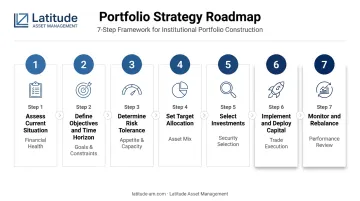
The number of steps varies depending on who's counting, but the process flows through the same core stages regardless of asset class.
- Assess the current situation — Understand available capital, existing holdings, and any constraints (liquidity needs, regulatory limits, existing debt)
- Define investment objectives and time horizon — Set measurable goals: income, appreciation, capital preservation, or a blend
- Determine risk tolerance — Both financial capacity and psychological comfort with loss
- Set target asset allocation — Divide capital across categories aligned with objectives and risk profile
- Select specific investments — Identify assets that fit the allocation and pass underwriting discipline
- Implement and deploy capital — Execute acquisitions, negotiate terms, structure capital appropriately
- Monitor performance and rebalance — Track results against benchmarks, rebalance when drift exceeds predefined thresholds
Steps 6 and 7 are where most strategies either succeed or fail. The first five steps are planning. Execution is the hard part.
That execution challenge is amplified significantly in hotel portfolios, where illiquidity and operational complexity compound every decision:
- Assets cannot be bought or sold on demand
- Repositioning and brand transitions take months to years
- Operational performance directly affects financial value in real time
Latitude Asset Management structures this through a three-phase process — Assess, Strategize, and Maximize — combining cycle-aware market intelligence, portfolio architecture design, and ongoing asset-level oversight into a continuous investment lifecycle. Strategy and execution are treated as inseparable, not sequential.
Portfolio Strategy in Hotel and Real Estate Investment
The Added Complexity of Hotel Assets
Portfolio strategy principles are universal. Applying them to hotel investment adds meaningful layers of complexity.
Unlike stocks or bonds, hotel assets are:
- Illiquid — U.S. individual hotel sales fell 32.8% in 2023 as financing costs widened the bid-ask gap
- Operationally intensive — revenue is generated daily, costs are largely fixed, and operator quality directly affects returns
- Location-specific — demand drivers, seasonality, and competitive dynamics vary sharply by market
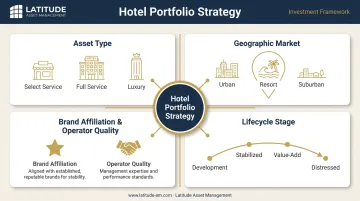
A hotel portfolio strategy must account for:
- Asset type (select service vs. full service vs. luxury)
- Geographic market (urban, resort, suburban)
- Brand affiliation and operator quality
- Lifecycle stage (new development, stabilized, value-add, or distressed)
Diversification Across Dimensions
Research on hotel portfolio diversification reaches nuanced conclusions. A 2014 U.S. lodging study linked geographic diversification to stronger firm performance, while a separate hotel REIT study found that concentrated portfolios actually carried lower systematic risk. A 2021 study added further complexity, identifying non-linear relationships between brand diversification and returns.
Taken together, the evidence suggests diversification works — but only when engineered around actual demand-source correlations, operating leverage profiles, and brand exposure, not geographic labels alone.
Effective hotel portfolio diversification covers:
- Markets with different demand drivers (corporate, leisure, group)
- Segments that perform differently across economic cycles
- Lifecycle stages that balance current income against future upside
The Role of Specialized Asset Management
Hotel portfolios require active, hands-on oversight — not passive monitoring. Translating portfolio strategy into results means:
- Holding operators accountable against agreed performance benchmarks
- Managing brand relationships and negotiating franchise terms
- Planning and executing capital improvements at the right point in the cycle
- Identifying underperforming assets before problems compound
Latitude Asset Management delivers this kind of specialized oversight for hotel investors across the Americas. The firm's team includes former brand executives from Hyatt, Loews, and IHG alongside CFA-credentialed financial analysts — combining operational depth with capital markets discipline to drive measurable performance at the asset level.
Common Challenges in Portfolio Strategy Execution
Market Volatility and Cyclical Shocks
The hotel sector's cyclicality is real and severe. U.S. hotel RevPAR fell 47.5% in 2020 — a demand interruption with no precedent in modern hospitality history. The Global Financial Crisis produced a monthly RevPAR decline of 20.4% year-over-year at its trough in May 2009.
No portfolio strategy eliminates volatility. The goal is building one that survives it:
- Diversification across demand drivers and geographies reduces correlation in downturns
- Appropriate liquidity reserves prevent forced dispositions at the worst moments
- Scenario planning stress-tests assumptions against both ordinary recessions and discontinuous demand shocks
Behavioral Biases and Discipline Gaps
Market shocks test portfolios. Behavioral biases test the people managing them. Even a well-designed strategy fails when investors abandon it under pressure — and three patterns emerge consistently:
- Recency bias — overweighting recent performance and extrapolating trends that won't persist (chasing the last outperforming market)
- Loss aversion — refusing to sell an impaired asset, or overreacting after a drawdown. Kahneman and Tversky's Prospect Theory established that losses register roughly twice as painfully as equivalent gains, which makes disciplined selling genuinely hard
- Overconfidence — Barber and Odean's research found that excess trading reduced individual investors' net returns by 2.65 percentage points annually, a measurable penalty for believing you can time the market
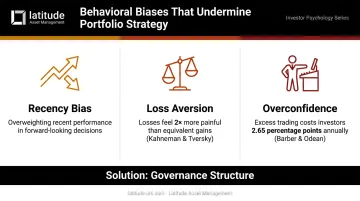
The solution is governance, not willpower. Pre-agreed review triggers, written exception criteria, and independent underwriting create the structure that keeps investors disciplined when markets make it hardest to be.
Frequently Asked Questions
What is a portfolio strategy?
A portfolio strategy is a structured plan guiding how an investor builds, allocates capital across, and manages a collection of assets to achieve specific financial goals — balancing risk and return over a defined time horizon. It looks at the whole portfolio, not individual assets in isolation.
What are common portfolio strategy allocation rules like 70/20/10 and 60/20/20?
These are percentage-based frameworks dividing capital among core/stable, growth, and higher-risk or alternative buckets. The right rule depends on each investor's goals, risk tolerance, and time horizon — they serve as starting points for portfolio construction, not fixed prescriptions.
What are the seven steps of the portfolio strategy process?
The seven steps are: assess current situation and capital, define objectives and time horizon, determine risk tolerance, set target asset allocation, select specific investments, implement and deploy capital, then monitor and rebalance. Execution discipline in the final two steps is where most strategies succeed or fail.
What is the difference between portfolio strategy and portfolio management?
Portfolio strategy is the high-level plan — what to invest in, why, and at what allocation. Portfolio management is the ongoing execution and oversight of that plan. Both are essential; neither works well without the other.
How does portfolio strategy apply to hotel investments?
Hotel portfolio strategy involves intentional allocation across asset types, geographies, lifecycle stages, and demand drivers, with active asset management required to optimize each property's contribution to the portfolio's overall risk-adjusted return targets.
What makes a hotel investment portfolio strategy successful?
Several factors consistently separate successful hotel portfolios from underperforming ones:
- Clear investment objectives defined before capital is deployed
- Disciplined diversification across real dimensions — not just geography
- Active monitoring of both operational and financial performance
- Advisors who understand capital markets and the on-the-ground realities of hotel assets