
This guide covers the key entity options available to real estate investors, the most effective structural models (including the two-company approach and holding company structures), and what hotel and hospitality investors specifically need to consider when organizing their ownership entities. Note that this is an educational framework — work with qualified legal and tax professionals before making entity decisions for your specific situation.
Key Takeaways
- Holding property in your personal name exposes personal assets directly; a legal entity creates the separation
- For most investors, an LLC offers the best balance of liability protection, tax efficiency, and flexibility
- The two-company structure (management LLC + holding LLC) is the standard model for multi-property portfolios
- C corporations and S corporations are generally poor choices for real estate due to double taxation risks
- Hotel investors must account for franchise agreements, management contracts, and cross-border ownership rules
Why Your Real Estate Investment Company Structure Matters
The entity you choose at the outset shapes every downstream decision: tax treatment, liability exposure if litigation arises, how partners are brought in, and how properties are eventually transferred or sold.
Structuring goes well beyond picking an LLC. It means making deliberate decisions across four interconnected dimensions:
- How many entities to use — and whether a single entity is even appropriate
- What each entity does — operating, holding, financing, or some combination
- Where each entity is registered — state and tax jurisdiction both matter
- How entities relate to one another — ownership chains, management agreements, and capital flow
Get those decisions wrong and the consequences are real: an unexpected taxable distribution event, or a judgment against your operating business that reaches your most valuable assets.
Common Entity Types for Real Estate Investment Companies
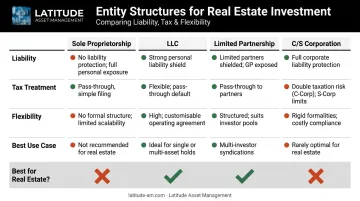
Sole Proprietorship
A sole proprietorship is the default structure for anyone investing without forming a separate entity. Income flows directly to your personal tax return, and there is zero legal separation between your personal finances and your investment activities.
A tenant lawsuit, a slip-and-fall claim, or a vendor dispute can reach your personal bank accounts, home equity, and other assets. According to Nolo's analysis of sole proprietorships vs. LLCs, this structure offers no liability protection whatsoever. It works for casual activity — not for building a real estate business.
Limited Liability Company (LLC)
The LLC is the most widely used entity for real estate investors. It separates personal finances from business liabilities, passes profits directly to members without corporate-level taxation, and accommodates partners or ownership changes without retitling property deeds.
Two variations matter here:
- Single-member LLCs — taxed as disregarded entities for federal purposes, simplest structure for a solo investor
- Multi-member LLCs — taxed as partnerships, appropriate for joint ventures or investor groups
Both benefit from the same liability shield, assuming the entity is properly maintained.
Limited Partnership (LP)
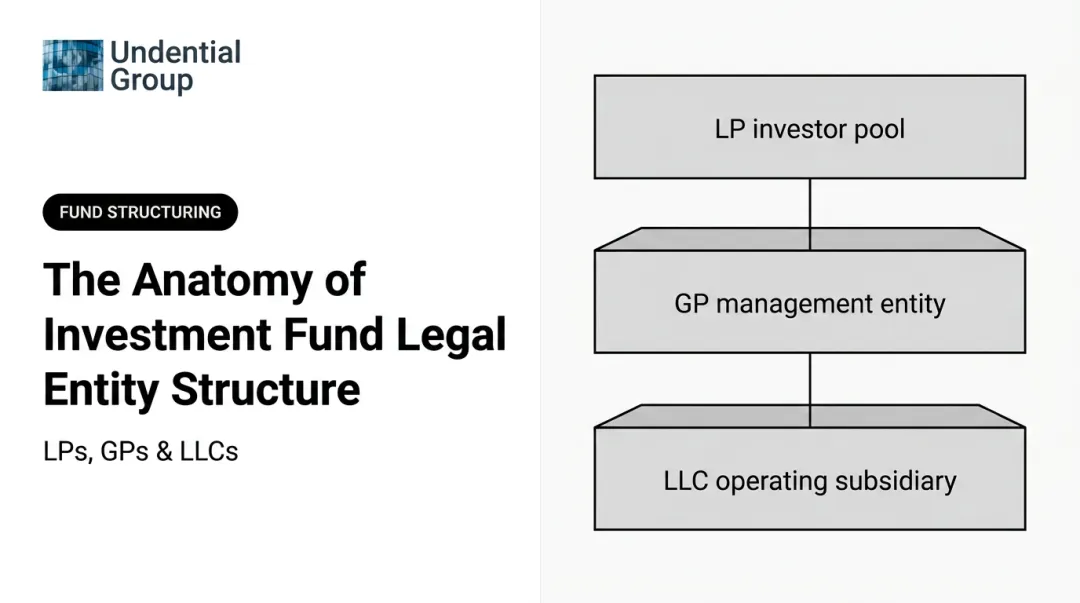
LPs are useful when raising outside capital. Limited partners contribute money and receive liability protection — they cannot lose more than their investment. The general partner manages operations but bears full personal liability, so most sponsors assign the general partner role to an LLC rather than an individual. This LP/LLC hybrid structure is common in real estate funds and larger syndications.
C Corporations and S Corporations
Both corporate forms create significant problems for real estate investors.
C corporations trigger double taxation: income is taxed at the corporate level, and distributions to shareholders are taxed again as dividends. On top of that, under IRC Section 311, distributing appreciated property out of a C corporation is treated as a sale at fair market value — creating an immediate taxable gain even if no cash changes hands.
S corporations create their own obstacles:
- Appreciated property distributed to shareholders triggers gain recognition as if sold at fair market value
- Ownership is restricted to U.S. individuals, which prevents trusts, other corporations, or foreign investors from holding shares
- Distributions must follow strict ownership percentages, limiting flexibility
For real estate investors, both structures introduce tax and structural constraints that the LLC or LP avoids entirely.
The Two-Structure Approach: Holding Company and Management Company
The core principle here is straightforward: separate the entity that generates legal exposure from the entity that holds valuable assets.
Any business that deals directly with the public — signing leases, collecting rent, contracting with vendors, hiring staff — creates liability through those interactions. The entity that holds title to properties should stay out of those relationships entirely. This separation is the foundation of real estate asset protection.
Management Company (Operating Entity)
The management company is the public face of your operation. It:
- Signs leases and collects rent
- Contracts with vendors and service providers
- Hires staff and engages contractors
- Handles all day-to-day transactional activity
Maintain it as a near-shell with minimal hard assets. If a judgment is entered against the management company, its limited assets make that judgment difficult to collect on.
Holding Company (Asset Entity)
The holding company operates in the background. It holds title to properties, pays taxes on those assets, and avoids direct contractual dealings with third parties.
Avoid cross-ownership between the two entities. A clean separation preserves the "no privity" legal defense: a plaintiff who wins a judgment against the management company cannot automatically claim a relationship with the holding company.
Series LLC option: For investors holding multiple properties, a series LLC allows each property (or group of similar properties) to be placed in its own series within a single legal structure. A lawsuit affecting one series cannot reach assets in another. Series LLCs are available in select states — confirm availability and legal treatment with an attorney before relying on this structure.
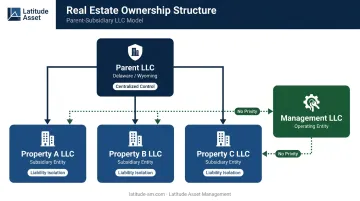
Parent Company and Subsidiaries Model
Investors with multiple properties or markets often use a parent-subsidiary model:
- A parent LLC (often formed in a business-friendly state like Delaware or Wyoming) holds ownership interests in subsidiary LLCs
- Each subsidiary owns an individual property
- The parent provides centralized control; each subsidiary provides individual asset protection
This structure works particularly well for investors managing assets across multiple markets or asset classes — centralized oversight at the parent level, with clean liability walls at the property level.
How to Set Up Your Real Estate Investment Company
Naming and Registration
Choose a name that complies with state requirements, verify availability through the state business registry, and include "LLC" in the entity name. Consider using an assumed name (DBA) for the management company — this reduces public exposure of the ownership structure and keeps the holding company out of tenant-facing communications.
Filing Articles of Organization
File Articles of Organization with the appropriate state authority (the Secretary of State in most states). Most states require the entity name, registered agent, and member/manager information. Filing fees vary by state — Delaware charges approximately $110, Florida $125, and Texas $300. Approval establishes the LLC as a legal entity.
Formation state matters. Many investors form parent entities in business-friendly states while forming subsidiary LLCs in the states where their properties are located (where registration is legally required regardless).
Operating Agreement
The operating agreement governs how the LLC operates — who holds authority, how profits flow, and what happens when ownership changes. It defines:
- Member roles and responsibilities
- Profit and loss distribution
- Decision-making authority
- Procedures for adding partners or transferring ownership
Even single-member LLCs need one. A well-drafted agreement strengthens the liability shield by demonstrating the entity operates as a genuine, separate business — not an extension of personal finances.
Post-Formation Essentials
- Obtain an EIN from the IRS — required for tax filings and to open business bank accounts. Apply online through the IRS at no cost
- Open dedicated business bank accounts — never commingle personal and business funds. Commingling is one of the most common grounds courts use to "pierce the corporate veil" and hold members personally liable
- Research state-specific licenses and permits required for your property type and investment activities
Special Considerations for Hotel and Hospitality Real Estate Investors
Hotel investments introduce structural complexity that doesn't exist in standard residential or commercial real estate. Three areas deserve particular attention.
Brand and Franchise Agreement Compatibility
The hotel operator or brand (whether a franchise or full-service management company) operates under a contract with the ownership entity. That means the ownership structure must be compatible with brand approval requirements, franchise agreement terms, and management contract provisions.
Major brands like Marriott and Hilton often retain approval rights over ownership transfers and have specific criteria for the legal structure, financial standing, and operational experience of ownership entities. An ownership vehicle that doesn't meet brand standards can delay or block a transaction or trigger default provisions in an existing franchise agreement.
When selecting an advisor, prioritize teams with direct experience inside brand organizations. Professionals who have held franchise development roles at major brands understand exactly what ownership structures pass scrutiny and which get flagged — a distinction that can determine whether a transaction closes on schedule. Latitude Asset Management's team includes former brand executives from IHG, Hyatt, and Loews Hotels with that specific vantage point.
Cross-Border Ownership Complexity
Investors acquiring hotels across the Americas in Mexico, Colombia, the Caribbean, or Brazil face an additional layer of complexity that U.S.-only investors don't encounter.
Each jurisdiction has distinct rules governing:
- Corporate formation and entity types recognized under local law
- Foreign ownership restrictions (Mexico's restricted zone rules, for example, require foreign investors to use specific ownership vehicles for non-residential property)
- Tax treaty considerations affecting how profits flow between jurisdictions and how gains are taxed on exit
- Capital repatriation and currency considerations
Structuring a cross-border hotel acquisition without jurisdiction-specific legal and tax advice can expose the investor to tax inefficiencies, transfer restrictions, and regulatory penalties that surface well after closing. Latitude Asset Management maintains dedicated regional partners in Mexico (Germán Ongay, former Regional VP of Franchise Development for IHG Mexico), Colombia (Olmedo Herrera, operations lead for the Colombian Hub), and the Caribbean (Simon Lagardera, VP of Business Development) — regional infrastructure built to navigate exactly this complexity.
Hotel Asset Management as a Structural Layer
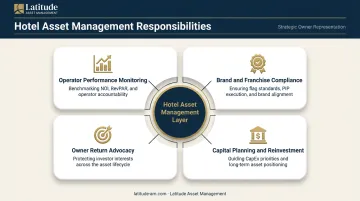
Beyond the ownership entity itself, hotel investors benefit from a professional layer that sits between the ownership entity and the hotel operator. This function (hotel asset management) covers a distinct set of owner-side responsibilities:
- Monitoring operator performance against agreed benchmarks
- Managing brand relationships and franchise compliance
- Overseeing capital planning and reinvestment decisions
- Advocating for owner return objectives throughout the asset's hold period
Without this intermediary, ownership entities often lack the capacity or hospitality-specific expertise to hold operators accountable. The wrong operator, left unchecked, can erode asset value well before problems appear in the financials.
Latitude Asset Management specializes in this function across the Americas, acting as the owner's proxy through operator oversight, brand and operator transitions, and institutional-grade performance monitoring.
Frequently Asked Questions
How to structure a real estate investment company?
Most investors use an LLC as the foundational entity for liability protection and pass-through taxation. More complex portfolios benefit from a two-company structure (separate management and holding companies) or a parent-subsidiary model. The right structure depends on portfolio size, investor type, and applicable state and tax laws — consult qualified legal and tax professionals for your specific situation.
What is the best entity structure for a hotel investment company?
An LLC (or LP/LLC hybrid for capital-raising structures) is generally preferred for hotel ownership entities. It offers pass-through taxation, flexibility for partner arrangements, and compatibility with brand and franchise agreement requirements. C and S corporations are typically avoided due to their unfavorable tax treatment of real estate distributions.
Should I use a separate LLC for each hotel property I own?
Many experienced investors use separate LLCs (or series within a series LLC) for each property to isolate liability — so a legal issue at one hotel cannot reach assets held in another. This approach becomes increasingly important as portfolio size and total asset value grow.
What is the difference between a holding company and a management company in real estate?
The management company is the public-facing operating entity that handles leases, vendor contracts, and tenant dealings. The holding company is the private entity that holds title to assets and avoids direct dealings with third parties. Keeping the two separate is the foundation of real estate asset protection strategy.
How does a two-company structure protect real estate investors?
By separating operating activities (which generate legal exposure) from the entity holding valuable assets, a judgment against the management company cannot automatically reach the assets in the holding company. This legal defense, known as "no privity," protects investor assets even when the operating business faces litigation.
Do hotel investors need a special type of company structure?
Hotel investments require the ownership entity to be compatible with brand franchise agreements and management contracts, which adds structural constraints absent in most real estate asset classes. Cross-border hotel investors face further complexity around jurisdiction-specific corporate formation and tax treaty rules. This requires specialized legal, tax, and asset management guidance tailored to each market.