This guide is written for hotel investors, asset managers, developers, and PE-backed owners navigating transactions across the Americas. The structural decisions made at signing — leverage levels, capital stack position, governance terms, rollover equity — shape every operational and financial outcome during the hold period. Understanding them isn't optional; it's the prerequisite for negotiating well.
What follows covers the building blocks of PE deal structure, the most common transaction types, the factors that determine which structure fits a given asset, and the mistakes that most reliably destroy value before the deal even closes.
Key Takeaways
- A PE deal structure defines how a transaction is financed, how ownership is divided, and how proceeds are distributed at exit
- The most common structures — LBOs, majority recaps, minority investments, and full buyouts — each suit different investor goals and risk profiles
- Leverage cuts both ways; private credit deals recently averaged 4.6x–5.1x EBITDA, amplifying returns in upside scenarios and losses when performance slips
- Earnout provisions, preferred equity terms, and capital stack position often matter more than headline purchase price
- In hospitality PE deals, brand fees, management contracts, and PIP obligations compress free cash flow before debt service, demanding more rigorous pre-close underwriting than standard operating company transactions
What Is a Private Equity Deal Structure?
A PE deal structure is the financial and legal framework that governs a private equity transaction. Specifically, it defines:
- How the transaction is financed (debt, equity, and hybrid instruments)
- How ownership stakes are divided between the PE firm and existing shareholders
- How control and governance rights are allocated among parties
- How returns are distributed to each stakeholder at exit
The structure serves a specific purpose: it aligns the incentives of the buyer, seller, management team, and lenders around a shared value-creation plan, and it establishes who absorbs the downside if performance falls short.
One distinction worth drawing clearly: deal structure is not the same as deal process. The process describes the steps of sourcing, due diligence, and closing. The structure is the financial and legal architecture of the transaction itself — two concepts frequently conflated in early-stage conversations, to the detriment of sellers who don't grasp the distinction until after signing.
The Capital Stack: Debt, Equity, and Leverage in PE Deals
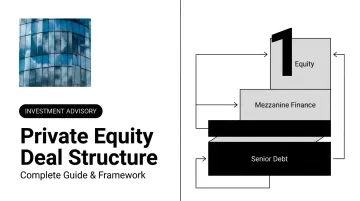
The capital stack is the layered hierarchy of financing instruments used to fund a PE acquisition, ordered by repayment priority. Position in the stack determines both risk exposure and return potential for each investor class: senior lenders face the least risk and receive repayment first, while common equity holders sit at the bottom, absorbing losses first but capturing the most upside when performance exceeds projections.
Debt Financing
Middle-market PE deals typically include several debt layers:
- Senior term loan — the largest tranche, secured against business assets, priced at a spread over a benchmark rate (84% of Q1 2026 new-issue LBO spreads priced below SOFR+550 bps, per Capstone Partners)
- Revolving credit facility — for working capital needs
- Subordinated or mezzanine debt — higher yield, higher risk, sits below senior debt in the repayment waterfall
For general corporate PE deals, Proskauer's private credit research found closing leverage averaged 4.6x EBITDA in 2023, rising to 5.1x in 2025 across more than 450 deals. Hotel mortgage debt is sized differently: HVS reports stabilized hotel acquisitions typically require 55%–65% loan-to-value, with lenders focused on property NOI and asset condition rather than corporate EBITDA multiples.
Equity Contribution
The equity side of the stack includes:
- PE firm equity — typically the majority of the equity check
- Management rollover equity — existing owners reinvest a portion of their sale proceeds into the recapitalized entity
- Co-investor equity — where applicable
Management rollover is a meaningful structural tool. PE firms prefer it because it preserves incentive alignment: the selling owner retains meaningful equity exposure and remains motivated to execute the value-creation plan. Sellers who insist on a fully clean exit with zero rollover often compress their valuation or reduce buyer interest.
The Leverage Effect
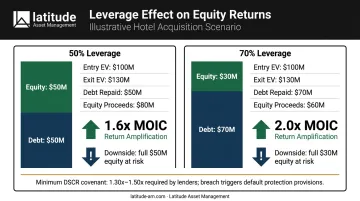
Leverage reduces the equity check required upfront, amplifying returns on invested equity when EBITDA grows. A simplified example:
| Scenario | Entry EV | Debt | Equity | Exit EV (+30%) | Equity Return |
|---|---|---|---|---|---|
| 50% leverage | $100M | $50M | $50M | $130M | 1.6x MOIC |
| 70% leverage | $100M | $70M | $30M | $130M | 2.0x MOIC |
The same EBITDA growth produces a larger equity multiple with more debt in the stack. The reverse is equally true: underperformance hits equity holders harder when more leverage is present. This is why lenders set debt service coverage ratio (DSCR) floors. HVS reports hotel acquisition lenders typically require 1.30x–1.50x DSCR on stabilized assets, ensuring sufficient NOI to cover debt obligations before equity distributions.
Standard corporate LBO models don't account for the cost structure built into hotel management and franchise agreements. These obligations sit above debt service in the operating waterfall, directly compressing the cash available to lenders. HVS research identifies the key line items:
- Base management fees: typically 2%–4% of total operating revenue
- Franchise costs (combined): 8.6%–14.5% of rooms revenue, depending on brand and chain scale
- Capital improvement reserves (FF&E): typically 4%–5% of revenue, required under most brand agreements
Leverage sizing that ignores these costs will produce DSCR compression under even modest revenue stress.
Common Types of Private Equity Deal Structures
The right structure depends on the investor's goals, the seller's preferences, the company's stage, and the financing environment. Structure determines control allocation, tax treatment, risk distribution, and how proceeds flow at exit — choosing the wrong one is difficult to unwind after closing.
Leveraged Buyout (LBO)
In an LBO, the PE firm acquires the majority or all of a company using a combination of equity and substantial debt, with the acquired company's future cash flows servicing that debt over the hold period.
LBOs work best in stable, cash-generative businesses. The CFA Institute identifies recurring, predictable cash flow as the central characteristic of strong LBO candidates. Full-service hotels with contracted group business have historically been cited in this context — though CBRE's hotel brand performance research found urban full-service RevPAR grew only 0.5% annually from 2018–2023, with one-third of brands still below 2019 RevPAR levels by 2023. That data point matters: contracted group demand alone doesn't establish the stable cash flow an LBO requires. Asset-level testing of actual NOI and PIP obligations is essential before applying an LBO structure to a hotel acquisition.
Majority Recapitalization
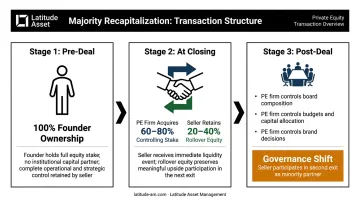
The PE firm acquires a controlling stake — typically 60%–80% — while the founder or owner rolls over a minority equity position and receives substantial liquidity at closing. The seller gets capital now, retains upside through continued ownership, and participates in a second exit when the PE firm sells its stake.
What hotel owners across the Americas frequently underestimate: governance changes materially once control transfers. Board composition, operating budgets, capital expenditure approvals, and brand decisions shift to the PE firm's framework. The rollover equity is real, but it operates under new governing terms — and those terms, not the headline check at closing, determine what the seller ultimately collects from the second exit.
Minority Growth Investment
The PE firm acquires less than 50%, typically to fund growth without forcing a control change. This sounds like the most founder-friendly structure. In practice, minority investors negotiate protective provisions that constrain autonomy meaningfully:
- Board seats and observer rights
- Veto rights over major decisions (new debt, acquisitions, key hires)
- Drag-along and tag-along provisions
- Anti-dilution protections
Founders should evaluate minority investment terms as carefully as majority deal terms — a veto right over "major acquisitions" can block an add-on that the operator considers routine. The definition of materiality thresholds in those provisions is where the real negotiation happens.
Full Buyout
The PE firm acquires 100% of the company. The seller exits entirely, maximizing immediate liquidity. PE firms typically prefer some management rollover even in full buyouts, because operational continuity affects underwriting confidence. Sellers insisting on zero rollover should expect either valuation discounts or reduced buyer conviction — particularly in hospitality transactions, where institutional knowledge of a property's revenue mix, operator relationships, and brand obligations is difficult to transfer through documentation alone.
Earnouts and Structured Equity
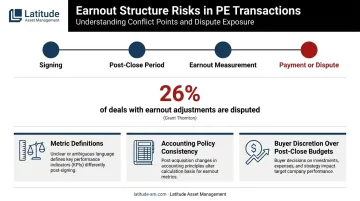
Earnouts are a post-closing payment mechanism: part of the purchase price is paid at signing; the remainder is contingent on hitting defined post-close financial targets. Buyers use them when projected performance looks aggressive or its sustainability is uncertain. Sellers resist them because they lose control over the very operations they're being measured on.
The risk is measurable: Grant Thornton's M&A dispute survey found 26% of deals with post-close earnout adjustments were disputed. Metric definitions, accounting policy consistency, and buyer discretion over post-close budgets and staffing are the recurring conflict points — all require explicit drafting before a seller accepts an earnout structure.
Beyond the earnout itself, preferred equity and participation rights add further complexity to the distribution waterfall. Founders or hotel owners rolling equity need to understand exactly where they sit in the stack relative to preferred holders before signing — because preferred equity typically receives its full return before any proceeds flow to common or rollover equity.
Key Factors That Influence PE Deal Structure
Cash Flow Profile and Asset Stability
Assets with predictable, recurring cash flows support higher leverage and simpler structures. Assets with volatile or cyclical revenues — resort hotels with seasonal demand, properties in emerging markets with developing fundamentals — typically require:
- Lower leverage ratios
- Longer hold period assumptions
- More conservative covenant packages
- Larger interest reserves
The PitchBook US PE middle market definition covers buyouts of $25M–$1B in enterprise value. Within that range, middle-market deals generally access senior bank debt plus equity; larger deals can tap high-yield bond markets and syndicated credit. Distressed or turnaround situations command wider spreads and tighter covenants regardless of size.
Market Conditions and Interest Rate Environment
Rising interest rates compress the viable leverage range and change the relative attractiveness of different structures. CBRE reported that Americas hotel investment fell 9.3% year over year in 2024, with US cross-border hotel investment down 17.1%, citing high interest rates as a primary constraint. Higher financing costs mean less debt can be supported at the same coverage ratio — which either reduces purchase price, increases the equity check, or both.
Hospitality-Specific Structural Constraints
Those rate-driven cost pressures compound with property-level obligations that further constrain free cash flow. For hotel and real estate PE deals, several operational items function as structural constraints that affect how much cash reaches debt service and ultimately equity:
- Brand franchise fees (royalties, marketing fund contributions, reservation fees)
- Base and incentive management fees
- Property improvement plan (PIP) capital requirements tied to brand standards
- Non-disturbance agreement obligations that survive ownership transfers
Latitude Asset Management, which specializes in hotel investment and asset management across the Americas, embeds this operational layer into deal underwriting before closing. Javier Revelo (CFA) leads financial analysis across acquisitions, ensuring brand and management fee obligations are modeled into DSCR calculations — not treated as post-close surprises.
Anthony Del Gaudio, Chief Business Development Officer, brings 35+ years of brand-side experience across Hyatt, Loews, and IHG. That background enables pre-close assessment of what a particular franchise agreement will actually cost an owner across a seven-year hold.
How PE Deal Structure Affects Value Creation — and Common Mistakes
The First 100 Days Are Set at Signing
Deal structure is not just a financing exercise. It sets the conditions for value creation or value destruction during the hold period. Structures that load too much debt leave insufficient cash flow to fund capital improvements or absorb a demand softening. Structures that are too conservative limit return amplification. The first 100 days post-close (when the value-creation plan is activated) are shaped entirely by structural decisions made months earlier at the negotiating table.
The Most Common Structural Mistake
Optimizing for headline price rather than total economic outcome.
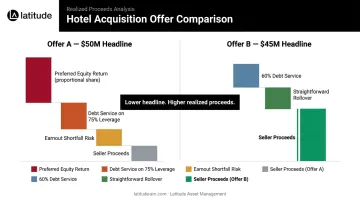
Consider two offers for a hotel asset:
- Offer A: $50M, with heavy earnout provisions, aggressive preferred equity, and 75% leverage
- Offer B: $45M, cleaner stack, 60% leverage, straightforward rollover terms
Offer A's headline number is higher. But if preferred equity holders receive their return first, earnout targets aren't met (due to buyer-controlled operational decisions post-close), and debt service consumes the majority of NOI, the seller's actual realized proceeds from Offer A may be materially lower than from Offer B.
The number on the term sheet is where the conversation starts. Capital stack position and waterfall mechanics determine where it ends — and how much each party actually walks away with.
Structural Flexibility During the Hold
That outcome — lower realized proceeds from a nominally higher offer — is exactly what poor hold-period flexibility produces. In hotel investments across the Americas, market conditions shift quickly and reinvestment cycles are tight. Three structural variables drive whether a sponsor can respond:
- Leverage levels — how much cash flow must service debt versus fund capital improvements
- Management rollover percentage — how aligned the operating team remains through the hold
- Governance terms — how quickly decisions can be made when conditions change
Latitude Asset Management's approach to bridging deal structure and operational performance illustrates why this integration matters. The firm's three-phase investment process — Assess, Strategize, Maximize — treats capital structure decisions and operator selection as interdependent inputs, not sequential steps.
The financial modeling embedded at acquisition directly informs what operational interventions are executable during the hold. Regional partners like Olmedo Herrera (Colombia) and Germán Ongay (Mexico) ensure that local market realities are reflected in structural assumptions, not discovered after close.
Latitude's position is direct: most distressed hotel situations are not the result of bad hotels, but of capital structures that left no margin for error.
Frequently Asked Questions
How do you structure a private equity deal?
Structuring a PE deal involves determining the debt-to-equity split, selecting the transaction type (LBO, recap, minority investment, etc.), negotiating the capital stack, and establishing governance and distribution terms. All of these must align with the investor's return targets and the asset's realistic cash flow capacity under base-case assumptions, not optimistic projections.
What is the "2 and 20" fee structure in private equity?
"2 and 20" refers to the standard PE compensation model: a 2% annual management fee on committed capital, plus 20% carried interest on profits above a preset hurdle rate. According to ILPA and Goodwin research, roughly 67%–80% of PE funds use an 8% preferred-return hurdle, with rates varying by strategy and fund vintage.
What is rollover equity in a private equity deal?
Rollover equity is when a seller reinvests a portion of their sale proceeds into the recapitalized entity, participating in future upside alongside the PE firm. It typically sits behind preferred equity in the capital stack. New operating agreement terms govern the arrangement, and sellers should review them carefully before closing.
What is the difference between a majority recapitalization and a full buyout?
In a majority recap, the PE firm buys a controlling stake while the seller retains a minority equity position and participates in a future exit. In a full buyout, the PE firm acquires 100% and the seller exits entirely, maximizing immediate liquidity but forfeiting continued upside. The two structures also differ in board control, information rights, and veto provisions — all negotiated at closing.
How does leverage affect returns in a PE deal?
Leverage amplifies equity returns when business performance improves — the same EBITDA growth produces a larger equity multiple with more debt in the stack — and equally amplifies losses when performance falls short. Hotel lenders typically require 1.30x–1.50x DSCR on stabilized acquisitions, which serves as the primary constraint on how much debt a given asset can support.
What is an earnout and when is it used in private equity?
An earnout is a post-closing payment triggered when the acquired business hits defined financial targets, used when buyers question whether projected performance is sustainable. With 26% of deals involving disputed post-close adjustments, sellers should insist on precise metric definitions and retain operational control over the results they're accountable for.