Introduction
Buying or developing a hotel is nothing like acquiring a standard commercial property. As CoStar notes, hotels operate as daily-lease, labor-intensive businesses measured by operating KPIs — not passive real estate that simply collects rent. That means ownership comes with management contracts, franchise agreements, brand standards, capital programs, operator relationships, and performance pressure all running simultaneously.
Most investors are not equipped to manage all of this alone — and every party sitting across the table, from architects to operators to brands, is optimizing for their own interests.
An owner's representative is the professional who changes that equation: the one role in the room whose loyalty runs exclusively to the owner's goals, budget, and return.
This guide breaks down what an OR is, what they do, how they differ from other roles, when to engage one, and what to look for when hiring one.
Key Takeaways
- An owner's representative (OR) acts exclusively as the hotel owner's advocate — overseeing budget, schedule, operators, and brand relationships
- In hotel investment, the OR role extends well beyond construction to cover the full ownership lifecycle
- Earlier engagement typically yields greater cost savings and risk reduction
- Hotel-specific OR expertise covers RevPAR, GOP margins, franchise agreements, and operator accountability — well beyond general construction oversight
- Independent representation eliminates conflicts of interest that every other project party carries
What Is an Owner's Representative?
An owner's representative is a professional hired to act exclusively as the owner's advocate — not a builder, not a designer, not an operator. Their sole purpose is to protect the owner's interests, budget, and objectives throughout the project or investment lifecycle.
The AIA defines the role as a professional retained to oversee and advise the owner throughout design and construction — monitoring budgets, coordinating stakeholders, and addressing bottlenecks. But in hotel investment, the scope extends considerably further.
The Hotel OR vs. a General Construction OR
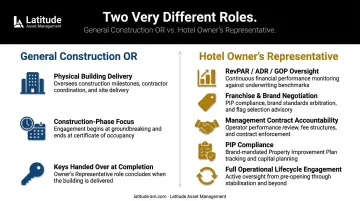
A traditional OR focuses on delivering a physical building. A hotel OR must also understand:
- RevPAR, ADR, and GOP margins — the commercial metrics that determine investment returns
- Franchise agreements and brand standards — and how to negotiate them in the owner's favor
- Management contracts — including performance clauses, fee structures, and operator incentive alignment
- PIP compliance — what brand-mandated renovation scope actually means for capital deployment
A general construction OR hands over keys at project completion. A hotel OR stays engaged through the operational life of the asset — which is where most of the real investment risk actually lives.
Independent vs. In-House Representation
The OR role can be filled by an in-house team member or an independent third-party firm. Independent representation is generally preferred for one straightforward reason: every other party at the table — architect, contractor, operator, brand — has financial motivations that don't always align with the owner's. The independent OR has no competing incentive.
In practice, this means the OR acts as the owner's eyes and ears across three critical areas:
- Performance management — holding operators accountable to agreed KPIs and financial targets
- Capital planning — guiding renovation timing, PIP responses, and CapEx prioritization
- Operator accountability — ensuring management contracts are enforced, not just signed
Latitude Asset Management, for example, structures its owner's representative work as a direct extension of ownership — embedding into the asset rather than advising from the sidelines.
Core Responsibilities of an Owner's Representative in Hotel Investments
Oversight of Capital Programs and Budget Control
The hotel OR monitors all capital expenditure — from initial development or acquisition costs through renovation, PIP compliance, and ongoing FF&E budgets — ensuring every dollar spent aligns with the owner's return objectives.
HVS's 2025 development cost survey reports median total development costs ranging from $167,000 per room for limited-service hotels to over $1 million per room for luxury — figures that underscore how much is at stake when budget discipline breaks down. HVS's renovation estimating guide also recommends carrying a 15% contingency for quick budgets and 10% for detailed budgets, with professional fees (architecture, design, project management, procurement) typically adding another 10% on top of construction costs.
Key OR responsibilities in capital oversight include:
- Reviewing and challenging contractor bids before commitment
- Tracking and approving change orders to prevent scope creep
- Monitoring PIP compliance timelines and cost exposure
- Identifying value-engineering opportunities before design is locked
As Hotel Management reported from industry experts, some hotel developers were carrying 20–30% contingencies during periods of construction cost volatility — versus the traditional 5–10%. Engaging an OR early, before design is complete, is one of the most effective ways to avoid that kind of cost inflation.
Brand, Operator, and Franchise Management
One of the hotel OR's most distinct responsibilities is managing the owner-brand-operator relationship. This includes:
- Reviewing management contracts and franchise agreements for terms that favor the owner
- Evaluating brand-mandated PIPs — which under CoStar's transaction framework are triggered at ownership transfer and define renovation scope and timetable
- Negotiating PIP timelines and cost-sharing when possible
- Holding the operator accountable to agreed performance benchmarks
Latitude's team includes professionals with direct brand-side experience. Anthony Del Gaudio spent 14 years at Hyatt, 19 years at Loews, and three years at IHG across wholly owned, managed, and franchise operations — giving him firsthand knowledge of how brands structure demands, where there's room to negotiate, and what owners can realistically push back on.
Communication, Coordination, and Risk Mitigation
Capital oversight and brand negotiation only work if information flows cleanly between all parties. The OR serves as the central communications hub across every project stakeholder:
- Architects and engineers
- General contractors and FF&E vendors
- Brand representatives and franchise compliance teams
- Lenders and equity partners
- Local authorities and permitting bodies
The OR also identifies risks at every phase — permitting delays, contractor performance gaps, brand compliance failures, market-driven underperformance — and develops mitigation strategies before they escalate.
Key Benefits of Hiring an Owner's Representative for Your Hotel Investment
| Benefit | What It Means in Practice |
|---|---|
| Unbiased Advocacy | The OR is the only team member whose sole purpose is the owner's return — every other party has competing interests |
| Cost and Budget Control | Early OR engagement enables value engineering before construction costs are locked in |
| Informed Decision-Making | The OR translates technical and operational complexity into clear, actionable guidance |
| Team Accountability | Architects, contractors, operators, and brands are held to contractual commitments and quality benchmarks |
| Owner Focus | Investors can concentrate on capital allocation and deal strategy while the OR manages day-to-day complexity |
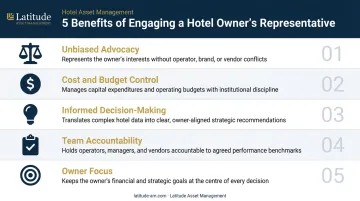
Of the five benefits above, cost control has the most direct financial impact — and timing determines how much of it you capture. Waiting until design is complete to value-engineer a hotel project produces fewer savings, because redrawing plans consumes time while construction costs continue rising. Engaged early, the OR's fee is almost always recovered through avoided overruns, better contractor bids, and smarter PIP negotiations.
At Latitude Asset Management, the pattern is consistent: hospitality investments underperform not because of bad assets, but because of misalignment, structural gaps, and execution failures that go unmanaged. Bringing in an OR early is how owners catch those problems before they show up in the NOI.
Owner's Representative vs. Other Hotel Roles: Understanding the Difference
OR vs. Project Manager
A project manager typically works within a defined phase — often construction — and may be employed by or aligned with a contractor or development firm. The OR works exclusively for the owner across all phases and disciplines, with no stake in the outcome except the owner's success.
The CMAA's Owners Guide describes the agency CM/PM role as an advocate without interests other than the owner's — but even that framing is more construction-phase focused. The hotel OR extends this advocacy through the full operational lifecycle.
OR vs. Architect
The architect designs the building and owns design intent and documentation. Protecting the owner's budget, holding the contractor accountable, and negotiating brand terms fall outside that scope. The OR bridges what designers produce and what the owner actually needs delivered — holding the architect accountable to ownership goals, not design vision alone.
OR vs. Asset Manager or Hotel Operator
Three roles often get conflated in hotel investment, but each carries a distinct mandate:
- The operator runs day-to-day hotel operations under a management contract, with fee incentives that don't always align with ownership's long-term goals
- The asset manager monitors operator performance for ownership, reviewing budgets, capital decisions, and management agreement compliance
- The OR may perform many asset management functions, but is specifically positioned as the owner's proxy — actively overseeing and challenging operator performance rather than simply reviewing reports
In practice, Latitude Asset Management delivers these functions as an integrated service: acting as the owner's proxy, holding operators accountable, overseeing capital planning, and managing brand relationships — each engagement structured around ownership objectives, not operator or brand priorities.
When Should You Engage an Owner's Representative?
Engaging an OR at project inception — before selecting an architect, contractor, or brand — consistently produces the best outcomes. Early involvement allows them to:
- Help define realistic goals and budgets from the start
- Evaluate and vet all team members before commitments are made
- Identify risks before they are priced into contracts
Early entry is ideal, but OR engagement at any phase still moves the needle. Mid-construction, pre-opening, and post-opening engagements all add value — especially when a project is at risk or an asset is underperforming.
Hotel-Specific Trigger Points
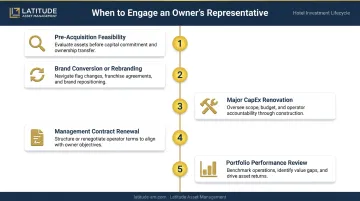
These are the moments when OR engagement is most critical:
- Pre-acquisition feasibility — before capital is committed and assumptions are locked in
- Brand conversion or rebranding — a high-stakes transition where franchise terms, PIP scope, and operator alignment can shift dramatically
- Major capex renovation — particularly PIP-driven programs triggered by ownership transfer or franchise renewal
- Management contract renewal or transition — when the owner has an opportunity to renegotiate terms or change operators
- Portfolio-level performance reviews — when underperformance suggests systemic misalignment between operator execution and owner objectives
Latitude's own investment philosophy frames acquisition as "arguably the most consequential moment in the hotel investment lifecycle" — noting that downstream challenges almost always trace back to decisions made at entry. Owners who engage an OR before the ink dries on an acquisition are simply buying themselves more options — and fewer costly corrections down the road.
What to Look for When Choosing a Hotel Owner's Representative
Not all owner's representatives are built for hotel investment. Here is what to prioritize:
Hotel expertise. Look for direct experience with hotel operations, brand relationships, franchise negotiations, operator management contracts, and the hospitality financial metrics — RevPAR, NOI, GOP — that drive investment returns. General construction oversight is not enough.
An owner's mindset with operational credibility. The best hotel ORs have sat on both sides of the table — as operator and as investor advocate — and can challenge brand or operator decisions from a position of genuine expertise. That dual perspective is what allows them to ask the right questions, catch misalignment early, and negotiate from strength.
Regional reach for cross-border investments. If you are investing in Mexico, the Caribbean, or Latin America, regional intelligence matters enormously. Local regulatory environments, brand dynamics, and stakeholder relationships differ meaningfully from U.S. markets. A firm with embedded regional leadership — not just a U.S. team advising from afar — provides a fundamentally different level of on-the-ground protection.
Latitude Asset Management is built for exactly this type of engagement. The team covers each dimension of hotel OR work:
- Hotel operations: Olmedo Herrera, decades leading full-service hotels across Latin America
- Franchise negotiation: Germán Ongay, former Regional VP of Franchise Development at IHG Mexico
- Brand accountability: Anthony Del Gaudio, 35+ years across Hyatt, Loews, and IHG
- Institutional financial analysis: Javier Revelo, CFA
- Investor advocacy: Haizar Baiz, Cornell-certified hotel investment professional with 18+ years across brands, operations, and investor representation
Few OR firms can match that depth across all five disciplines simultaneously — which is precisely why cross-border hotel investors should treat it as a non-negotiable standard when evaluating candidates.
Frequently Asked Questions
What is an owner's representative?
An owner's representative is a professional hired exclusively to act as the owner's advocate throughout a project or investment — overseeing budget, schedule, team performance, and decision-making on the owner's behalf. Unlike every other party on the project, the OR has no competing financial interests.
What is the difference between an owner's representative and a project manager?
A project manager typically operates within a defined phase — often construction — and may be aligned with a contractor or developer. An owner's representative works exclusively for the owner across all phases and disciplines, with a fiduciary duty to protect the owner's interests above all else.
What is the difference between an architect and an owner's representative?
The architect is responsible for designing the building and managing design intent. The OR focuses on protecting the owner's budget, timeline, and goals — serving as the owner's independent check on all team members, including the architect.
When should you hire an owner's representative?
As early as possible — ideally before selecting the design team, contractor, or brand — so the OR can help structure the project for success from the start. Engagement at any later phase still adds value, but earlier involvement yields the greatest cost and risk savings.
How much does an owner's representative typically cost?
Fee structures vary by scope, complexity, and engagement length — commonly structured as a percentage of project cost, a monthly retainer, or a negotiated lump sum. The AIA and CMAA both note there is no standard fee schedule; compensation should reflect actual scope and effort. OR fees are typically recovered many times over through avoided overruns and better-negotiated contracts.
Do hotel investors specifically need a different kind of owner's representative?
Yes. Hotels are operating businesses requiring specialized knowledge of brand relationships, management contracts, operator performance, and hospitality financial metrics — expertise that a general construction OR typically lacks.