
Introduction
Managing one hotel well is hard. Managing five or ten across different markets, brands, and currencies is an entirely different discipline — and confusing the two is one of the most common and costly mistakes hotel investors make.
The gap between property-level management and true portfolio strategy is where returns are made or lost. A single underperforming asset drags the whole portfolio. A misaligned acquisition changes the risk profile for every other holding.
Market cycles in Mexico, the Caribbean, and Colombia don't move in lockstep with U.S. markets — and a portfolio structured without that awareness is permanently exposed.
This guide covers what real estate portfolio management actually means, the four core strategy types, the metrics that matter, and what makes hotel portfolios distinctly more complex than any other commercial real estate category. The goal is to give you a framework for thinking about your assets as a coordinated whole — not a collection of separate bets.
Key Takeaways
- Portfolio management is about how assets work together — not just how each performs individually
- Four strategy types — diversification, growth-oriented, income-focused, and opportunistic — each serve distinct risk tolerances and return objectives
- NOI, Cap Rate, IRR, RevPAR, and ADR are the metrics that reveal whether each asset advances or undermines portfolio goals
- Hotel portfolios require a specialist lens: brands, management contracts, and operating complexity set them apart from every other asset class
- Geographic diversification across markets with different demand cycles is the most reliable buffer against concentration risk
What Is Real Estate Portfolio Management?
Real estate portfolio management is the strategic oversight of a collection of properties to achieve defined financial goals. The emphasis is on strategy — a coordinated discipline focused on how assets interact, contribute, and compete within a single investment framework, not on day-to-day property operations.
ULI defines portfolio management as decisions about investment mix and policy, matching investments to objectives, allocating assets, and balancing risk against performance. In practice, that scope includes:
- Acquisitions and dispositions
- Geographic and segment exposure
- Leverage management
- Portfolio rebalancing
None of these are property-level concerns.
Portfolio Management vs. Asset Management
These two functions are related but distinct, and mixing them up creates gaps in accountability.
| Function | Focus | Decisions Made |
|---|---|---|
| Portfolio Management | Investment strategy and allocation | What to buy, hold, sell; how to balance risk across assets |
| Asset Management | Individual property performance | Operator oversight, CapEx, budgets, brand compliance |
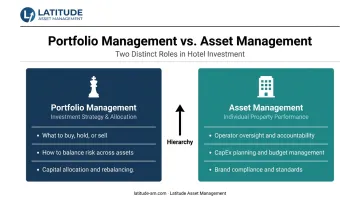
In hotel real estate, this distinction matters more than in any other asset class. Operators, brands, and asset managers all play different roles — and without a clear portfolio layer sitting above them, the strategic coherence of the collection collapses into a series of disconnected property decisions.
CBRE's hotel asset management framework describes asset management as ownership representation, operating assessment, detailed benchmarking, and brand accountability. These functions feed up into portfolio-level decisions. They don't replace them.
Core Real Estate Portfolio Strategies
Most sophisticated portfolios blend elements of multiple approaches. What separates disciplined investors from reactive ones is having a dominant orientation defined by strategy — not one that simply emerges by default.
Diversification Strategy
Diversification means spreading investments across property types, geographies, and contract or lease structures to reduce correlation risk. The logic is straightforward: when one segment declines, others may hold or even benefit.
ULI applies Modern Portfolio Theory to real estate, noting that combining assets with low return correlations can reduce total portfolio variance for a given return target. That said, correlations rose sharply during the 2008–2009 downturn — meaning diversification provides risk mitigation, not loss prevention, when systemic shocks hit.
For hotel portfolios specifically, geographic diversification across markets like the U.S., Mexico, and the Caribbean is particularly effective because demand drivers differ substantially. A slowdown in U.S. corporate travel doesn't hit Caribbean leisure markets the same way.
Growth-Oriented and Value-Add Strategies
Growth-oriented strategies target markets with strong demand drivers and assets positioned to appreciate — prime locations, emerging tourism corridors, supply-constrained markets.
Value-add strategies acquire underperforming or under-managed properties and improve them through renovation, repositioning, or operational upgrades. In hospitality, this typically means:
- Brand conversions (IHG reported conversions represented approximately 50% of both openings and signings in 2024, up from 191 conversion signings in 2023 to 366)
- Management changes that align operator incentives with owner objectives
- Capital improvement plans (PIPs) that reposition an asset within its competitive set
In Latin American markets, where many assets lack professional asset management, brand conversions paired with operational improvements can unlock substantial ADR uplifts — making value-add the dominant strategy type for investors entering those markets.
Income-Focused Strategy
Income-focused portfolios prioritize stable, recurring cash flow over appreciation. This means assets with long-term leases or management contracts generating predictable NOI — properties where the income floor is more important than the upside ceiling.
Hotels managed under long-term agreements with reputable operators can serve this strategy well. Resort assets, short-term rentals, and leisure-dependent properties with high seasonal volatility typically don't. The income-focused investor should prioritize contract structure and operator credit quality over market positioning potential.
Opportunistic Strategy
Opportunistic investing targets distressed assets, undervalued properties in market dislocations, or situations where risk-adjusted upside is significantly higher than what's available in stabilized markets. This strategy requires higher tolerance for complexity and execution risk.
Cross-border investors in markets like Mexico, Colombia, and the Caribbean regularly encounter opportunistic situations driven by:
- Currency fluctuations that reduce the USD entry basis
- Post-crisis travel recovery creating RevPAR rebound potential
- Under-managed hotel assets in emerging tourist corridors where professional sponsorship is scarce
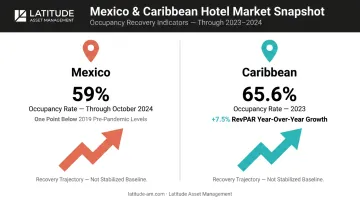
The market data reflects exactly the kind of conditions these drivers create. Mexico's country-wide hotel occupancy averaged 59% through October 2024 — one point below 2019 levels — while Caribbean occupancy reached 65.6% in 2023 with +7.5% RevPAR growth year-over-year. These are recovery trajectories, not stabilized baselines, which is precisely the profile opportunistic investors look for.
Key Components of an Effective Real Estate Portfolio Strategy
Strategic Asset Allocation and Acquisition
Asset allocation defines the portfolio's risk/return profile before a single property is purchased. Acquisition criteria should be set at the portfolio level — each new asset must advance the overall strategy, not just clear a standalone underwriting threshold.
For hotel portfolios, due diligence must assess:
- Market demand drivers — what generates demand, how durable it is, and how it behaves across economic cycles
- Competitive supply pipeline — existing and incoming supply that could pressure occupancy or rate
- Brand fit — capital requirements, rate ceilings, operating cost implications, and exit liquidity
- Operator quality — track record, alignment with ownership objectives, and accountability structures
In a disciplined acquisition framework, market positioning and operator quality carry equal weight to property financials. By the time a deal closes, the performance trajectory is largely set.
Financial Planning and Cash Flow Management
Portfolio-level financial management covers budgeting, capital expenditure planning, debt service, and scenario-based cash flow forecasting. Three practices separate disciplined portfolios from reactive ones:
- Model adverse scenarios regularly — rising interest rates, demand drops, and new competitive supply. A capital structure with no margin for error becomes a distressed situation when conditions shift.
- Protect liquidity reserves — maximizing deployed capital at the expense of cash on hand is a common and correctable mistake.
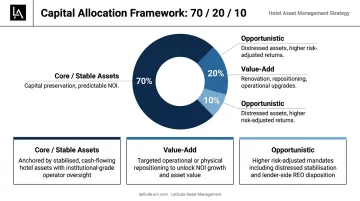
- Apply a structured capital allocation framework — the 70/20/10 model (70% in core/stable assets, 20% in value-add, 10% in opportunistic) gives portfolios a clear starting point for balancing capital preservation with growth potential.
Javier Revelo, Financial Analysis & Research Advisor at Latitude Asset Management, leads this work for the firm's hotel portfolio advisory practice — covering acquisition underwriting, scenario analysis, and capital structure evaluation with the discipline of a CFA charterholder who came up through institutional investment management.
Asset Management and Operational Oversight
Portfolio strategy translates into property performance through asset management. At the hotel level, this means holding operators and brand partners accountable — not just reviewing reports, but evaluating whether execution matches underwriting assumptions.
Key oversight functions include:
- RevPAR performance benchmarked against the competitive set, not just internal targets
- Cost structure monitoring against budgeted margins
- Brand compliance and guest satisfaction scores
- Capital improvement program execution and timing
Structuring these accountability frameworks requires knowing how operators actually behave — not just in theory, but across ownership structures. Anthony Del Gaudio, Chief Business Development Officer at Latitude Asset Management, brings that perspective through 35 years of experience across Hyatt Hotels (14 years), Loews Hotels (19 years), and IHG (3 years), spanning wholly owned, managed, and franchise operations.
Exit Strategy and Portfolio Rebalancing
An effective portfolio strategy includes defined exit criteria from the start. According to HVS, typical hotel holding periods run 7–10 years, though CoStar data shows this varies significantly by segment — budget hotels average 4.9 years while limited-service hotels average more than 10 years. This variation means exit assumptions should be set by hotel type, not applied uniformly across a portfolio.
Portfolio rebalancing should be driven by:
- Changes in an asset's strategic role within the portfolio
- Market cycle positioning (entry or exit timing relative to cap rate compression or expansion)
- Capital structure opportunities — refinancing to improve liquidity or returns
- Operator or brand underperformance that can't be corrected within the current structure
Essential Performance Metrics for Real Estate Portfolio Management
Without consistent tracking of the right metrics, portfolio managers can't identify underperformers, justify capital reallocation, or report credibly to investors. The metrics you monitor — and how you interpret them — directly shape every hold, sell, and reinvestment decision.
Core Financial Metrics
| Metric | What It Measures | Portfolio Use |
|---|---|---|
| NOI | Net operating income after expenses, before financing | Primary indicator of cash-generating ability per asset |
| Cap Rate | Stabilized NOI ÷ acquisition price | Benchmarks acquisition pricing; CBRE's H2 2025 survey shows ranges from 5.25%–7.25% (full-service NYC) to 8.5%–9.5% (limited-service Las Vegas) |
| IRR | Total return factoring all cash flows over hold period | Evaluates long-term investment performance |
| Cash-on-Cash Return | Annual pre-tax cash income ÷ cash invested | Measures leveraged return on equity deployed |
| DSCR | NOI ÷ annual debt service | Assesses leverage risk and debt capacity |
Hotel-Specific Metrics
Standard commercial real estate metrics don't capture hotel performance fully — hospitality assets operate as businesses, not just income-producing properties. These additions are essential for any hotel portfolio:
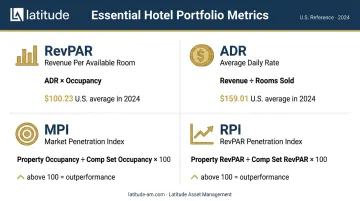
- RevPAR (Revenue Per Available Room) = ADR × Occupancy — the primary revenue performance indicator. U.S. RevPAR reached $100.23 in 2024, the first time it crossed the $100 threshold
- ADR (Average Daily Rate) — revenue divided by rooms sold; 2024 U.S. ADR was $159.01
- MPI (Market Penetration Index) — your occupancy divided by competitive set occupancy × 100; values above 100 indicate outperformance
- RPI (RevPAR Penetration Index) — your RevPAR divided by competitive set RevPAR × 100
Connecting Metrics to Asset Value
HVS research shows an 85–90% correlation between GOPPAR and hotel value — higher than the 70–75% correlation for RevPAR alone — making profit-level metrics the most direct link to asset valuation.
The 2% rule (monthly rent ≥ 2% of purchase price) is a residential screening heuristic with no place in hotel underwriting. Hotel acquisitions are evaluated on RevPAR trajectory, NOI margin relative to competitive set, and stabilized DSCR — metrics that reflect the asset's operating business, not just its rent-generating capacity.
Risk Management and Diversification Across Markets
Primary Risk Categories
Every hotel portfolio faces four core risk types:
- Concentration risk: over-reliance on a single geography, asset type, or operator amplifies any localized downturn
- Market cycle risk: acquiring or disposing at the wrong point in the cycle erodes returns that good operations cannot recover
- Credit risk — operator or tenant financial instability
- Liquidity risk — inability to exit positions when conditions require it
Each of these risks compounds in cross-border portfolios where regulatory environments, currency dynamics, and market cycles differ by country.
Diversification Levers
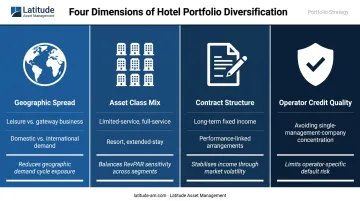
Portfolio managers can reduce correlation risk across several dimensions:
- Geographic spread: markets with distinct economic drivers — leisure versus gateway business, domestic versus international demand — limit single-event exposure
- Asset class mix: limited-service, full-service, resort, and extended-stay assets respond differently to demand shocks, creating natural offsets
- Contract structure diversity — long-term fixed income assets alongside shorter performance-linked arrangements
- Operator credit quality — avoiding concentration with a single management company across multiple assets
CBRE's NCREIF data confirms that hotel returns carry higher volatility than commercial property returns broadly. This makes active diversification management a structural requirement for hotel portfolios, not an optional layer of discipline applied after problems emerge.
Proactive Risk Mitigation
- Conduct portfolio reviews at least annually — quarterly for assets in underperforming markets or mid-transition
- Stress-test cash flow models against downside scenarios before conditions force the exercise
- Build performance trigger clauses into management agreements: operator underperformance requires contractual remediation mechanisms, not informal conversations that rarely produce accountability
- Maintain insurance coverage calibrated to the actual replacement and revenue exposure of each asset
Hotel Real Estate Portfolio Strategy: A Specialized Approach
Hotels are operating businesses. That single fact changes everything about how portfolio strategy works in hospitality compared to office, industrial, or multifamily real estate.
Daily revenue management, brand positioning, labor costs, and guest experience all directly affect NOI — meaning hotel asset managers must engage at an operational level far more intensive than collecting rent from a commercial tenant. CBRE's review of NCREIF indexes confirms that hotel returns are more volatile than commercial property returns overall, which is the financial expression of this operational complexity.
What Makes Hotel Portfolios Distinctly Complex
Brand relationships drive RevPAR penetration, rate ceilings, capital requirements, and exit options. A Cornell University study of more than 40,000 U.S. property-year observations found branded properties achieve significantly higher RevPAR than independents — but that advantage comes with fee structures, PIP obligations, and contract terms that owners must underwrite carefully. HVS reports management base fees of 2–4% of gross revenue and incentive fees of 10–15% of GOP as standard structural benchmarks.
Management contract structure determines how much operating control an owner retains. Franchise agreements separate brand affiliation from daily management, giving ownership more flexibility on operator selection and exit. Management agreements transfer more operating control and can constrain termination or sale — a critical distinction when building a portfolio with clear exit timelines.
Capital improvement programs (PIPs) function simultaneously as value creation tools and forced capital expenditure obligations. A PIP required at brand renewal can represent a significant unplanned capital call if not underwritten at acquisition.
Geographic and segment diversification matters as much in hotel portfolios as in any other commercial category. A portfolio spanning U.S. urban business hotels, Mexican resort properties, and Caribbean leisure assets has meaningfully lower demand correlation than one concentrated in a single market type.
The Specialist Advantage
Hotel portfolio owners increasingly benefit from advisors who understand both the investment and operational dimensions simultaneously. Generic real estate portfolio managers often lack the hotel-specific expertise to evaluate operator accountability, negotiate with brands, or identify repositioning opportunities that aren't visible in the financials.
Latitude Asset Management is built around exactly that requirement. The team combines operational, brand, and institutional finance expertise across a single advisory relationship:
- Haizar Baiz, CEO — 18+ years across hotel operations, brand representation, and investor advocacy throughout the Americas
- Anthony Del Gaudio, Chief Business Development Officer — 35 years spanning Hyatt, Loews, and IHG across wholly owned, managed, and franchise operations
- Germán Ongay, Senior Strategic Partner (Mexico) — 40+ years in Mexico's hotel industry, including senior roles at IHG and Óptima Hoteles
- Olmedo Herrera, Operations Lead (Colombia) — decades leading full-service hotels across Latin America through openings, renovations, and rebrands
- Simon Lagardera, VP Business Development (Caribbean) — regional operator turned entrepreneur, connecting local markets to institutional standards
- Javier Revelo, CFA — institutional finance background anchoring disciplined underwriting, scenario analysis, and capital structure evaluation

For owners managing hotel assets across the U.S., Mexico, and the Caribbean, this depth of integrated expertise — operational, regional, and financial — is what enables portfolios to compound value rather than drift.
Frequently Asked Questions
What is portfolio strategy in real estate?
A real estate portfolio strategy is a documented plan governing how a collection of properties is acquired, managed, and disposed of to meet specific investment objectives. It defines asset allocation, risk tolerance, return targets, and exit criteria — treating the portfolio as a coordinated whole rather than a collection of independent assets.
What are the 4 types of portfolio management?
The four main approaches are:
- Diversification — reducing risk through geographic and asset-type variety
- Growth-oriented — targeting capital appreciation through emerging markets and prime locations
- Income-focused — prioritizing stable, recurring cash flow
- Value-add/opportunistic — active improvement or distressed asset strategies targeting higher risk-adjusted returns
What is the 70/20/10 investment strategy?
The 70/20/10 framework allocates roughly 70% of portfolio capital to core stable assets, 20% to value-add opportunities, and 10% to higher-risk opportunistic investments. Investors use it as a starting point for balancing capital preservation with growth — adjustable based on risk tolerance and market conditions.
What is the 2% rule for properties?
The 2% rule suggests monthly gross rent should equal at least 2% of a property's purchase price to support positive cash flow. It's a rough residential screening heuristic — not a rigorous analytical tool, and not applicable to hotel assets, where RevPAR, NOI margins, and competitive benchmarking are the relevant measures.
What is the difference between a real estate portfolio manager and an asset manager?
A portfolio manager oversees the overall investment strategy — what to buy, hold, sell, and how to allocate capital across assets. An asset manager focuses on maximizing the value and operational performance of individual properties within that portfolio. In hotel real estate, both roles are essential and must work in coordination.