

This guide frames online reputation management (ORM) as an asset management discipline, not a marketing function — and covers what ownership needs to monitor, measure, and act on.
Key Takeaways
- A 1-point gain in review score correlates with up to 1.42% higher RevPAR, per Cornell research
- 76% of travelers say they would pay more for a hotel with better reviews
- Review recency matters: guests focus on the most recent reviews first — cited by 78% of travelers surveyed
- Track reputation KPIs in operator performance reviews — not just marketing dashboards
- Falling review scores flag operational problems weeks before RevPAR reports catch them
What Is Hotel Online Reputation Management?
Hotel ORM is the ongoing practice of monitoring, influencing, and responding to how a property is perceived across digital channels — review platforms, OTAs, social media, and search engines — with the goal of driving bookings and protecting asset value.
The distinction that matters most for ownership is the difference between reactive and proactive ORM:
- Reactive ORM responds to reviews after they appear. It is necessary but insufficient.
- Proactive ORM builds a system that generates positive feedback, shapes guest perception, and routes feedback directly into operational corrective action before problems escalate into public complaints.
A complete ORM program covers five areas:
- Review monitoring across all primary platforms
- Response management — timely, personalized, on-brand
- Sentiment analysis by category (cleanliness, service, value, location)
- Post-stay survey programs that capture feedback before it reaches public platforms
- Guest feedback loops that connect review data directly to operations teams
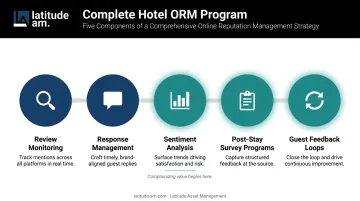
Most properties execute the first two consistently. The final three — sentiment analysis, pre-public feedback capture, and operational feedback loops — are where the compounding value lies: they convert guest data into margin protection and repeat revenue rather than simply managing perception after the fact.
How Online Reputation Directly Impacts Hotel Asset Value
The Revenue Connection
Cornell's lodging performance research — the most rigorous published study on this relationship — found that a 1-point gain on a 100-point reputation index correlated with up to 0.89% higher ADR, 0.54% higher occupancy, and 1.42% higher RevPAR across more than 31,000 monthly hotel observations. The same data suggested a 1-point increase on a 5-point review scale could support an estimated 11.2% price increase without sacrificing occupancy.
The Cornell data is correlational, not causal — but the pattern is durable across market cycles and property types. Even modest reputation improvements compound into measurable NOI gains across a full operating year.
Demand and Pricing Behavior
Travelers are not neutral about reviews. Expedia Group's 2025 Traveler Value Index, based on a survey of 11,000 consumers across 11 markets, found that 76% would pay more for a hotel with better reviews — a figure that rises to 80% among travelers under 40.
A TripAdvisor/Ipsos MORI survey of over 23,000 users found that 81% always or frequently read reviews before booking. Another 79% were more likely to book a property with a higher bubble rating. Neither dataset measures actual booking conversions directly, but the behavioral signal is consistent enough across independent sources to inform pricing and distribution strategy.
Algorithm Visibility
Google, TripAdvisor, and major OTAs all confirm that review signals affect search placement:
| Platform | Review Signal Documented |
|---|---|
| Google Business Profile | Review count and score factor into local ranking |
| TripAdvisor | Quality, recency, quantity, and consistency drive Popularity Ranking |
| Booking.com | Guest Review Score affects property ranking and visibility |
| Expedia | Guest experience quality links to marketplace visibility |
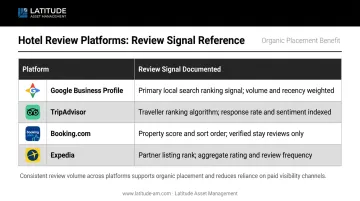
No platform publishes the exact numerical weight assigned to each factor. But the directional evidence is clear: higher-rated, actively reviewed properties earn better organic placement, which reduces paid distribution dependency.
The Due Diligence Angle
For investors evaluating acquisitions, a property's review profile and reputation trajectory are forward-looking indicators that financial statements often miss. A declining review score frequently signals underlying problems before they appear in RevPAR. Reviewing ORM data as part of acquisition due diligence gives investors an early read on operational risk that the income statement hasn't yet priced in.
Common signals worth tracking during acquisition review include:
- Staffing gaps — recurring complaints about slow service, unavailable staff, or inconsistent quality
- Deferred maintenance — pattern complaints about room condition, HVAC, plumbing, or cleanliness
- Management misalignment — boilerplate responses, unresolved repeat complaints, or no response activity at all
- Brand standard drift — guest expectations mismatched with the flag the property carries
Key Platforms and Metrics Hotel Owners Must Monitor
Where Reviews Actually Live
Shiji ReviewPro's 2025 hotel review dataset shows the current platform landscape:
- Booking.com produced 627,000 more reviews globally than Google
- Google recorded 12.4 million hotel mentions worldwide
- TripAdvisor recorded 10.3 million mentions
- Expedia represented more than 37% of reviews in North America after significant share gains
Those volumes tell you where travelers are talking — and where your monitoring attention should follow. For most hotel owners, the priority list is:
- Google Business Profile — critical for local search visibility and traveler trust
- TripAdvisor — high organic authority and review depth
- Booking.com and Expedia — ratings directly affect OTA placement and conversion
KPIs Ownership Should Track
Don't monitor ratings in isolation. The metrics that matter:
- Overall average rating and trend direction (improving, flat, declining)
- Review volume and recency — a high rating with few recent reviews is a vulnerability
- Review response rate — the 2024 industry average was 67.4%, per Shiji ReviewPro data
- Sentiment by category — cleanliness, service, value, and location each tell a different operational story
- Competitive set ranking — relative positioning drives demand share more than absolute score
A 4.2 rating looks different if your nearest competitor averages 4.5. That gap is where demand share shifts — and where owners need to focus their operational response first.
Proven Strategies for Hotel Reputation Management
Proactive Review Generation
Volume and recency matter as much as average score. TripAdvisor user data shows 78% of travelers focused on the most recent reviews when evaluating a property. A strong historic average doesn't protect you if the last six months show a decline.
Building a consistent review pipeline requires active outreach:
- Post-stay email or SMS within 24-48 hours of checkout
- Mid-stay check-in messages that catch issues before they become reviews
- QR code prompts at checkout or in-room
Revinate's hospitality guide reports that post-stay survey programs produced a 51% increase in review volume — a vendor-sourced figure, though it aligns with a straightforward reality: asking guests for feedback produces more of it.
Response Protocols That Build Trust
A 2018 analysis of 5,356 Texas hotels found that hotels that began responding to reviews saw 12% more reviews and ratings increase by 0.12 stars. The engagement effect is real.
Best practices for structured response protocols:
- Target a 72-hour response window for all reviews (Shiji ReviewPro's documented recommendation)
- Acknowledge specific feedback — generic replies are worse than no reply in terms of prospective guest trust
- Maintain brand voice across positive and negative responses
- Address negative reviews constructively — acknowledge the issue, describe the corrective action, invite the guest back
For negative reviews specifically, the response is not written for the reviewer. It is written for every future traveler who reads it.
Operational Feedback Integration
Review data that lives only in a dashboard has no operational value. Guest sentiment needs to translate into departmental performance metrics and operator accountability — otherwise the insight stops at the report.
How to operationalize this:
- Identify recurring complaints — noise, cleanliness, breakfast quality, check-in wait times
- Create action plans with specific, measurable improvements and assigned ownership
- Monitor subsequent reviews to verify whether the intervention produced improvement
- Report the trend to ownership in monthly performance summaries alongside RevPAR and ADR
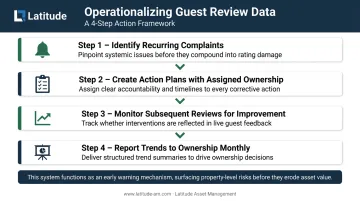
When sentiment patterns are tracked this way, they function as an early warning system. Operational problems appear in reviews weeks before they show up in financial reports.
Crisis and Recovery Planning
A reputation crisis (sudden rating drop, viral negative incident, negative press) is easier to manage with a plan already in place.
The recovery framework:
- Address the root cause operationally — the review problem is a symptom
- Increase positive review volume through proactive outreach to recent guests
- Respond publicly to existing negative reviews, acknowledging the issue and communicating specific corrective steps
- Track the recovery trajectory monthly — rating trend, response rate, sentiment by category
Operational fixes come first. Responding to reviews without addressing the underlying problem doesn't resolve the crisis — it documents it more publicly.
Managing Reputation Across the Guest Journey
Pre-Arrival
Pre-arrival communications set expectations — and the gap between expectation and reality is the most common driver of negative reviews. Confirmation emails and pre-check-in messages should cover:
- Check-in process and timing
- Parking, transportation, and access details
- Available amenities and any current limitations (renovation, closed outlet)
- Contact information for questions
Getting these details right eliminates the "I wasn't told" complaint before it happens.
In-Stay
A mid-stay message — via SMS or messaging app — gives staff a window to catch dissatisfied guests before checkout. A guest who mentions a noise issue at 10pm can be moved. A guest who mentions it only in a review cannot be helped.
The message doesn't need to be elaborate: a brief check-in that invites feedback and provides a direct contact point is enough to catch recoverable situations.
Post-Stay
An effective post-stay sequence has three stages:
- Thank-you message within 24 hours of checkout
- Satisfaction survey sent separately from the review request — capturing qualitative feedback before it goes public
- Review request sent a few days after the survey
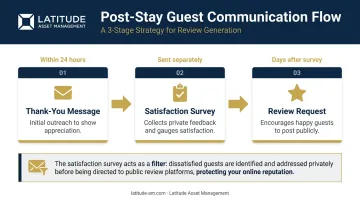
Staging these communications improves both survey completion rates and public review volume. The survey functions as a filter — guests who flag dissatisfaction internally can receive a personal follow-up before they post publicly.
Low survey scores should trigger an alert workflow so ownership or management can intervene directly. A personal outreach at that stage costs nothing; a one-star review that shapes future booking decisions costs considerably more.
Reputation Management as Part of Strategic Hotel Asset Oversight
From an asset management perspective, reputation KPIs belong in property management agreements and operator performance reviews — not treated as a separate marketing function that operators manage independently.
The case for formal integration:
- Reputation is a leading indicator. A declining review score often surfaces staffing gaps, maintenance deferrals, or service inconsistencies weeks or months before they appear in RevPAR or ADR reports. Monitoring it gives ownership an early warning system that financial reporting doesn't provide.
- Operators should be accountable. When reputation metrics — average rating, response rate, review volume, competitive rank — are part of documented performance expectations, operators manage them differently than when they are not.
- Ownership reporting should include both. Monthly summaries that cover financial performance without reputation context are incomplete.
Latitude Asset Management builds this performance lens directly into its asset management work, tracking both financial results and guest experience metrics as part of owner representation. The firm's oversight model holds operators accountable to brand compliance and reputation standards alongside financial targets — because performance measured only through the income statement leaves gaps that show up later as value erosion.
For ownership teams building or refining their asset management frameworks, the practical step is straightforward: add reputation KPIs to the metrics you review with your operator every month. The data is already there.
Frequently Asked Questions
What is reputation management in the hotel industry?
Hotel reputation management is the practice of monitoring, influencing, and responding to how a property is perceived online — across review platforms, OTAs, and search engines. Effective ORM goes beyond review responses to actively shape guest perception, generate consistent review volume, and feed operational improvement.
How much do hotel reputation management services cost?
Costs range from entry-level monthly subscriptions for standalone review monitoring tools to full-service agency retainers. Major platforms like ReviewPro, Revinate, and TrustYou price by engagement without published rate cards. Evaluate any spend against measurable impact on ADR, occupancy, and direct booking revenue.
How do online reviews affect hotel RevPAR and ADR?
Cornell research found a 1-point gain on a 100-point reputation index correlated with up to 0.89% higher ADR and 1.42% higher RevPAR. Higher review scores also support pricing power — Expedia Group data shows 76% of travelers would pay more for a better-reviewed property.
Which review platforms matter most for hotel bookings?
Google Business Profile, TripAdvisor, Booking.com, and Expedia are the highest-priority platforms for most hotels. Google has the greatest impact: review score and volume factor directly into local search ranking, shaping traveler trust before a guest ever reaches an OTA.
How often should hotel owners review their property's online reputation?
At minimum, a weekly review of new ratings and responses — with monthly deep-dive reporting on sentiment trends and competitive benchmarking. Reputation summaries should be part of standard asset performance reporting to ownership, not a separate process managed only by the operator.
Can a hotel recover from a period of negative reviews?
Yes — but recovery starts with fixing the underlying operational issues, not just managing the review feed. A structured approach combines root-cause improvements, proactive outreach to generate new positive volume, and transparent responses to existing negative reviews. Track progress monthly against a defined baseline.