
Introduction
Mexico's investment case has rarely been cleaner. The country closed 2025 with 0.8% real GDP growth and the IMF projects 1.6% growth in 2026 — modest by headline standards, but underpinned by structural tailwinds that matter far more than the number itself.
Mexico is now the U.S.'s top trading partner, with $935.1 billion in goods and services trade in 2024. Nearshoring continues pulling manufacturing operations out of Asia. Three Mexican cities are hosting the 2026 FIFA World Cup. And international tourism receipts exceeded $32 billion last year — up 7.4%.
Each of these factors alone would justify a closer look. Together, they create a specific, time-sensitive window for investors, hotel developers, and cross-border operators to move before the market fully absorbs the opportunity.
This guide covers:
- Which sectors are growing fastest and why
- Which entry structure fits your situation
- How the legal and regulatory framework works
- Which regional hubs align with different business models
Key Takeaways
- Mexico surpassed China as the U.S.'s top trading partner in 2024, with USMCA reducing barriers for North American businesses
- The 2026 FIFA World Cup is accelerating hospitality and infrastructure investment in Mexico City, Guadalajara, and Monterrey
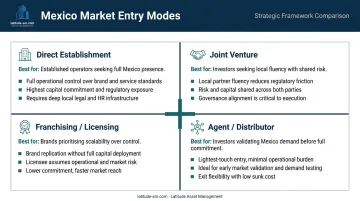
- Four primary entry modes exist: direct establishment, joint venture, franchising/licensing, and agent/distributor
- Regulatory compliance, regional hub selection, and local relationships drive outcomes — often more decisively than capital
- Hotel occupancy in Los Cabos hit 78.8% in early 2025, making tourism and hospitality among Mexico's highest-growth investment sectors
Why Mexico Is a Priority Market in 2026
The Macro and Trade Advantage
Mexico's position as the U.S.'s largest trading partner is both recent and structurally durable. The USMCA creates preferential tariff treatment for qualifying goods, electronic customs processes, and investment protections including fair and equitable treatment standards for covered investments.
For cross-border operators, this framework meaningfully lowers entry costs and legal exposure compared to markets without equivalent treaty structures.
Companies manufacturing or sourcing from Mexico can serve the entire North American market with logistics and customs advantages unavailable elsewhere in Latin America.
The Nearshoring Boom
The manufacturing relocation trend from Asia to Mexico has already moved past "emerging story" status. BBVA and AMPIP tracked 830 new foreign firms entering Mexican industrial parks between 2018 and 2022, with 20% originating from Asia — and park operators projected 453 additional arrivals for 2023–2025. Northern border cities, including Tijuana and Juárez, accounted for 67% of nearshoring space commercialized in January–September 2024 alone.
The downstream effects extend well beyond manufacturing. Nearshoring creates immediate demand for commercial real estate, workforce housing, hospitality, logistics, and business services. That demand concentration in border cities and industrial corridors makes the opportunity relevant across multiple asset classes — hospitality included.
The 2026 FIFA World Cup Catalyst
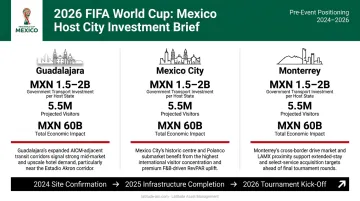
Guadalajara, Mexico City, and Monterrey are hosting FIFA World Cup 2026 matches. The Mexican federal government announced MXN 1.5–2 billion in mobility and public transport investment for each of the three host states. SECTUR projected 5.5 million visitors and more than MXN 60 billion in economic impact.
For hospitality investors, the investment case is clear: demand compresses ahead of the event, hotel rates spike during it, and infrastructure improvements outlast it. Pre-event positioning captures the appreciation — entry during peak demand does not.
High-Growth Sectors for Business and Investment in Mexico
Tourism and Hospitality
Mexico received 45 million international tourists in 2024, with visitor receipts exceeding $32 billion — a 7.4% increase over 2023. Hotel occupancy figures reflect the demand:
| Market | Occupancy | Period |
|---|---|---|
| Cancún | 74.5% | H1 2025 |
| Los Cabos | 78.8% | Jan–Apr 2025 |
| Monterrey | 64% | Through Oct 2024 |
| Mexico City | 59% | Through Oct 2024 |
Cancún's ADR rose 21% and RevPAR grew 27% in H1 2025. More than 5,000 rooms were under construction across Cancún, Riviera Maya, and Los Cabos for 2025–2027. And over 50% of surveyed hotel investors planned to increase Mexico, Central America, and Caribbean hotel investment in 2024.
For investors entering this market, local relationships and operator knowledge carry real weight. Latitude Asset Management's Senior Strategic Partner for Mexico, Germán Ongay, brings more than four decades of leadership in Mexico's hotel industry — including roles as CEO of Óptima Hoteles de México and Regional Vice President of Sales and Franchise Development for IHG Hotels & Resorts in Mexico. His network of owners, developers, and brand contacts informs how Latitude structures acquisitions and franchise negotiations across the country.
Manufacturing and Nearshoring
Mexico's automotive, aerospace, and advanced manufacturing sectors attract consistent foreign direct investment, with Banco de Mexico identifying early nearshoring employment effects in semiconductors, electronic components, and steel products. Foxconn's announcement of a major Nvidia GB200 facility in Mexico — following more than $500 million already invested in Chihuahua — illustrates how serious the manufacturing relocation trend has become.
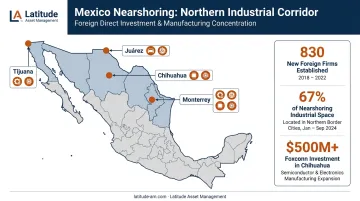
For commercial real estate operators and B2B service businesses, this concentration of industrial activity is generating sustained demand for logistics infrastructure, workforce housing, and supporting hospitality supply in northern border cities.
Technology and Fintech
Mexico's fintech ecosystem comprised 773 locally founded startups at year-end 2023, growing at an 18.4% compound annual rate since 2019. Mexico-based startups attracted $1.176 billion across 125 VC deals in 2024, with fintech accounting for $865 million of that total. Northern border cities — particularly Monterrey, Tijuana, and Juárez — are emerging as secondary tech hubs driven by nearshoring activity.
Renewable Energy
Mexico's installed renewable capacity reached 7,090 MW of wind and 10,000 MW of solar photovoltaic generation at year-end 2024. The IFC provided a $150 million sustainability-linked loan to FIBRA Macquarie Mexico in 2024 for green-certified industrial construction. Long-term institutional investors are treating Mexico's energy transition as a structural allocation — one supported by sovereign policy direction and growing multilateral lending activity.
Mexico Market Entry Strategy Options
Choosing the Right Entry Mode
Direct Establishment (Wholly-Owned Subsidiary)
The most common structure for large-scale operators is the Sociedad Anónima de Capital Variable (S.A. de C.V.) — a variable-capital corporation that provides full control and legal separation from the parent entity. Simpler operations can use the Sociedad por Acciones Simplificada (S.A.S.), which can be formed online by one or more individuals. Both require registration with SAT (Mexico's tax authority) through the RFC process.
This structure offers maximum operational control, but demands the most upfront investment, administrative infrastructure, and regulatory compliance. Best suited for long-term operators with committed in-market resources.
Joint Venture with a Local Partner
A JV gives foreign entrants access to regulatory familiarity, supplier networks, and cultural fluency they'd otherwise spend years building. JVs in Mexico are separate legal entities and must register independently for tax purposes.
Structuring the agreement carefully from the outset protects both parties. Any JV agreement should address:
- Profit-sharing and equity split
- IP ownership and licensing terms
- Dispute resolution mechanisms (arbitration is strongly preferred over local courts)
- Exit provisions and buy-sell arrangements
Franchising and Licensing
Mexico has approximately 1,800 franchise systems operating domestically. Franchising is governed by the Federal Law for the Protection of Industrial Property, and required disclosure must be delivered at least 30 business days before contract execution. The model is well-established and particularly relevant for retail, service, and hospitality brands.
The tradeoff is lower capital risk and faster market access against reduced control over brand execution. Who operates under your brand in Mexico reflects directly on the brand itself — franchisee selection requires as much rigor as the deal terms.
Agent, Distributor, or Representative Office
The lightest-touch entry mode. Useful for market validation, regulated product categories, or sectors with significant regulatory or government procurement components. The ITA recommends that companies consider multiple regional representatives given Mexico's geographic scale — one representative for Mexico City rarely covers Guadalajara or Monterrey adequately.
How to Choose
| Factor | Points Toward |
|---|---|
| Large capital commitment, long-term horizon | Direct Establishment |
| Need for local regulatory fluency quickly | Joint Venture |
| Brand with proven replication model | Franchising |
| Testing demand before committing capital | Agent / Distributor |
| Hospitality with brand affiliation | Franchise or Management Contract |
For hotel investors specifically, the decision typically comes down to three paths:
- Direct ownership with a management contract — maximum control, highest administrative burden
- Franchise agreement with independent operations — brand access without operator dependency
- Joint venture with a local developer — faster market entry, shared risk, shared upside
Each path carries distinct contract structures, liability exposure, and day-to-day oversight demands. The right choice depends on your capital timeline, operational capacity, and risk tolerance in-market.
Legal, Tax, and Regulatory Framework for Mexico
Business Registration and Corporate Structure
All legal entities must register in the RFC through SAT. Engaging local legal counsel before registration is the single most important early decision. Mexico's legal framework is well-developed, but nuanced enough that foreign entrants who skip this step consistently encounter avoidable compliance issues.
Taxation Overview
| Tax | Rate |
|---|---|
| Corporate income tax (ISR) | 30% |
| VAT (IVA) | 16% |
| Dividend withholding (portfolio investors) | 10% |
| Interest withholding (varies by type) | 4.9%–15% |
| Royalty withholding | 10% |
The U.S.-Mexico tax treaty reduces withholding rates for qualifying structures. Entity structure and capital flows between parent and Mexican subsidiary directly affect after-tax returns. Financial underwriting should incorporate Mexico-specific tax assumptions from day one, not as a revision once the deal is underway.
Labor Law and Employment Compliance
Mexico's Federal Labor Law (LFT) mandates several provisions that affect operating cost structures:
- PTU (profit sharing): 10% of distributable profit, split between days worked and wages paid
- 2025 minimum wage: MXN 278.80/day general; MXN 419.88/day in the Northern Border Free Zone
- Severance: Legally defined provisions that apply regardless of employment term
Labor compliance is a core due diligence item for any acquisition or new operation. Underfunded labor liabilities are among the most common hidden costs in hotel and commercial acquisitions in Mexico.
Intellectual Property
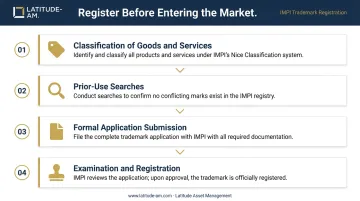
Register trademarks and patents with IMPI (Mexican Institute of Industrial Property) before entering the market, not after establishing operations. The process involves four sequential steps:
- Classification of goods and services
- Prior-use searches
- Formal application submission
- Examination and registration
Brand infringement disputes in Mexico are far harder — and costlier — to resolve once operations are established.
Regional Strategy: Mapping Mexico's Key Business Hubs
Mexico City (CDMX)
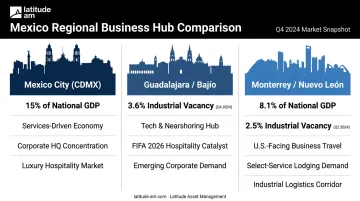
CDMX contributes 15% of national GDP — the largest single state-level contribution in Mexico. It functions as the country's financial, regulatory, and cultural capital, making it the natural home for corporate headquarters, financial services, and professional services infrastructure. For hotel investors, that translates to sustained corporate travel demand and strong positioning for luxury and upper-midscale properties serving government, finance, and multinational business segments.
Guadalajara and the Bajío Region
Guadalajara's "Silicon Valley of Mexico" designation reflects real economic depth. The ITA identifies electronics, semiconductors, and software as core strengths, and the broader Bajío region (including Querétaro and León) leads nearshoring demand — industrial vacancy sat at 3.6% in Q4 2024, effectively full.
For 2026, Guadalajara's FIFA World Cup venue status makes it a hospitality investment accelerant. Investors positioned before the event benefit from infrastructure improvements regardless of whether short-term event demand meets projections.
Monterrey and the Northern Border Region
Nuevo León generated 8.1% of national GDP in 2024. Monterrey holds 15.3 million square meters of industrial inventory with just 2.5% vacancy in Q2 2024, and led nearshoring demand through the first nine months of 2024. Its proximity to the U.S. border, strong transportation infrastructure, and transactional business culture make it the preferred base for U.S.-facing operations. For hotel investors, dense corporate activity and steady cross-border business travel create durable lodging demand across select-service and extended-stay segments.
Border cities like Tijuana and Juárez serve specific maquiladora and manufacturing strategies. They are not general-purpose entry points, but remain essential for businesses tied to cross-border supply chains.
At a glance — key metrics by hub:
| Market | GDP Contribution | Industrial Vacancy | Primary Opportunity |
|---|---|---|---|
| Mexico City (CDMX) | 15% of national GDP | N/A (services-driven) | Corporate HQ, luxury/upper-midscale hospitality |
| Guadalajara / Bajío | Growing tech/nearshoring hub | 3.6% (Q4 2024) | Hospitality investment, FIFA 2026 catalyst |
| Monterrey / Nuevo León | 8.1% of national GDP | 2.5% (Q2 2024) | U.S.-facing business travel, select-service lodging |
Cultural and Relationship Factors in Mexico Business
Mexico is a relationship-first market. The ITA is direct on this point: rapport-building through in-person visits, consistent direct communication, and channels like WhatsApp precedes formal business discussions. Skipping this step doesn't just slow deals; it often prevents them from happening at all.
In practice:
- Budget time for relationship development before expecting formal commitments
- Attend in person for initial meetings — video calls are for established relationships
- Use Spanish-language materials and consider an interpreter for formal meetings
- Titles and formality matter — address counterparts appropriately until invited to do otherwise
Localization deserves equal weight. Businesses that treat it as translation-plus-logistics underperform relative to those who embed local expertise into their operating model from the start. Regional etiquette, investor relationships, and market dynamics vary significantly between Mexico City, Guadalajara, and Monterrey. A hotel deal that closes smoothly in one market may require a fundamentally different approach — and different local contacts — in another. Treating Mexico as a monolithic market is a structural disadvantage.
Frequently Asked Questions
What are the main market entry strategies for Mexico?
The four primary modes are:
- Wholly-owned subsidiary (direct establishment)
- Joint venture with a local partner
- Franchising or licensing
- Agent or distributor arrangements
The right choice depends on your industry, capital available, desired control, and risk tolerance. Most large-scale operators use a combination over time.
Which industries are currently booming in Mexico?
Tourism and hospitality, manufacturing and nearshoring, technology and fintech, and renewable energy are the highest-growth sectors heading into 2026. Hospitality is particularly active, driven by record international visitor receipts and FIFA World Cup demand in Mexico City, Guadalajara, and Monterrey.
Can I buy a business in Mexico as a U.S. citizen?
Yes — U.S. citizens can own and operate businesses in Mexico, though certain sectors (energy, media) carry foreign ownership restrictions. Acquisitions should be structured through the appropriate legal entity with local legal counsel reviewing the transaction before closing.
How does USMCA benefit businesses entering Mexico?
USMCA eliminates or reduces tariffs on qualifying goods traded between the U.S., Mexico, and Canada, and provides investment protections for covered investors. For companies using Mexico as a manufacturing or operations base to serve the North American market, these provisions meaningfully reduce costs and legal exposure.
What makes hospitality a top investment opportunity in Mexico?
Record tourism revenue, 2026 FIFA World Cup demand, and rising middle-class travel are all driving hotel investment across Mexico. Cancún and Los Cabos are posting RevPAR growth above 20%, while World Cup host cities like Monterrey face strong demand against limited supply.
How do I find the right local partner for Mexico market entry?
Industry associations, trade shows, and specialized advisory firms with established Mexico networks are the most productive starting points. Vetting should cover track record, regulatory compliance, and operating philosophy alignment. Firms like Latitude Asset Management — with embedded senior leadership in Mexico — bring relationship credibility that cold outreach cannot match.