
Owning many assets is not the same as being truly diversified. This guide explains the difference.
You'll find a clear definition of portfolio diversification, the core strategies professional investors use, practical allocation models, and the discipline required to maintain a resilient portfolio over time — including where real assets like hotel real estate fit in.
Key Takeaways
- Diversification reduces unsystematic risk but cannot eliminate systematic (market-wide) losses
- True diversification requires low correlation between holdings, not just a large number of them
- A 60/40 portfolio fell 23.7% at the 2009 trough versus 54% for pure equities — a meaningful gap when markets collapse
- Without rebalancing, a 60/40 portfolio drifted to 73.4/26.6 over five years — quietly adding risk
- Real assets — including hotel real estate — can add income, inflation sensitivity, and low correlation to public markets for qualified investors
What Is Portfolio Diversification and Why Does It Matter
Defining the Concept
Portfolio diversification is the practice of spreading investments across different asset types, sectors, geographies, and risk profiles so that the poor performance of one holding is offset (or at least cushioned) by the stability or growth of others.
The mechanism behind this is correlation. When assets move independently, losses in one area don't automatically spread elsewhere. Highly correlated assets rise and fall together — meaning a portfolio can look varied on the surface while offering little real protection.
What Diversification Can and Cannot Do
The CFA Institute draws a clear line between two types of risk:
- Unsystematic risk — company- or sector-specific risk that diversification can reduce or eliminate
- Systematic risk — market-wide risk that no amount of diversification removes
Diversification is a meaningful tool against the first type. It provides no shield against the second.
Morningstar's 150-year stress test puts the difference in concrete terms: at the February 2009 market trough, equities fell 54% from their prior high while a 60/40 portfolio fell 23.7%. That 30-percentage-point gap is what diversification actually delivered during one of the worst financial crises in modern history.
Two Factors That Shape Every Diversification Decision
Before selecting any asset, two personal variables should drive the conversation:
- Time horizon — how long before the money is needed. Longer timelines allow more exposure to volatile assets because there's time to recover from downturns
- Risk tolerance — both the financial ability and the psychological capacity to absorb losses without making poor decisions under pressure
A 35-year-old building retirement savings and a 62-year-old funding near-term income needs require fundamentally different approaches, even if their total capital is identical.
The Return Trade-Off Misconception
A common concern is that diversification limits returns. That concern misses the point: diversification optimizes risk-adjusted performance, not raw returns. NBER research across more than 40,000 brokerage accounts found Sharpe ratios of 0.34 for two-stock portfolios versus 0.56 for portfolios with 15 or more stocks. More holdings, when properly selected, generated better return per unit of risk, not lower returns overall.
Core Portfolio Diversification Strategies
Effective diversification happens at two levels simultaneously: across asset classes and within each one. Neither level alone is sufficient.
Asset Class Diversification
The three traditional asset classes each serve a different portfolio role:
| Asset Class | Return Potential | Risk Level | Primary Role |
|---|---|---|---|
| Equities | Higher | Higher | Growth |
| Fixed Income | Moderate | Lower | Stability and income |
| Cash/Equivalents | Low | Minimal | Capital preservation |
Over the 20 years ended June 30, 2026, large-cap blend equity returned 8.5% annualized with 14.8% standard deviation, while intermediate core-plus bonds returned 3.0% with 4.8% standard deviation, per J.P. Morgan Asset Management data.
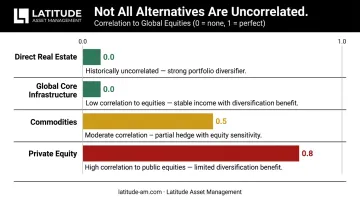
Beyond the traditional three, alternative asset classes — real estate, infrastructure, commodities, and private equity — can add meaningful diversification. Not all alternatives are equally uncorrelated, however. J.P. Morgan's Guide to Alternatives found that from 2Q08 through 4Q25, direct real estate and global core infrastructure both had 0.0 correlation with global equities, while private equity had 0.8. The label "alternative" does not automatically mean "uncorrelated."
Geographic Diversification
Home-country bias — the tendency to over-invest in familiar domestic markets — creates concentration risk that many investors underestimate. U.S. equities represent roughly 55% of global public-equity capitalization, according to Morningstar. Allocating significantly above that level without a deliberate rationale reflects bias, not strategy.
Different regional markets respond differently to:
- Domestic economic cycles and policy decisions
- Currency movements and interest rate environments
- Political events and regulatory shifts
The Americas offers meaningful geographic diversification within a single hemisphere. The U.S. provides liquidity and market depth; Latin America and Mexico offer distinct growth cycles tied to tourism, commodity exports, and emerging consumer demand; the Caribbean operates on demand drivers that are structurally different from either. These markets do not move in lockstep.
Sector and Industry Diversification
Sectors rotate through performance cycles tied to economic conditions. Fidelity's analysis of 1962–2020 market data found that consumer discretionary outperformed in every early-cycle observation and consumer staples in every recession observation. No sector had a better than 50% hit rate in mid-cycle because leadership rotated unpredictably.
Holding exposure across healthcare, energy, financials, technology, real estate, and other sectors reduces the impact of any single sector's downturn on overall portfolio performance.
Investment Style Diversification
Sector leadership rotates — so does style leadership. Growth and value outperform at different points in the economic cycle, and the same holds for market capitalizations. Large-cap, mid-cap, and small-cap stocks each respond differently to interest rate environments and economic momentum.
Blending styles and capitalizations smooths returns across full market cycles. Concentrating in the prior decade's winning style is a reliable way to underperform the next one.
Common Portfolio Allocation Models Explained
Every allocation model makes a concrete bet on the balance between growth and stability. The right structure depends on your goals, timeline, and risk tolerance — and it should be reviewed whenever those factors shift.
The Three Foundational Archetypes
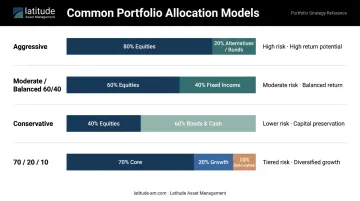
- Aggressive (~80% equities / 20% alternatives or bonds): Best for long time horizons and high risk tolerance. Maximizes growth at the cost of short-term volatility.
- Moderate/Balanced (~60% equities / 40% fixed income): The 60/40 portfolio carries a 150-year track record, though it lost 18.4% in 2022 when stocks and bonds fell together, showing that asset class correlations can shift under stress.
- Conservative (~40% equities / 60% bonds and cash): Suited for near-term goals or investors who cannot absorb significant drawdowns. Prioritizes capital preservation and income over growth.
The 70/20/10 Framework
This tiered approach structures a portfolio into three distinct sleeves:
- ~70% in stable, diversified core holdings
- ~20% in higher-potential growth assets
- ~10% in speculative or alternative investments
The framework works well for investors who want structured exposure to growth without abandoning capital preservation. It functions as a governance template rather than a rigid formula; the specific instruments in each sleeve matter as much as the percentages.
The Equal-Weight (25/25/25/25) Approach
Allocating evenly across four distinct asset classes, such as domestic equities, international equities, bonds, and real assets, eliminates the judgment call of which class to overweight. The S&P 500 Equal Weight Index returned 10.21% annualized over 10 years through June 30, 2026.
The tradeoff: equal weighting may lag during strong bull markets dominated by a single asset class, but it limits concentrated downside during sector-specific or regional downturns.
Warren Buffett's 90/10 Model
In his 2013 Berkshire Hathaway shareholder letter, Buffett described a simplified approach for his family trust: 90% in a low-cost S&P 500 index fund, 10% in short-term government bonds. It prioritizes passive, low-fee equity exposure. Buffett himself framed it as an instruction for a specific personal situation, not a universal institutional prescription.
Each of these models offers a different answer to the same question: how much risk is appropriate for your situation? The most effective starting point is the one that reflects your actual constraints, not the one with the most compelling historical returns.
Real Assets and Alternative Investments in a Diversified Portfolio
Why Real Assets Belong in a Diversified Portfolio
Direct real estate and global core infrastructure each showed 0.0 correlation with global equities from 2008 through 2025. That's the data point that explains why institutional investors treat real assets as structural portfolio components rather than opportunistic additions.
Real assets tend to:
- Generate income independent of stock market cycles
- Appreciate during inflationary periods in certain conditions
- Provide portfolio stability when public markets experience volatility
Performance characteristics, however, vary significantly by property type, geography, and market cycle — "real asset" is not a monolithic category.
Hotel Real Estate: Distinct Characteristics and Considerations
Hotel investments occupy a specific position within real assets. The NCREIF Hotel Index recorded a 7.00% mean return and 10.86% standard deviation from 1983–2020, compared to 8.27% return and 7.25% standard deviation for the broader NCREIF Property Index. Hotels delivered comparable returns with higher volatility — a tradeoff investors need to understand clearly before allocating.
What makes hotels potentially valuable in a diversified portfolio:
- Room rates reprice daily, unlike office or retail leases locked in for years
- Recurring cash flow comes from operations, not just appreciation
- ADR tracks inflation at an approximate 0.54 correlation (CBRE), with the relationship strongest for luxury and resort properties
- Economy hotels have shown a negative inflation sensitivity — the connection is conditional, not uniform
Luxury and resort properties are where the inflation hedge is most defensible; economy hotels have not demonstrated the same dynamic.
Hotel Investment Across the Americas
U.S. hotel transaction volume reached $24 billion in 2025, up 17.5% year-over-year, reflecting strong institutional liquidity in the domestic market. Beyond the U.S., Latin American and Caribbean markets operate on different demand cycles and entry economics — offering geographic diversification within the hotel asset class itself.
Hotel real estate requires specialized expertise to evaluate properly. Several factors interact to determine actual investment performance:
- Market positioning and brand alignment
- Operator quality and management structure
- Capital expenditure requirements and timing
- Geographic demand drivers by submarket
Investors seeking exposure across the Americas — whether in the U.S., Mexico, the Caribbean, or Latin America — benefit from advisors who combine institutional financial discipline with direct operational experience in the asset class.
Latitude Asset Management focuses specifically on cross-border hotel investment and asset management across the Americas. The firm's team includes Cornell-certified hotel investment professionals, a CFA charterholder with institutional finance and hospitality analytics experience, and former brand executives from Hyatt, Loews, and IHG — bringing financial, operational, and brand expertise together under one advisory structure.

The Tradeoffs of Alternatives
Compared to publicly traded securities, alternative investments typically involve:
- Lower liquidity and longer holding periods
- Minimum investment thresholds that limit accessibility
- Higher due diligence requirements
For investors with longer time horizons and appropriate capital, these tradeoffs can be worthwhile. For those who need near-term liquidity, alternatives generally belong in a smaller portfolio sleeve — or not at all.
Common Portfolio Diversification Mistakes to Avoid
Over-Diversification ("Di-worsification")
Holding too many overlapping positions creates the appearance of diversification without the substance. Research on active mutual funds found that combining 1 to 10 funds cut active risk from 3.3% to 1.2% but raised fees per unit of active risk from 19.4 to 53.2 basis points. The result: index-like exposure at active-fund prices.
Hidden overlap is easier to spot than most investors expect. If you hold multiple large-cap equity funds, check whether they own the same underlying stocks. Many investors are surprised to find two or three funds with 60–70% overlap in their top holdings.
Ignoring Correlation
Buying several different assets doesn't mean buying uncorrelated ones. Gold, silver, and platinum may feel like three distinct commodity positions — but their one-year rolling correlation has ranged from 0.68 to 0.95, meaning they often move together. Owning all three provides limited protection compared to what three genuinely independent assets would offer.
The test is not whether assets are different. It's whether they behave differently when it matters — specifically, during market stress.
Treating Diversification as a One-Time Event
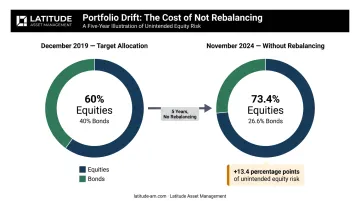
A 60/40 portfolio on December 1, 2019 became 73.4/26.6 by November 30, 2024 without any rebalancing. Equity risk increased by 13.4 percentage points — not through any deliberate decision, but through market movement alone. An investor who thought they held a balanced portfolio was actually running a significantly more aggressive one.
To keep drift in check without over-trading, most advisors follow two practical guidelines:
- Review allocations at least annually, regardless of market conditions
- Rebalance when any asset class drifts more than 5–10% from its target weight
Vanguard's threshold-based method reduced modeled 10-year trading costs to 0.05%, versus 0.22% for monthly rebalancing. Discipline and cost efficiency point in the same direction.
Frequently Asked Questions
What is the best portfolio diversification strategy?
No single strategy fits all investors. The best approach balances asset class diversity, geographic spread, and sector allocation based on an individual's specific risk tolerance, time horizon, and financial goals. A 30-year-old accumulating wealth needs a fundamentally different structure than someone five years from retirement.
What is the 70/20/10 investment strategy?
The 70/20/10 model allocates roughly 70% to stable core holdings, 20% to growth-oriented assets, and 10% to speculative or alternative investments. It provides a structured way to pursue growth while maintaining a defensive foundation. That said, the specific instruments in each sleeve matter as much as the percentages themselves.
What is Warren Buffett's 90/10 rule?
From Berkshire Hathaway's 2013 shareholder letter, Buffett suggested allocating 90% to a low-cost S&P 500 index fund and 10% to short-term government bonds. He framed it specifically as guidance for his family trust: a simplified, passive approach for long-term individual investors, not a universal institutional model.
What is the 25/25/25/25 portfolio?
This equal-weight model divides a portfolio evenly across four distinct asset classes — such as domestic stocks, international stocks, bonds, and real assets or cash. It minimizes concentration in any single category but may underperform during periods when one asset class dominates, such as a sustained equity bull market.
How often should you rebalance a diversified portfolio?
Review your portfolio at least annually — or after major life or financial changes — and rebalance when any asset class drifts more than 5–10% from its target allocation. Threshold-based rebalancing typically outperforms fixed-interval approaches on a net cost basis.
Does portfolio diversification guarantee against investment losses?
No. Diversification is a risk management tool designed to reduce volatility and limit the damage any single underperforming investment can cause. It does not guarantee profits or prevent losses — particularly during market-wide downturns that affect all asset classes simultaneously.