

Introduction
Committing capital to a hotel deal without understanding the legal structure governing that investment is one of the most expensive mistakes an investor can make. The structure shapes everything: who controls decisions, how returns are distributed, what taxes apply, and whether institutional capital can even participate.
Hotels add a layer of complexity that most real estate deals don't face. Unlike a leased office building, a hotel combines real property with an active operating business: the investment structure must account for both asset-level and operating-level cash flows at once.
According to HVS, hotels carry distinctive risks from seasonality and daily room rental cycles that require active revenue management. Those risks need to be reflected in how the investment is structured from day one.
This guide covers the five most common investment structures used in hotel real estate, how each one works, what it's best suited for, and what to consider when choosing among them, including cross-border deals across the US, Mexico, Caribbean, and Latin America.
TL;DR
- Investment structures define how capital is deployed, returns are distributed, and decisions are made
- Main types include direct ownership, JV structures (LLC/LP), private equity funds, REITs, and debt/hybrid instruments
- Each carries distinct implications for control, liability, taxation, and investor access
- The wrong structure leads to costly reorganizations, tax drag, or misaligned incentives
- The right structure depends on deal size, investor type, hold period, and return objectives — no universal answer exists
What Is an Investment Structure?
An investment structure is the legal and financial arrangement governing four core elements:
- How the asset is owned and titled
- How capital is contributed by each party
- How returns are distributed among stakeholders
- Who holds decision-making authority
In hotel real estate, structures govern the relationship between the asset, the capital, and all parties involved — whether a single owner, a group of co-investors, or an institutional fund. Cornell University's hospitality program frames hotel ownership structure as the arrangement determining control and management, with direct consequences for cost, benefit, and risk.
The structure chosen before closing shapes every financial outcome that follows — from tax treatment and profit splits to exit rights and liability exposure.
Why Investment Structures Matter in Hotel Real Estate
Hotels are operationally complex investments. They generate income as both a property and a business — which means a structure that works well for a passive apartment investment may create real problems in a hotel context.
CBRE reported that global cross-border hotel investment rose 54% year over year in 2024, with total global hotel transaction volume rising 16%. That scale of capital movement makes structure selection more consequential, not less — particularly as more deals cross jurisdictions.
What goes wrong without a well-considered structure:
- Mismatched incentives between owners and operators
- Ambiguous distribution waterfalls that trigger disputes when cash flows are thin
- Poor tax positioning that creates entity-level drag
- Difficulty attracting institutional capital due to governance gaps
For cross-border deals — across the US, Mexico, the Caribbean, and Latin America — structure selection also determines how foreign capital is treated legally and fiscally in each jurisdiction. A structure that works in Miami may create regulatory exposure in Cancún or Cartagena.
In practice, many hospitality investments underperform not because of poor location or weak demand, but because misalignment, structural gaps, and execution failures erode returns before the asset reaches its potential. The sections below break down the structures most commonly used in hotel real estate — and the tradeoffs each one carries.
Types of Investment Structures
Investment structures vary significantly based on the number of investors involved, the level of control each party needs, the desired tax treatment, and the deal's scale and complexity. In hotel real estate, different structures serve different investor profiles — from a family office buying a boutique property to an institutional fund assembling a multi-country portfolio.
Direct / Sole Ownership
A single individual or entity holds legal title to the asset outright — no co-investors, no partnership agreements, no shared governance. All capital, risk, and returns flow directly to the owner.
Best suited for: High-net-worth individuals or family offices acquiring a single hotel with no need to pool outside capital; buyers who prioritize full operational control.
Key strengths:
- Simple decision-making with no governance negotiations
- Low administrative overhead
- No profit-sharing obligations
- Full flexibility on operational and exit timing
Limitations:
- Unlimited personal or entity-level liability
- No risk-sharing or scalability
- Less attractive to third-party capital partners
For single-asset owners operating without an in-house team, Latitude Asset Management provides asset oversight and owner representation — acting as the owner's proxy to ensure operators deliver results aligned with investment objectives.
Joint Venture — LLC or LP Structure
The joint venture is the most common structure in hotel investment. Two or more parties — typically a sponsor/operator and one or more capital investors — form a limited liability company (LLC) or limited partnership (LP) to co-own a property. The entity holds the asset; each party's rights and obligations are governed by a negotiated operating or partnership agreement.
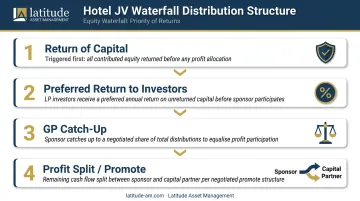
The defining feature is the separation of roles: the sponsor contributes expertise, deal sourcing, and management; the capital partner provides most of the equity. Returns flow through a tiered waterfall — typically a preferred return to investors first, followed by a profit split (the promote or carried interest) once return thresholds are met.
Goodwin's hospitality-specific JV analysis identifies the core issues in these agreements: venture scope, equity commitments, asset-level financing, management authority, major-decision consent rights, distribution waterfalls, promote economics, transfer restrictions, and exit or deadlock mechanisms.
Best suited for: Mid-to-large hotel acquisitions where a sponsor needs equity capital beyond its own balance sheet; institutional investors seeking co-investment with an experienced operating partner.
Key strengths:
- Pass-through tax treatment (no entity-level federal income tax for partnerships)
- Limited liability for passive investors
- Flexible profit distribution
- Incentive alignment through the promote structure
Limitations:
- Complex legal documentation
- Governance negotiations can be contentious
- Disputes arise when return thresholds aren't met or exit timelines diverge
The IRS treats partnerships as pass-through entities — profits and losses are reported by the partners directly, not at the entity level. A domestic multi-member LLC defaults to partnership tax classification unless it elects otherwise. Confirming the tax treatment of any LLC structure is a necessary step, not an assumption.
Private Equity / Fund Structure (GP/LP Model)
A private equity fund is a pooled investment vehicle — typically a limited partnership — in which a general partner (GP) manages the fund and makes investment decisions, while limited partners (LPs) provide capital. The fund deploys that capital across one or more hotel assets. The GP earns a management fee and carried interest (performance fee).
The key difference from a single-asset JV: the fund structure lets a GP aggregate capital across many investors and deploy it across a portfolio of deals, providing LPs with diversification and the GP with institutional-grade infrastructure. CFA Institute research describes the conventional model as a management fee around 2% and carry of approximately 20% of profits above a threshold — though actual hotel fund terms vary.
Real-world scale: Noble Investment Group closed its $1.0 billion Noble Hospitality Fund V in January 2024, targeting value-added select-service and extended-stay hotels across the US. Certares closed a $284 million hospitality-focused real estate fund in 2023, with approximately $228 million deployed across 10 hotels since 2021.
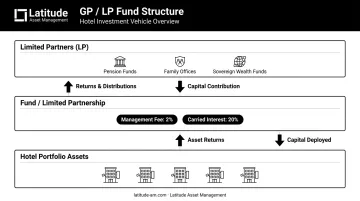
Best suited for: Experienced hotel sponsors building a portfolio across multiple markets; institutional investors (pension funds, family offices, sovereign wealth funds) seeking diversified hotel exposure without direct deal management.
Key strengths:
- Scalable capital deployment across multiple assets
- Professional fund governance and institutional credibility
- Diversification across geographies and risk profiles
Limitations:
- Higher legal and administrative setup costs
- LPs have limited influence over individual deal decisions
- Illiquid over the fund's life
Real Estate Investment Trust (REIT)
A REIT is a corporate-style vehicle that owns and operates income-producing real estate — including hotels — and is required by law to distribute at least 90% of its taxable income to shareholders (based on the IRS Form 1120-REIT distribution test, with specific statutory adjustments applied).
Two distinct categories matter for hotel investors:
| REIT Type | Liquidity | Key Characteristic |
|---|---|---|
| Publicly traded | High — exchange-listed shares | Share price can diverge from underlying asset value |
| Public non-listed | Limited — redemption restrictions apply | SEC-registered but not exchange-traded |
At March 31, 2026, the FTSE Nareit Lodging/Resorts Index contained 12 companies with $31.4 billion in market capitalization, a one-year total return of 20.04%, and a dividend yield of 3.74%.
Best suited for: Passive investors seeking diversified hotel exposure without direct deal involvement; retail investors prioritizing liquidity (public REITs) or income yield (non-traded REITs).
Key strengths:
- Broad investor access, including retail capital
- Liquidity for public REIT shareholders
- Required income distributions
Limitations:
- Investors sacrifice control over individual asset decisions
- Most REIT dividend income is taxed at ordinary income rates, not long-term capital gains rates
- Public REIT share prices can disconnect significantly from underlying asset values
Debt, Preferred Equity, and Mezzanine Structures
In these structures, an investor provides capital as a loan (senior debt), a hybrid instrument (mezzanine debt or preferred equity), or a combination — receiving a contractual return rather than an ownership stake in the upside.
ULI places mezzanine loans and preferred equity in "gap financing" — sitting between a traditional mortgage and common equity in the capital stack. The legal distinction matters: mezzanine debt is typically secured by a pledge of equity interests in the property-owning entity, while preferred equity is an ownership interest with contractual priority over common equity. Their default remedies differ meaningfully from each other and from a first mortgage.
Best suited for: Credit-oriented investors seeking defined returns with asset-level protection; equity owners needing to fill a capital stack gap without diluting their position; investors wanting hotel exposure with downside protection.
Key strengths:
- Defined return profile with contractual priority
- Senior position in cash flow distribution and capital recovery
- Lower exposure to operating performance volatility
Limitations:
- No participation in equity upside or asset appreciation
- Borrower creditworthiness is a key risk factor
- In cross-border deals, debt enforcement can be legally complex
How to Choose the Right Investment Structure for Hotel Investments
The right structure is determined by the investor's specific objectives, risk tolerance, capital availability, and the nature of the asset and market — not by convention.
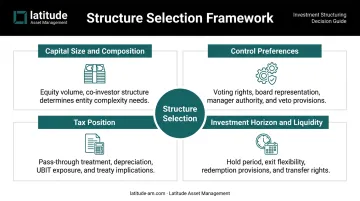
Four factors to evaluate:
- How much equity is available, and from how many sources? Pooling capital from multiple investors typically requires a JV or fund structure (capital size and composition)
- Active investors seeking operational influence need governance rights built into the structure; passive investors should prioritize structures that limit liability exposure (control preferences)
- Entity-level and individual-level tax treatment vary significantly by structure and investor domicile; pass-through treatment, REIT dividend taxation, and carry all need to be modeled (tax position)
- Fund structures and direct ownership lock up capital; public REITs offer daily liquidity; JV exits depend on negotiated transfer rights (investment horizon and liquidity needs)
Hotel-specific considerations:
Brand and management structure — Whether a property is wholly owned, managed, or franchised affects how governance rights should be structured in any investment agreement
Cross-border legal and fiscal treatment — Each jurisdiction carries distinct requirements that don't transfer across borders:
- Mexico distinguishes foreign ownership rights inside and outside the restricted coastal and border zone (100km from borders, 50km from coasts)
- Colombia requires separate foreign investment registration for exchange rights
- The Dominican Republic's tourism incentive framework under Law 158-01 requires a distinct application process beyond entity formation
Each requires dedicated legal and fiscal analysis before capital is committed
Investors working with a specialized hotel asset management advisor gain guidance that connects investment structure to operational realities. Latitude Asset Management's team — spanning institutional finance, hotel operations, and cross-border deal experience — provides advisory work across deal structure analysis, scenario modeling, and pre-acquisition capital planning throughout the Americas.
Common Mistakes to Avoid
Three structural errors account for a disproportionate share of deal complications in hotel investment — and all three are avoidable with proper upfront diligence.
Defaulting to a familiar structure without evaluating fit. Using an LLC because it worked on a previous deal — without assessing whether it fits the current deal's tax, liability, or governance requirements — leads to expensive restructuring. A structure that succeeded in one jurisdiction can create serious problems in another.
Leaving the capital stack undefined. Failing to clearly define where preferred equity sits relative to senior debt and common equity creates disputes when cash flows fall short. Latitude's advisory work reflects a consistent pattern: many distressed hotel situations trace back to capital structures that left no margin for error, not to weak underlying assets.
Ignoring cross-border complexity until after capital is committed. A US investor entering a hotel deal in Colombia or Mexico must confirm the investment structure is compatible with local legal requirements before closing — not after. Structures that work cleanly in domestic deals rarely translate across jurisdictions without modification, and the regulatory consequences of assuming otherwise are real.
Identifying which mistake applies to a given deal is the starting point for structuring correctly — the next step is knowing which structure actually fits.
Frequently Asked Questions
What is an investment structure?
An investment structure is the legal and financial framework that defines how a hotel asset is owned, how capital is contributed and distributed, and how decisions are made throughout the investment lifecycle — governing the relationship between the asset, the capital, and all parties involved.
What are the main types of investments in hotel real estate?
The main types range from direct ownership to joint ventures (LLC or LP), private equity fund structures, REITs, and debt or hybrid instruments such as mezzanine debt and preferred equity.
What is the 70/20/10 investment strategy?
The 70/20/10 framework is a portfolio allocation model used to balance risk across investment categories. Some hotel investors apply this logic to split capital across core, value-add, and opportunistic strategies, though no standard hotel-specific definition of the rule exists.
What is the difference between debt and equity investment structures?
Equity structures give investors an ownership share with participation in profits and appreciation. Debt structures offer a contractual fixed return with repayment priority but no upside. Hybrid instruments — mezzanine debt and preferred equity — blend both, combining contractual priority with limited equity-like participation.
What investment structure is most commonly used for hotel real estate deals?
Joint ventures structured as LLCs or limited partnerships are the most common vehicle for hotel investment transactions, given their pass-through tax treatment, flexible distributions, and sponsor-investor alignment through preferred returns and promotes.