Introduction
Most hotel lenders want audited operating history, a clean pro forma, or both. Repositioning deals offer neither. Unlike stabilized acquisitions — where lenders can anchor on 12-24 months of trailing performance — or ground-up construction with a blank-slate pro forma, repositioning combines the uncertainty of a transitional asset with the capital intensity of a full renovation.
There's no clean trailing NOI to underwrite. Cash flow gets disrupted mid-project. The post-renovation performance record doesn't exist yet. That's what makes repositioning financing among the most complex structures in hospitality real estate — lenders must underwrite a forward-looking thesis on an asset that looks nothing like its future self during the period they're being asked to fund it.
This guide covers the financing instruments most relevant to hotel repositioning, how to build a capital stack that accounts for all three phases of a project, what lenders actually look at when underwriting transitional hotel assets, and how to prepare a package that gets funded at competitive terms.
Key Takeaways
- Bridge loans are the primary repositioning instrument, sized on exit value and pro forma cash flow rather than trailing performance
- Most repositioning projects require two financing phases: a transitional instrument followed by permanent debt post-stabilization
- Mezzanine debt and preferred equity typically price at 12–14% and fill the gap between senior debt and sponsor equity
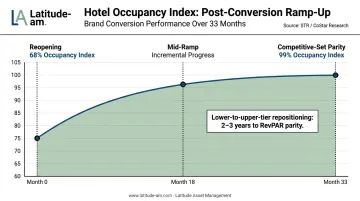
- Independent-to-brand conversions average 33 months to reach competitive-set occupancy parity — build your financing structure around that timeline
- Sponsor credibility carries outsized weight; lenders underwrite the team as much as the asset
What Makes Hotel Repositioning Financing Different
Lenders Can't Use the T-12
The trailing 12-month financial statement is the foundation of conventional hotel underwriting. For a stabilized asset, lenders typically require 12–24 months of actual operating results, 1.30x–1.50x DSCR, and lend at 55–65% LTV.
None of that applies to a repositioning deal. The T-12 reflects the old product — a misbranded, underperforming, or neglected asset. Using it to underwrite the future repositioned property would be meaningless.
Lenders have to pivot to pro forma-based analysis, which means they're evaluating projections rather than history. That shift increases perceived risk, which is why repositioning financing carries higher costs and demands stronger evidence that the sponsor can execute.
Three Cash Flow Phases — Each Creates Risk
Repositioning projects rarely generate consistent cash flow. The financing structure has to survive three distinct phases:
- Renovation phase — partial or full closure, minimal revenue
- Ramp-up phase — reopening with reduced occupancy, elevated operating costs
- Stabilization phase — target performance achieved
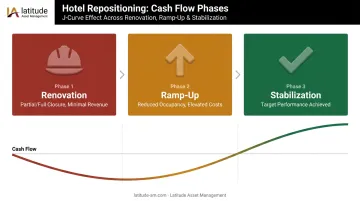
Each phase creates a different cash flow profile. A structure that only works at stabilized occupancy is not a viable repositioning capital stack.
Brand Conversion Adds Capital and Timeline Pressure
Those three phases become harder to navigate when a flag change is layered in. Brand conversion expands both the capital requirement and the timeline. New franchise agreements trigger Property Improvement Plan (PIP) requirements, upfront franchise fees, and brand-mandated renovation standards. Brands don't negotiate PIP scope — they set minimum standards as a condition of affiliation.
Lenders treat unsigned franchise agreements as a material risk. A signed brand letter of intent significantly improves lender confidence because it converts the brand story from aspirational to contracted.
Management Credibility Is Underwritten Like Collateral
For stabilized acquisitions, lender scrutiny focuses on the asset. For repositioning, it shifts heavily toward the team. A sponsor with no prior repositioning experience, no established brand relationships, and no credible operator engaged will face longer timelines and worse terms — or no commitment at all. Lenders price the gap between a compelling pro forma and an unproven team — and that gap is expensive.
Key Financing Options for Hotel Repositioning Projects
Bridge Loans
Bridge loans are the most common primary financing vehicle for repositioning. They're designed specifically for transitional assets — typically structured with 12–36 month terms plus extension options, and underwritten on forecast cash flow, the execution plan, and sponsor experience rather than stabilized operating history.
What bridge lenders require for a repositioning deal:
- Credible post-renovation pro forma with phased occupancy assumptions
- Defined refinancing or exit strategy at the end of the bridge term
- Contractor-level renovation budget with line-item detail
- Sponsor track record on comparable repositioning projects
- Clear articulation of the market gap the repositioning addresses
Vague narratives and aggressive pro formas are the fastest path to lender skepticism. Bridge underwriters are experienced enough to recognize when projections haven't been stress-tested.
Private Debt Funds
Private debt funds occupy a similar role to bridge lenders but accept a higher risk profile and move faster. They finance repositioning projects where current property performance is too weak for conventional bridge terms, or where the scope is complex enough that institutional banks aren't the right fit.
The trade-off is cost. Private debt is significantly more expensive than bank bridge financing — that premium is the price of flexibility and speed.
Most effective when:
- The asset has severe performance deficits that disqualify conventional bridge terms
- The repositioning involves a simultaneous brand change and significant physical renovation
- Timeline pressure makes conventional underwriting timelines impractical
Mezzanine Financing and Preferred Equity
Mezzanine financing fills the gap between senior debt and sponsor equity. Senior lenders on transitional hotel assets typically lend at lower LTVs than they would on stabilized properties — meaning a significant portion of total project cost falls below the senior debt ceiling and above what sponsors are willing to fund with pure equity.
Mezzanine debt and preferred equity sit in that gap. HVS reports typical 2026 pricing at 12–14% — materially more expensive than senior debt, reflecting the subordinate position and transitional risk.
Important trade-offs to understand:
- Requires an intercreditor agreement with the senior lender (adds negotiation time)
- May include equity-like features — warrants, conversion rights, or governance participation
- Preferred equity investors commonly seek approval rights over sale, refinancing, or management changes
- Only justified when post-repositioning NOI projections support the full combined debt load
A real transaction benchmark: Access Point provided $44M of mezzanine debt within a $286M total financing package for the acquisition and repositioning of 38 U.S. hotels — illustrating how mezzanine can function at scale in a repositioning context.
Conventional Bank and CMBS Loans
Conventional bank and CMBS financing is not a repositioning tool — it's the exit from repositioning financing. These instruments become accessible once the repositioned property has 12–24 months of clean operating performance reflecting the new positioning, at which point they replace the bridge or private debt at a materially lower cost of capital.
Planning the refinancing into permanent debt from day one is not optional. Failing to account for what the asset needs to achieve to qualify for permanent financing — and building that into the original capital structure — is a common and expensive mistake.
Equity Structures
Where debt financing defines the floor of a repositioning capital stack, equity defines the upside. Private equity firms and JV partners are active in repositioning deals because the value-creation thesis is compelling: a property acquired at distressed valuations and repositioned to a higher-performing segment can generate strong equity returns.
Equity partnerships in repositioning deals create alignment requirements that must be negotiated carefully:
- Exit windows are non-negotiable for PE partners — typically 3–7 years, defined upfront
- IRR hurdles and preferred return structures must be agreed before capital is committed
- Decision rights over capital allocation, brand selection, and disposition need clear contractual definition
In JV structures, misalignment on renovation scope, brand selection, or exit timing consistently generates the most project friction. Addressing these points in the partnership agreement — before capital is deployed — is far less costly than resolving them mid-execution.
Building the Right Capital Stack for Repositioning
Typical Stack Structure
A repositioning capital stack generally looks like this:
| Layer | Typical Range | Notes |
|---|---|---|
| Senior debt (bridge/private) | 50–65% of total project cost | Based on post-repositioning value; lower end for higher-risk projects |
| Mezzanine / preferred equity | Variable gap-fill | Priced at 12–14%; requires senior lender consent |
| Sponsor equity | Remainder | Higher contribution expected for transitional assets |
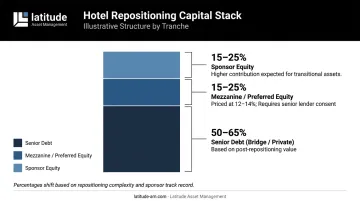
These percentages shift based on the perceived complexity of the repositioning scope and the sponsor team's demonstrated track record.
Plan Both Phases Before Closing Phase One
The two-phase financing journey should be mapped out before the first loan closes:
- Phase one: Bridge or private debt funds the acquisition, renovation, and brand conversion
- Phase two: Permanent financing (bank or CMBS) replaces phase one once the asset stabilizes
Too many sponsors treat phase two as something to figure out later — a decision that routinely creates maturity risk on bridge debt that is entirely avoidable. The target permanent lender's requirements — occupancy track record, DSCR, operating history length — should be built into the phase one structure from the start.
Reserve Sizing Is Not Optional
Lenders require reserves, and sizing them correctly is critical:
- Renovation completion reserve — covers budget overruns during construction
- Operating reserve — covers debt service and operating shortfalls during ramp-up
- Contingency reserve — accounts for unexpected delays or cost escalation
Undercapitalizing reserves is one of the most frequent causes of repositioning project stress. A well-structured stack typically targets a contingency reserve of 10–15% of total renovation costs — enough to absorb schedule slippage and scope changes without forcing an emergency recapitalization.
C-PACE as a Supplementary Layer
For repositioning projects that include qualifying improvements — HVAC upgrades, LED systems, building envelope work, water conservation — C-PACE financing is available through active programs in 36 states plus D.C., with repayment terms of up to 30 years through a property assessment structure.
C-PACE reduces the senior debt requirement and preserves equity without adding conventional debt service pressure. Senior lender consent is required, and program eligibility varies by jurisdiction — confirm both before including C-PACE in the capital plan.
What Lenders Evaluate in a Repositioning Deal
Pro Forma and Stabilization Timeline
Because T-12 financials don't reflect the repositioned asset, lenders anchor on the post-repositioning pro forma. The key metrics they focus on:
- Projected NOI and RevPAR at stabilized occupancy
- DSCR modeled at ramp-up occupancy (not just steady state)
- Cost-per-key renovation budget relative to market segment
- Comparable repositioned asset performance in the same market and submarket
On stabilization timelines, the data supports conservative assumptions. STR/CoStar research found that independent-to-brand conversions progressed from a 68% occupancy index to 99% by month 33, while lower-to-upper-tier repositioning projects often required two to three years before reaching competitive-set RevPAR parity. Plan the financing structure around these realities, not optimistic assumptions.
Sponsor Credibility
For transitional assets, lenders apply a credibility premium. What they look for:
- Prior repositioning experience with comparable assets
- Established brand relationships that validate the conversion plan
- A credible operator or asset manager already engaged
- Financial projections grounded in operational knowledge, not modeling alone
This is where the composition of the sponsor team directly affects financing terms. A team that has managed hotel transitions, worked within major brand systems, and stabilized underperforming assets presents a fundamentally different risk profile than a financial sponsor approaching hospitality for the first time.
Why Advisory Engagement Changes Lender Reception
Engaging an experienced hotel asset management partner early in the process — before approaching lenders — directly changes how a repositioning deal is received. Advisors who combine operational depth, brand relationships, and institutional financial rigor can build more credible projections, navigate PIP negotiations, and present a package that lenders recognize as professionally prepared.
Latitude Asset Management's team reflects exactly the advisory credibility lenders are looking for. Key credentials that translate directly to lender confidence:
- Anthony Del Gaudio (35+ years across Hyatt Hotels, Loews Hotels, and IHG — wholly owned, managed, and franchise operations) provides brand-side validation that proposed flag changes are realistic and that renovation budgets reflect actual PIP experience
- Germán Ongay (former Regional VP of Sales and Franchise Development, IHG Mexico, with 40+ years in the industry) adds franchise negotiation depth that supports lender confidence in brand conversion plans
- Javier Revelo, CFA, brings institutional-grade underwriting, scenario analysis, and capital structure evaluation that lenders expect in a serious financing package
How to Prepare Your Repositioning Financing Package
Essential Documents
An incomplete package is the single biggest source of delay in repositioning financing. Lenders expect:
- Current property valuation
- Detailed repositioning budget (framed in cost-per-key)
- Brand conversion letter or PIP documentation (if applicable)
- Post-repositioning pro forma with phased occupancy assumptions (renovation, ramp-up, stabilized)
- Comparable repositioned asset performance comps in the same market
- Current franchise or management agreement
- Borrower financial statements
- Clear exit strategy and permanent financing plan
For brand conversions specifically, lenders also examine franchise termination rights, comfort letters from the franchisor providing notice and cure rights, and PIP obligations — all standard components of conversion diligence.
Frame the Repositioning Narrative Effectively
The financing package should lead with the value-creation thesis:
- What demand segment is underserved in this market, and why this location is positioned to capture it
- How the renovation, brand conversion, and operational transition will be sequenced and managed
- How the three risks lenders will raise — timeline slippage, cost overruns, and ramp-up underperformance — are specifically mitigated
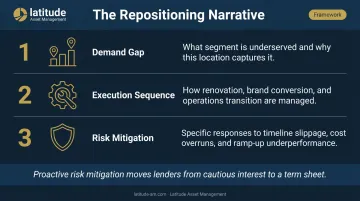
Lenders know what can go wrong in a repositioning. A package that proactively addresses those risks — with specific mitigation strategies, not vague reassurances — demonstrates institutional discipline. That discipline is what moves a lender from cautious interest to a term sheet.
Frequently Asked Questions
What is the difference between hotel repositioning financing and standard renovation financing?
Repositioning financing treats the property as a transitional asset — underwritten on pro forma projections and phased capital structures rather than historical performance. Standard renovation financing on a stabilized asset uses the existing operating track record as the underwriting foundation, making it a simpler and lower-cost process.
How much equity is typically required for a hotel repositioning project?
Repositioning projects require more equity than stabilized acquisitions — lenders offer lower leverage on transitional assets and want sponsors meaningfully at risk alongside debt providers. The exact contribution depends on repositioning scope, the sponsor's track record, and the perceived risk of the specific project.
Can bridge financing cover both the acquisition and the renovation costs of a repositioning project?
Yes. Many bridge loans are structured to cover total project cost — acquisition plus renovation budget — provided the lender is comfortable with the exit strategy and the combined loan amount stays within their LTV comfort zone for the post-repositioning value. The key is a credible exit plan and a detailed renovation budget.
How does a brand flag change affect the financing of a hotel repositioning?
Brand conversions add capital requirements — PIP costs, franchise fees, and brand-mandated improvements — plus timeline complexity that must be built into the financing structure. A signed brand agreement or letter of intent significantly strengthens the lender package, converting the brand story from speculative to contracted.
What financial metrics do lenders use to underwrite a transitional hotel asset?
Current operating history is largely set aside. Lenders focus instead on:
- Post-repositioning pro forma NOI
- Projected DSCR at both ramp-up and stabilized occupancy
- Cost-per-key renovation budget
- Comparable repositioned asset performance in the same market and segment
When is the right time to refinance out of bridge financing after a repositioning project?
Permanent refinancing is typically pursued once the repositioned asset has 12–24 months of clean operating performance that supports conventional or CMBS underwriting standards. Planning the refinancing timeline from day one and structuring the bridge accordingly is the most reliable way to avoid maturity risk.