
Introduction
Most investors who commit capital to a private equity fund understand the basics — a GP manages money, LPs provide it, and profits are split. What many miss is the operational and legal machinery beneath that surface: who controls decisions when things go sideways, how fees stack across the structure, what triggers a capital call, and what "illiquid for 10 years" actually means for cash planning.
A private equity fund structure is the formal legal and economic framework (typically a limited partnership) that governs how capital is raised, managed, deployed, and returned. Understanding it isn't academic.
For hotel investors, family offices, and institutional allocators evaluating PE-backed deals across the Americas, the structure directly determines liability exposure, governance rights, and realistic return timelines.
This guide breaks down every layer: the parties involved, how the structure looks visually, the fund lifecycle, fee mechanics, and the misconceptions that cost investors clarity before they commit.
Key Takeaways
- PE funds are structured as limited partnerships, separating GP decision-making from LP capital contribution
- The LPA is the fund's rulebook: it governs fees, duration, profit-sharing, and governance rights
- GPs earn a management fee (average 1.74% for 2024-vintage buyout funds, per Preqin) plus 20% carried interest above a preferred return
- Fund lifecycle runs approximately 10 years: a 5-6 year investment period followed by a 4-5 year harvest phase
- Understanding fund structure before committing capital is essential for evaluating liquidity constraints and GP/LP alignment
What Is a Private Equity Fund Structure?
A PE fund structure is the legal and economic framework that organizes the rights, responsibilities, and financial arrangements between fund managers and investors in a private equity vehicle.
The structure exists to accomplish a specific set of outcomes:
- Pool capital from multiple investors under one mandate
- Deploy it into private companies or assets
- Return profits — while limiting passive investor liability
- Achieve tax efficiency through pass-through treatment
The limited partnership dominates PE fund formation because no other legal structure simultaneously delivers pass-through taxation, capped liability for passive investors, and flexible governance terms. That combination has made it the standard vehicle across private equity for decades, a position validated by both the Debevoise fund formation guide and ILPA's model LPA framework.
PE funds are closed-end vehicles. Capital is raised during a fixed window, deployed over an investment period, and returned during a harvest phase. Unlike open-end mutual funds, investors cannot freely enter or exit — your commitment runs until the fund winds down and capital is returned.
The Core Parties: GP, Management Company, LPs, and Portfolio Companies
Four distinct parties form the core of any PE fund structure. Each plays a different role, carries different rights, and faces different liability exposure.
General Partner (GP)
The GP sits at the top of the structure with full legal authority — it makes all investment decisions, manages fund operations, and assumes unlimited liability for fund obligations. In practice, GPs are almost always organized as LLCs specifically to shield individual partners from that personal exposure. The fund entity carries GP liability; the LLC form insulates the humans behind it.
Management Company
A separate operating entity — legally distinct from the GP — that employs the investment professionals who source deals, conduct diligence, and manage the portfolio day-to-day. It operates under a Management Agreement with the fund and receives management fees for this service. The distinction matters for regulatory and tax treatment, even though the management company and GP are typically affiliated with the same principals.
Limited Partners (LPs)
LPs provide the capital — pension funds, endowments, sovereign wealth funds, insurance companies, family offices, and high-net-worth individuals. Under Delaware law, LP liability is capped at their committed capital provided they don't participate in fund management. They have no say in individual investment decisions; their governance rights are confined to matters explicitly reserved in the LPA.
Portfolio Companies
The operating businesses the fund acquires. In exchange for capital, portfolio companies may offer the fund preferential voting rights or liquidation preferences. The GP's investment mandate defines which types of companies are targeted.
For PE funds holding hospitality assets, this layer gets more complex. Hotel operations require specialized oversight that most GPs aren't staffed to provide directly, so they engage a dedicated hotel asset manager — a firm that acts as the owner's proxy, oversees operators, manages brand transitions, and holds hotel-level performance accountable to the fund's return targets. Latitude Asset Management fills this role across the Americas, applying institutional discipline to on-the-ground hotel execution throughout the U.S., Mexico, the Caribbean, and Latin America.

How a PE Fund Is Structured: A Visual Breakdown
The fund structure runs vertically — GP at the top, portfolio companies at the bottom — with each layer connected by specific legal agreements.
[GP Entity — LLC]
        |
[Management Company] ←→ Management Agreement
        |
[The Fund — Limited Partnership]
   ↑ LPA + Subscription Agreements
[Limited Partners]
        |
[Portfolio Companies]
Surrounding Vehicles
Most institutional funds add layers to accommodate different investor types:
- Feeder funds — pool capital from specific LP categories (U.S. taxable investors, offshore entities) and invest into a master fund
- Parallel funds — run in tax-efficient jurisdictions (Cayman Islands, Luxembourg) for international LPs, investing alongside the main fund on identical terms
- Co-investment vehicles (SPVs) — allow select LPs to invest in single deals outside the blind pool, often at reduced or zero fees and carry
The LPA: The Fund's Rulebook
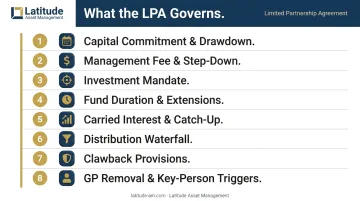
The Limited Partnership Agreement governs everything. Per ILPA's model LPA framework, it covers:
- Capital commitment procedures and drawdown mechanics
- Management fee rates and step-down triggers
- Investment mandate — geography, sector, deal size
- Fund duration and extension rights
- Carried interest calculation and catch-up mechanics
- Distribution waterfall sequencing
- Clawback provisions
- GP removal and key-person event triggers
Capital Calls
LPs commit capital upfront but don't transfer funds immediately. When the GP identifies a deal, it issues a capital call, typically with at least 10 business days' notice before payment is due. This keeps LP cash productive until actual deployment is needed.
Key mechanics to understand:
- Notice period — most LPAs require 10+ business days between the call notice and the funding deadline
- Default consequences — failing to fund a capital call can result in LP interest dilution or forced sale of LP units
- Credit facilities — GPs often use subscription lines to bridge timing gaps before formal capital calls are issued
The PE Fund Lifecycle: From Formation to Exit
PE funds follow a defined three-phase structure. Knowing where a fund sits in its lifecycle is critical for matching PE commitments to your own liquidity planning.
| Phase | Typical Timing | What Happens |
|---|---|---|
| Formation | Pre-launch | Strategy defined, LPA negotiated, offering documents prepared, initial targets identified |
| Investment Period | Years 1–5 or 6 | Capital called and deployed, portfolio companies acquired and actively managed |
| Harvest Period | Years 5–10 | Focus shifts to exits — IPO, secondary sales, trade sales — and distributions flow to LPs |
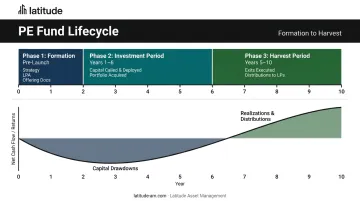
The finite term creates urgency for exits and disciplines GP behavior — without a deadline, GPs have less incentive to sell. Most funds run a 5–6 year investment period followed by a 4–5 year harvest phase. Up to two optional one-year extensions are available, typically requiring LP Advisory Committee consent.
During the investment period, LPs experience net outflows as capital calls draw down committed capital. The harvest period reverses this: distributions start flowing back. Pension funds and family offices allocating to PE must plan around this J-curve dynamic, where early negative cash flows precede later positive returns.
Fee Structure, Carried Interest, and Distribution Waterfall
The "2 and 20" shorthand is a useful starting point — but the actual economics are more nuanced than the label suggests.
Management Fees
Preqin's 2024 benchmark puts the mean headline management fee at 1.74% for 2024-vintage buyout funds — not the 2% often cited. During the investment period, fees are typically calculated on committed capital. After the investment period, the base typically steps down to invested capital less the cost of realized positions.
Carried Interest
The GP's performance compensation is typically 20% of profits above the preferred return. According to ILPA data, this structure applies to 71% of funds surveyed, with an 8% hurdle rate used by 67% of those funds.
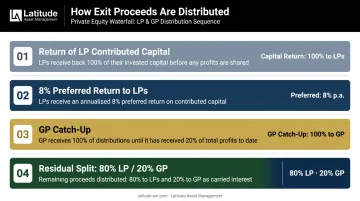
The catch-up provision then sequences as follows:
- LPs receive their 8% preferred return first
- Subsequent distributions flow 100% to the GP until it reaches its pro-rata carry entitlement
- Remaining profits then split 80% LP / 20% GP
Distribution Waterfall
The sequential order in which exit proceeds flow:
- Return of LP contributed capital
- Preferred return to LPs (typically 8% compounded)
- GP catch-up
- Residual split — 80% LP / 20% GP
Waterfall type matters: According to ILPA's dataset of 695 funds, whole-of-fund (European) waterfalls — where carry is only paid after LPs recover all capital and preferred return across the entire fund — represent 58% of North American funds and 73% of European funds. Deal-by-deal (American) waterfalls pay carry per exit, creating earlier GP liquidity but higher clawback risk if later investments underperform.
Common Misconceptions About PE Fund Structure
"LPs Can Veto Individual Investments"
They can't. ILPA's Principles explicitly state that LP Advisory Committees should focus on conflicts and governance matters — not investment selection. The GP has full discretion within the mandate defined by the LPA. LPs can withhold re-commitment to future funds but have limited recourse on existing investments.
"2 and 20 Is the True Cost"
Headline rates overstate net economics. Most LPAs include management fee offsets: fees paid by portfolio companies (transaction fees, monitoring fees, board fees) that reduce the management fee charged to the fund. ILPA recommends 100% offset of these fees. The SEC found that inconsistent application of offsets at one PE firm produced over $500,000 in excess management fees. That gap matters. Always ask for net economics, not gross terms.
"GPs Bear Unlimited Personal Liability"
The GP entity bears unlimited statutory liability for fund obligations — but individual GP principals are typically insulated because the GP itself is organized as an LLC. The LLC form is explicitly used in ILPA's model LPA as the standard GP drafting assumption. The liability sits at the entity level; the LLC shields the people behind it.
Frequently Asked Questions
What is a typical private investment fund structure?
Most private investment funds are organized as limited partnerships, with a General Partner managing operations and Limited Partners providing capital. The LPA governs all rights and obligations : fees, duration, investment restrictions, and profit-sharing — and serves as the binding contract between all parties.
What are the main types of private investment funds?
The primary categories are private equity (buyout, growth equity, venture capital), private credit, real estate, and infrastructure funds. Each shares the LP/GP legal structure but differs in strategy, asset type, and return profile. Preqin tracks these as distinct asset class strategies with separate performance benchmarks.
What is the 80/20 rule in private equity?
It refers to the distribution waterfall split: after LPs receive their preferred return and the GP completes its catch-up, remaining profits are split 80% to LPs and 20% to the GP as carried interest. This is the market standard, though some funds negotiate variations — 70/30 splits appear occasionally in GP-favorable structures or first-time funds.
What is the role of a General Partner in a private equity fund?
The GP manages all fund operations: sourcing and executing investments, overseeing portfolio companies, and managing exits. In exchange, it receives management fees and carried interest. Because the GP entity bears unlimited legal liability for fund obligations, it is almost always structured as an LLC.
How long does a typical private equity fund last?
Most PE funds have a 10-year legal term : roughly a 5-6 year investment period followed by a 4-5 year harvest phase. Optional one-year extensions (typically up to two) are available when assets need more time to reach an optimal exit.
What is carried interest in private equity?
Carried interest is the GP's share of fund profits: typically 20% of gains above a preferred return threshold, commonly set at 8%. It aligns GP incentives with LP outcomes — the GP earns meaningful upside only after investors have recovered their capital and preferred return.
Conclusion
A private equity fund structure accomplishes something specific: it separates investment management from capital provision, limits passive investor liability, achieves tax-efficient pass-through treatment, and aligns manager incentives with investor outcomes through performance-based carry. Every element — the LP form, the LPA, the waterfall, the lifecycle — exists to serve those four goals.
For hotel owners, developers, and investors navigating PE-backed transactions across the Americas, this structure isn't abstract. It defines who controls the asset, what fees reduce your net return, and when you'll see capital back. Knowing the mechanics before committing is the difference between informed allocation and a decade of surprises.
For PE funds with hotel portfolio companies, that knowledge also extends to asset-level execution. Latitude Asset Management works alongside fund GPs and institutional investors across the U.S., Mexico, Caribbean, and Latin America. The firm provides hotel-specific asset management, operator oversight, brand negotiations, and performance turnaround expertise — translating institutional fund discipline into measurable property-level results. With a team spanning four languages and deep regional presence, Latitude connects capital objectives to on-the-ground execution across every market it serves.