Introduction
A hotel room, stripped of context, is a commodity. Four walls, a bed, a bathroom: interchangeable with the property down the street. A brand is what makes guests choose you, pay more to stay with you, and come back when they could go anywhere.
For hotel owners, developers, and investors, branding is not a marketing exercise. It is a strategic decision that shapes RevPAR, distribution costs, lender appetite, and ultimately exit value. Done well, the brand becomes a value amplifier. Done poorly, it creates friction at every level: between ownership, operator, and guest.
This guide covers what hotel branding actually means at an ownership level, why it carries direct financial consequences, and how to build a brand strategy that serves your investment thesis, not just your marketing team. You'll also find a step-by-step framework for 2026, a breakdown of the franchise versus independent decision, and the key trends reshaping guest expectations right now.
Key Takeaways
- Hotel branding drives RevPAR, reduces OTA dependency, and improves NOI
- Effective brand clarity aligns with your asset's location, physical product, and investment objectives
- Choose franchise, soft brand, or independent based on your investment thesis — not convention
- Touchpoint consistency converts a brand promise into measurable guest loyalty
- Brand strategy requires ongoing monitoring; stagnation carries a measurable financial cost
What Is Hotel Branding?
Hotel branding is the total identity and reputation of a property in the market. It encompasses values, visual identity, service philosophy, guest experience promises, and competitive positioning. A logo is one small piece of it. The name is another. The brand itself is the sum of every impression a guest forms: from the first search result they see to the moment they check out.
Branding vs. Marketing: A Critical Distinction
These two functions are often conflated, and the confusion costs owners real money.
- Branding is the long-term identity that drives perception and loyalty — the why guests choose you
- Marketing is the tactical effort to reach and convert them — the how they discover you
A hotel can spend aggressively on marketing and still fail to build a brand. Marketing drives traffic; branding drives preference, repeat visits, and pricing power.
What Effective Branding Actually Looks Like
A strong hotel brand creates recognition and emotional connection across every stage of the guest journey. That journey spans five distinct touchpoints:
- Pre-booking research — first impressions formed through search results, reviews, and social media
- Arrival — physical environment and staff interaction set the tone immediately
- The stay — service culture and room experience either confirm or contradict the brand promise
- Check-out — final in-person moment that shapes what guests remember
- Post-stay follow-up — communications that determine whether a guest returns or doesn't
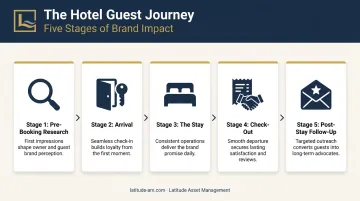
Consistency across these touchpoints builds trust. Inconsistency generates one-star reviews.
The guest experience is the brand. When service culture, physical environment, digital presence, and communication all tell the same story, guests internalize that story. When those elements conflict, the gap erodes confidence — and no marketing spend closes it. That alignment between promise and delivery is where brand strategy either creates value or destroys it.
Why Hotel Branding Is a Strategic Investment Decision
Brand Strength and RevPAR
CBRE's 2025 analysis of 50 hotel brands across six major publicly traded companies found a 26% cumulative RevPAR performance spread between the best and worst-performing brand families over a decade. The strongest brand achieved a 2.1% RevPAR compound annual growth rate from 2014 to 2024. That spread is not a rounding error — it represents a fundamental difference in what a brand-aligned asset can command versus an undifferentiated one.
Well-positioned brands consistently support higher average daily rates and more stable occupancy because guests paying a premium for a trusted experience are less sensitive to rate fluctuations and competitor discounts.
Brand Clarity and Distribution Cost
OTA and GDS channels cost three to four times more than direct booking channels, according to Kalibri Labs. That cost differential compounds dramatically at scale. A $1.5 billion shortfall in direct revenue capture translated into an estimated $18.6 billion reduction in U.S. hotel asset value in 2024 alone.
A strong brand drives direct bookings, shrinks OTA dependency, and lowers acquisition cost per guest. Each of those outcomes flows directly to net operating income. Branding is, in practice, revenue management.
Brand Differentiation During Downturns
Hotels with clearly differentiated brand identities tend to hold rate and occupancy better during soft market cycles. Their guests are loyalty-driven rather than price-driven — they're choosing the brand, not just the cheapest available room. That loyalty creates a buffer when demand softens.
Branding and Asset Valuation
Brand affiliation is a recognized qualitative factor in cap rate analysis for hotel assets. A well-branded, correctly positioned property is more financeable, more attractive to a broader buyer pool, and supports a stronger exit. Buyers and lenders evaluate brand strength, market positioning, and guest loyalty metrics as part of underwriting.
Brand conversions in under-branded assets can unlock ADR uplifts of 15–40%, based on repositioning activity observed across the Americas. That income improvement translates directly into asset value — which is why brand selection deserves the same analytical rigor as any other underwriting input.
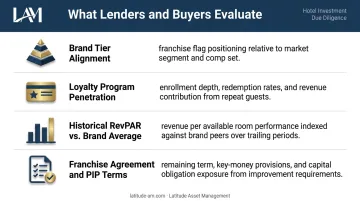
Key valuation factors lenders and buyers assess:
- Brand tier alignment with market demand and competitive set
- Loyalty program penetration and direct booking share
- Historical RevPAR performance relative to brand average
- Franchise agreement terms and remaining PIP obligations
The Core Elements of a Hotel Brand Identity
Visual Identity and Name
A hotel's name, logo, color palette, and typography are its primary market identifiers. These elements must authentically reflect the property's positioning:
- Earthy tones and organic shapes signal eco-conscious or nature-driven positioning
- Serif fonts and muted palettes suggest understated luxury
- Clean sans-serif typography and bold color blocks communicate contemporary select-service
Critically, these choices must be applied consistently — across the website, OTA profiles, in-property signage, social media, and every piece of guest-facing collateral. Visual inconsistency signals a brand that hasn't figured itself out.
Brand Philosophy, Values, and Mission
The brand philosophy is the "why" behind the hotel: the values and purpose that guide operational decisions and experience design. This is not a marketing tagline. It is the north star for hiring, service standards, F&B programming, and capital decisions.
Research from Booking.com and Expedia confirms that 92% of Gen Z and Millennial travelers prioritize nature protection when booking trips, and a growing proportion specifically plan to stay at properties whose brand values they share. A clearly articulated philosophy is now essential for reaching the traveler segments that dominate demand.
Storytelling and Emotional Connection
Storytelling is how abstract brand values become tangible experiences. The stories a hotel tells through its design, staff interactions, locally sourced amenities, and content create emotional connections that differentiate it beyond functional attributes.
Place-based branding is particularly effective across the Americas, where destinations carry rich cultural narratives. A property in Cartagena has a different story to tell than one in Tulum or San Juan. The strongest brands in those markets weave location into every layer of the guest experience, from the lobby playlist to the menu.
Consistency Across Guest Touchpoints
Brand consistency is what converts a brand promise into brand reality. Every stage of the guest journey must express the same values:
- Pre-arrival emails and booking confirmations
- Lobby experience and check-in interactions
- In-room amenities and service touchpoints
- Departure process and post-stay follow-up
Staff training and service culture are the most critical delivery mechanisms. The brand lives or dies the moment a team member interacts with a guest.
No amount of good design compensates for a service culture that contradicts what the brand promises.
How to Build a Hotel Brand Strategy in 2026
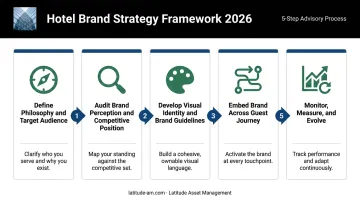
Step 1 — Define Your Core Philosophy and Target Audience
Every brand strategy starts with two foundational questions:
- What do we want guests to remember most about their stay?
- Who is the guest we are trying to attract?
These answers define the brand's purpose and its target segment. They must also align with the asset's location, physical product, and investment objectives. Without this alignment, every subsequent branding decision will be built on an unstable foundation.
Step 2 — Audit Current Brand Perception and Competitive Position
Before building or rebuilding a brand, assess honestly how the market currently perceives the property:
- Analyze online reviews for recurring themes (positive and negative)
- Benchmark ADR, occupancy, and RevPAR against the competitive set
- Review OTA positioning — what story do your photos and descriptions tell?
- Evaluate whether current messaging matches the experience being delivered
This audit surfaces the gap between aspiration and reality. That gap defines the repositioning opportunity.
Step 3 — Develop a Cohesive Visual Identity and Brand Guidelines
Translate brand philosophy into concrete visual and verbal assets: name, logo, color scheme, typography, photography style, and tone of voice. Codify these in brand guidelines and apply them consistently across every channel.
Location should directly inform those aesthetic choices. A coastal Caribbean resort should feel different from a business hotel in Bogotá or a boutique property in Mexico City — not because one is better designed, but because each is telling a place-specific story.
Step 4 — Embed the Brand Across the Full Guest Journey
A brand strategy is only as strong as its execution at the property level. Practical examples of brand embedding include:
- Signature welcome experiences that reflect local culture
- F&B programs sourced from regional producers or inspired by local cuisine
- Staff greeting rituals and service language that reinforce the brand's personality
- Pre-arrival communications that build anticipation consistent with the brand promise
- Post-stay follow-up that extends the relationship beyond check-out
This is where many properties fall short: a beautifully articulated brand promise eroded by inconsistent on-property delivery.
At Latitude Asset Management, brand strategy integration is a core component of the asset management mandate. The firm acts as the owner's proxy, ensuring brand vision is reflected in operator performance standards, franchise compliance, and day-to-day execution — translating branding into measurable NOI improvement.
Step 5 — Monitor, Measure, and Evolve
Brand strategy is not a one-time project. Sustained performance requires:
- Annual review of guest feedback, online reputation scores, and competitive positioning
- Financial benchmarking to assess whether brand strategy is translating into rate and occupancy performance
- Periodic refresh every five to seven years, or when market shifts, physical renovations, or changes in target guest segments signal that the current identity no longer resonates
Brand stagnation is a measurable risk. It shows up first in softening direct bookings and declining review scores — well before the damage reaches the income statement.
Franchise, Soft Brand, or Independent? The Branding Decision Every Owner Faces
Every hotel owner eventually faces three principal paths:
| Path | What It Offers | Trade-Offs |
|---|---|---|
| Hard Brand (Marriott, Hilton, IHG) | Distribution, loyalty program access, recognized brand equity | Franchise fees, strict operating standards, limited creative control |
| Soft Brand / Collection (Autograph Collection, Curio) | Distinctive identity plus major distribution platform | Fees still apply; requires a differentiated product to justify the model |
| Fully Independent | Maximum brand control and creative flexibility | Requires stronger proprietary marketing investment; no loyalty program access |
The Marriott Autograph Collection, for example, charges royalties of 2% of gross room revenue plus a 1.92% Program Services Contribution under its 2025 franchise disclosure terms. Hilton's ResMax Program runs 5.4–5.9% of consumed revenue from affiliated bookings. These costs need to be weighed against the distribution and loyalty benefits each brand delivers for a specific asset in a specific market.
How to Make the Right Call
The choice between these paths should be driven by:
- The investment thesis and target hold period
- The target guest segment and their booking behavior
- The asset's competitive set and physical differentiation
- The owner's appetite for marketing investment and operational flexibility
Across the Americas — particularly in Mexico, Colombia, Brazil, and the Caribbean — soft brands and boutique independent positioning are gaining ground. Travelers in these markets increasingly seek authentic, locally rooted experiences over standardized chain products.
That shift makes the brand selection decision more consequential — and more nuanced — than ever. Latitude Asset Management advises owners across the Americas on franchise negotiations and brand positioning, drawing on direct experience from both sides of the deal. The team includes Germán Ongay, former Regional Vice President of Sales and Franchise Development for IHG Mexico, and Anthony Del Gaudio, whose 35+ years span wholly owned, managed, and franchise operations.
Hotel Branding Trends Shaping 2026 and Beyond
Experience-First Positioning
The dominant traveler segments — Millennials and Gen Z — choose hotels based on the quality and authenticity of the experience. According to Expedia research, 71% of travelers are interested in hotels with Michelin stars or celebrity chefs, and positive reviews for hotel dining increased 40% year over year. This is not just about F&B — it reflects a broader shift toward hotels with a strong sense of place, locally curated programming, and a brand purpose guests can connect with.
Sustainability as a Baseline, Not a Differentiator
That brand purpose increasingly includes environmental responsibility. 35% of Gen Z and 36% of Millennials plan to stay at certified sustainable accommodations in the next 12 months, per Booking.com's 2026 research. Sustainability has moved from a competitive differentiator to a baseline expectation for these segments.
Hotels that integrate sustainability authentically are better positioned with corporate travelers, group buyers, and eco-conscious leisure guests. This means going beyond marketing — it requires:
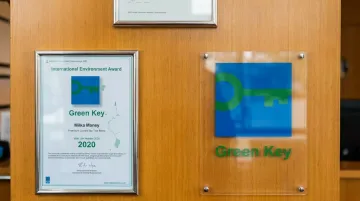
- Recognized third-party certifications (Green Key, LEED, EarthCheck)
- Operational practices embedded in daily hotel management
- Genuine storytelling that reflects actual commitments
Superficial greenwashing is detected and punished in review scores.
Technology as a Brand Delivery Mechanism
61% of consumers say they will spend more for customized experiences, according to Medallia research. Data-driven personalization (preferred room configurations, tailored pre-arrival communications, loyalty recognition) gives hotels a concrete mechanism to fulfill their brand promise for each guest.
Hotels leading in 2026 use technology to deepen human connection. The hospitality experience must drive every technology decision — not the reverse.
Frequently Asked Questions
How does hotel branding work?
Hotel branding works by defining a property's identity — its values, visual elements, service philosophy, and guest experience promises — then delivering that identity consistently across every touchpoint, from online listings to the on-property experience. Done well, it builds the clear, memorable impression that drives guest preference, loyalty, and repeat visits.
What is the 80/20 rule in hotels?
The 80/20 rule refers to the principle that roughly 80% of a hotel's revenue tends to come from approximately 20% of its guests — typically loyal repeat customers. This underscores why strong branding that builds guest loyalty is one of the highest-return investments an owner can make.
What is the difference between a branded hotel and an independent hotel?
A branded hotel operates under a recognized chain affiliation (such as Marriott or Hilton), gaining distribution, loyalty programs, and immediate name recognition. An independent hotel builds its own identity, offering greater creative control but requiring stronger proprietary marketing investment to drive awareness and direct bookings.
How does hotel branding affect property value?
A strong brand drives higher RevPAR, lower distribution costs, and more loyal guest demand — all of which improve net operating income. Better NOI, combined with the lender and buyer appetite that recognized brands attract, can result in a lower cap rate and higher valuation at exit.
How often should a hotel rebrand?
Hotels should review brand performance annually using guest feedback and competitive analysis. Meaningful brand refreshes typically occur every five to seven years, or when market shifts, physical renovations, or changes in target guest segments signal that the current identity no longer resonates with the intended audience.