Introduction
Most hotel investments don't fail because capital ran out. They fail because the operational risks were never properly understood before the deal closed.
A hotel is an active operation — one with staff, brand obligations, distribution channels, physical plant requirements, and revenue dynamics that shift daily. When investors rely solely on historical financials to make acquisition decisions, they're analyzing what happened, not what will happen once they own the asset.
Deloitte's operational due diligence framework defines ODD as a forward-looking, iterative process — one that tests whether the investment thesis is actually achievable from an operational standpoint, and produces an actionable value creation plan for post-close execution.
This guide is written for hotel investors, private equity firms, lenders, and developers who need to understand what operational due diligence covers, why it matters for hospitality assets specifically, and how to execute it rigorously before committing capital.
Key Takeaways
- ODD reveals how a hotel actually generates value operationally, beyond what historical financials show
- The five critical ODD lenses: management quality, revenue performance, property condition, technology, and labor
- A desk review is never sufficient — on-site assessment reveals what documents don't
- ODD findings should produce a concrete 100-day value creation plan
- Cross-border hotel deals in Mexico, Colombia, and the Caribbean require on-the-ground ODD expertise, not generalist financial review
What Is Operational Due Diligence?
Operational due diligence is the investigative process through which a buyer or investor examines how a target asset generates value operationally — not just what its income statement reports.
In hotel acquisitions, ODD extends well beyond the scope of standard M&A review. Hotels require an assessment of the interplay between brand agreements, operator relationships, physical asset condition, guest experience metrics, and labor dynamics — all of which directly affect net operating income and long-term asset value.
How ODD Differs from FDD and CDD
These three workstreams answer fundamentally different questions:
| Diligence Type | Primary Focus | Time Orientation |
|---|---|---|
| Financial (FDD) | Historical earnings, cash flows, liabilities | Backward-looking |
| Commercial (CDD) | Market demand, competitive positioning | External/market-facing |
| Operational (ODD) | How the business executes and creates value | Forward-looking |
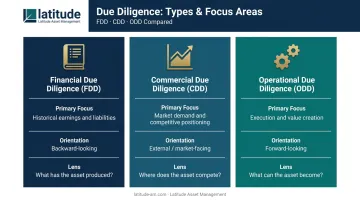
ODD asks: "Once we own this asset, what does it take to actually perform at underwritten levels — and where are the gaps?" Past financials don't answer it — they confirm what happened, not what will.
Brand compliance status, deferred capital expenditure, revenue management maturity, and labor structure rarely surface in a trailing 12-month P&L. Identifying those gaps before closing is precisely what ODD is designed to do.
Why Operational Due Diligence Matters for Hotel Investors
Hotels are operationally intensive in a way that most asset classes are not. Unlike a stabilized office building or a net-lease retail property, a hotel requires active daily management, brand oversight, workforce supervision, and dynamic pricing — and when those systems are weak, losses accumulate fast.
Consider the data: Bain's analysis of 65 mature private equity deals found that 71% missed projected margins by an average of 330 basis points. While that covers multiple sectors, the implication for operationally intensive businesses like hotels is direct — financial-only diligence routinely misses the operational realities that determine whether margin targets are achievable.
What Thorough ODD Delivers
- Uncovers deferred CapEx, outstanding PIPs, aging technology, and key-person dependencies that financial statements won't show
- Confirms whether RevPAR growth and cost reduction projections are operationally achievable — not just modeled
- Directly supports purchase price negotiations, seller representations, and earnout or escrow structuring
- Produces an actionable improvement plan that reduces time-to-performance after close
Closing on financial diligence alone and discovering operational problems afterward is a costly pattern. Deficiencies that surface in the financials post-close have already translated into missed NOI, strained lender relationships, and compressed exit valuations — problems that proper ODD would have priced in or prevented.
Key Focus Areas in Hotel Operational Due Diligence
Effective hotel ODD examines five distinct operational dimensions. Each one carries implications for both risk assessment and value creation planning.
Management Team and Organizational Structure
The quality of the on-property and above-property management team is often the single largest determinant of whether an asset performs to its potential.
Key questions to answer:
- Does the General Manager have the right skills and market experience for the hotel's positioning and competitive set?
- Is there a functioning revenue management structure, or is pricing reactive and undisciplined?
- Where are the key-person dependencies — and what happens if that person leaves post-close?
- Can the existing team execute a new owner's strategic plan, or does management change need to be part of the acquisition thesis?
Anthony Del Gaudio, Latitude Asset Management's Chief Business Development Officer, draws on 35 years across Hyatt, Loews, and InterContinental Hotel Group to evaluate precisely these questions — understanding not just what brand standards say on paper, but how management teams perform against them in practice.
Revenue Performance and Financial Operations
Historical EBITDA tells you what happened. Revenue performance metrics explain the underlying drivers and reveal where upside exists.
A thorough revenue review covers:
- STR report performance — is the hotel gaining or losing RevPAR market share against its comp set?
- RevPAR index — is the property punching above or below its weight relative to competitors?
- Channel mix — OTA dependency for independent hotels reached 63.4% in 2025, creating meaningful cost exposure
- Direct booking profitability — Kalibri Labs data shows direct bookings are on average 12.5% more profitable than OTA bookings, making channel mix a genuine valuation input
- Segment mix and pace reports — group, transient, and corporate segment balance reveals demand quality and revenue predictability
A hotel with strong occupancy but heavy OTA dependency and no direct booking strategy has a very different risk profile than its headline RevPAR suggests.
Property Condition, Brand Compliance, and CapEx Requirements
Underestimating capital requirements is one of the most common — and most costly — mistakes hotel investors make.
Critical areas of physical and compliance review:
- Is there an outstanding Property Improvement Plan (PIP) with the brand? What is its cost and timeline?
- When was the last full renovation? Industry practice calls for soft renovations every 3–5 years and hard renovations every 7–10 years
- HVS research found non-renovated hotels carry approximately 8.49% lower NOI and renovated properties command roughly a $25,000 per-room value premium — making renovation status a direct valuation input
- FF&E reserves are typically structured at 4–5% of total revenue — verify whether reserves are funded and whether deferred maintenance has accumulated
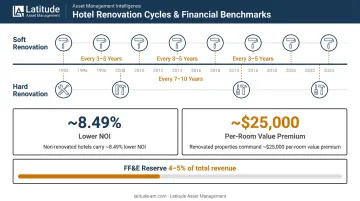
When PIP obligations surface after close, they compress returns and can convert a well-underwritten deal into a capital-intensive recovery situation.
Technology and Systems
Technology fragmentation is a pervasive form of operational risk that rarely appears in the financials until it's already costing money. According to a 2024 hospitality industry spend survey, PMS replacement ranked as the top hotel-level technology priority, yet only 24% of properties had fully integrated core systems. Nearly one-third still priced rooms manually or adjusted rates just once per week.
ODD technology review should cover:
- PMS (Property Management System) — is it current, cloud-based, and well-integrated?
- RMS (Revenue Management System) — is revenue optimization automated or manual?
- CRS connectivity and distribution infrastructure — are all channels connected and performing?
- Integration gaps between systems — these create revenue leakage, increase labor costs, and complicate post-close reporting
Outdated or fragmented technology isn't just an operational inconvenience. It affects revenue capture, labor efficiency, and the investor's ability to implement new reporting requirements after acquisition.
Human Resources, Labor, and Workforce Dynamics
Labor is the largest operational cost in most hotels. HVS reports it represents 45–50% of hotel operating expenses, and CBRE measured it at 31.8% of total hotel revenue in 2024. Staffing shortages remain a persistent challenge: as of early 2024, 67% of surveyed hotels reported staffing shortages.
Key areas of labor diligence:
- Staffing levels relative to competitive benchmarks and operational model
- Turnover rates by department — particularly in housekeeping, F&B, and front desk
- Union agreements, collective bargaining obligations, and any pending labor disputes
- Wage structures and total compensation relative to local market
For cross-border investments, labor law complexity is a critical ODD dimension. Mexico's statutory employee profit-sharing obligations (PTU), Colombia's 2025 labor reform under Law 2466 (which restored an eight-hour daily work limit and revised night and Sunday work provisions), and the varied regulatory environments across Caribbean jurisdictions each carry distinct compliance obligations. Assessing them accurately requires jurisdiction-specific legal and operational expertise.
How to Conduct Operational Due Diligence: A Step-by-Step Process
Effective hotel ODD is iterative, not sequential. It should begin during target selection — not after the letter of intent is signed.
Step 1 – Define the Investment Thesis and ODD Scope
Before gathering a single document, clarify the deal rationale:
- Is this a value-add acquisition requiring operational turnaround?
- A stabilized asset acquired for yield?
- A rebranding or brand conversion play?
- A distressed situation requiring stabilization?
The ODD scope — which risks matter most, which metrics deserve deepest scrutiny — must be calibrated to the investment thesis. A distressed hotel requires intensive management quality and liquidity assessment. A stabilized yield acquisition requires revenue sustainability and CapEx planning review. Generic ODD applied uniformly across deal types wastes time and misses the material issues.
Step 2 – Gather and Review Hotel Documentation
Request and analyze all key operational documents before the site visit:
- Trailing 24-month P&L by department
- STR reports with competitive set benchmarking
- Franchise and/or management agreements, including any outstanding PIP requirements
- Capital expenditure schedules and FF&E reserve funding status
- Staffing models and organizational charts
- Guest satisfaction scores (brand surveys, TripAdvisor)
- Any pending legal, regulatory, or compliance matters
Document review structures the on-site assessment. It tells you what questions to ask and where the gaps between reported performance and operational reality are most likely to appear.
Step 3 – Conduct the On-Site Assessment
A desk review is never sufficient for hotel ODD. The gap between what documents say and what operations show is almost always revealed on-site.
The on-site assessment should include:
- Walk the property — assess physical condition against brand standards and market expectations room by room, not just in public areas
- Review back-of-house operations — laundry, maintenance, receiving, employee facilities
- Interview the GM and department heads — individually, not as a group
- Benchmark the guest experience — visit competitor properties in the comp set during the same period
- Review live operational data — current occupancy, in-house rate, channel booking pace
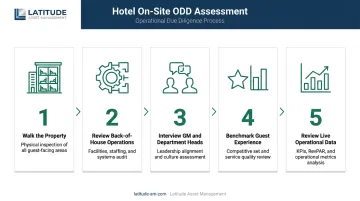
Experienced operators read what financial analysts miss. A former GM walking a property can identify deferred maintenance patterns, understaffed departments, and brand standard violations in 30 minutes that would never appear in a trailing P&L.
Step 4 – Evaluate Risks and Value Creation Opportunities
Synthesize findings into a structured risk and opportunity matrix:
- Operational risks: factors that could prevent the asset from performing at underwritten levels, including management gaps, deferred CapEx, and brand compliance exposure
- Near-term opportunities: revenue management adjustments, cost reductions, and direct booking improvements achievable within the first 12 months
- Medium-term value drivers: brand upgrade, renovation, operator transition, or technology modernization with projected return timelines
The opportunity side of this matrix frequently surfaces upside that a purely financial review overlooks — particularly in revenue management and channel mix, where even modest corrections can meaningfully shift NOI.
Step 5 – Build the Operational Value Creation Plan
Convert ODD findings into an actionable post-acquisition plan:
- Prioritized initiatives with timelines and responsible parties
- Capital requirements with phasing schedule
- Projected financial impact by initiative
- Key dependencies and risk mitigation actions
The resulting 100-day plan is what separates strategic ODD from a compliance checklist. It gives ownership a concrete operating roadmap with defined milestones, assigned accountability, and measurable performance targets from day one.
How Latitude Asset Management Supports Hotel ODD
Latitude Asset Management conducts operational due diligence from the perspective of an active asset manager — not a generalist advisory firm working through a checklist. That distinction matters at every stage of the process.
The Latitude team draws on hotel operations, brand management, real estate, and institutional finance — covering the full scope of what drives or undermines asset performance.
CEO Haizar Baiz's background spanning hotel operations, brand representation, and investor advocacy means every ODD engagement is evaluated through an operator's lens, a brand's standards, and a capital-conscious return framework simultaneously.
Specific ways Latitude adds value in hotel ODD engagements:
- Operational assessment conducted by experienced hotel operators with direct regional presence across the U.S., Mexico, Caribbean, Colombia, and broader Latin America
- Brand and franchise review, including PIP analysis and conversion feasibility, informed by Germán Ongay's 40+ years in Mexico's hotel market and senior franchise development roles at IHG
- Revenue benchmarking using STR data and market comp analysis, backed by CFA-level financial modeling from Javier Revelo
- Value creation plan development that connects ODD findings directly to an asset management strategy for post-acquisition performance improvement

For cross-border deals in Mexico, Colombia, and the Caribbean, Latitude's multilingual team (English, Spanish, Portuguese, and French) and in-market regional partners give institutional investors the local regulatory knowledge, operator relationships, and brand context that these markets require — and that no remote assessment can replicate.
Frequently Asked Questions
What does operational due diligence do?
ODD investigates how a business generates value from its daily operations and confirms whether the investment thesis is operationally achievable. It identifies risks and upside opportunities that historical financials don't reveal — informing post-acquisition strategy and value creation planning.
What is the difference between commercial due diligence and operational due diligence?
Commercial due diligence examines the external market: demand drivers, competitive positioning, and market attractiveness. Operational due diligence examines internal operations — how the business executes day-to-day. In hotel investing, CDD analyzes RevPAR trends and market demand; ODD evaluates management quality, systems, brand compliance, and cost structure.
What are the three types of due diligence?
The three most common types are financial (FDD), legal (LDD), and operational (ODD). Commercial due diligence (CDD) is frequently added as a fourth stream, particularly in hospitality and private equity transactions where market positioning and demand analysis are critical inputs.
What are the 4 P's of due diligence?
The 4 P's (People, Process, Performance, and Potential) provide a practical framework for structuring diligence inquiry. In hotels, this means: management team quality, operational process maturity, financial and revenue performance metrics, and the asset's upside potential under new ownership.
How long does operational due diligence take for a hotel investment?
Hotel ODD typically takes four to eight weeks depending on deal complexity, asset size, and documentation availability. Cross-border deals or assets with complex operator and franchise relationships generally require more time. Starting ODD during the target selection phase rather than after LOI significantly reduces timeline pressure.
What are common red flags in hotel operational due diligence?
Key warning signs include:
- Significant deferred CapEx or outstanding PIP requirements
- Heavy OTA dependency with low direct booking share
- High management or staff turnover
- Below-index RevPAR performance relative to the competitive set
- Outdated or fragmented technology systems
Any one of these warrants deeper investigation. Multiple red flags together typically signal a thesis that requires significant re-pricing or restructuring.