
For hotel investors, asset managers, and real estate investment groups operating across multiple geographies, AI-powered financial analysis tools are becoming core infrastructure. Whether the task is underwriting a full-service acquisition in Mexico City, stress-testing RevPAR assumptions against macro scenarios, or benchmarking operator performance across a Caribbean portfolio, the right AI platform can compress research timelines and sharpen decision quality.
This article breaks down the top 10 AI tools for financial analysis in 2026 — who each tool is best suited for, what it actually does, and what to evaluate before committing to one.
Key Takeaways
- The best AI financial tools synthesize structured and unstructured data — not just retrieve it
- Platform choice hinges on content model — bundled financial data, general-purpose LLM, or firm-licensed feeds
- Multi-document reasoning and macro market tools offer the strongest workflow fit for real estate and hotel investment
- AI tools accelerate research; they don't replace the judgment needed to make final investment decisions
- Vet hallucination safeguards, security standards, and Excel integration before committing to a platform
What Are AI Tools for Financial Analysis?
AI financial analysis tools are software platforms that use machine learning, natural language processing, and large language models to turn raw financial inputs (filings, transcripts, market data, internal documents) into structured, decision-ready insights.
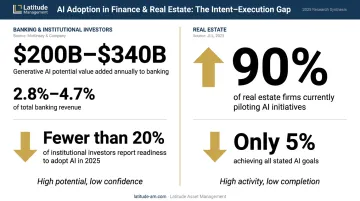
Adoption is growing, but execution gaps remain. McKinsey estimated that generative AI could create $200 billion to $340 billion in annual value for banking, equal to 2.8%–4.7% of industry revenue. Yet fewer than 20% of institutional investment participants said they were ready to incorporate AI into their workflows in 2025.
The real estate sector mirrors this pattern. JLL's 2025 Global Real Estate Technology Survey found that 90% of real estate companies were piloting AI — but only 5% had achieved all their stated AI goals.
The tools below represent the leading platforms evaluated across four criteria:
- Data depth — breadth and quality of financial data sources
- AI accuracy — reliability of outputs across complex inputs
- Workflow utility — how well the tool fits into real analyst workflows
- Investment research applicability — usefulness from equity analysis to hotel asset due diligence
Top 10 AI Tools for Financial Analysis in 2026
AlphaSense
AlphaSense is the most comprehensive enterprise-grade market intelligence platform available for financial professionals. It combines broker research, expert call transcripts, SEC filings, company documents, and over 500 million premium proprietary documents in a single interface — covering standardized financial data for more than 17,000 public companies.
AlphaSense was named a Leader in the inaugural 2026 Gartner® Magic Quadrant™ for Competitive and Market Intelligence Platforms, making it the benchmark platform for institutional research teams.
| Attribute | Details |
|---|---|
| Best For | Holistic financial research combining qualitative and quantitative intelligence across broker research, filings, and expert calls |
| Key Features | Generative AI search, Smart Summaries, Sentiment Analysis, Generative Grid, 4,500+ pre-built financial models, Excel Add-In, enterprise integrations |
| Pricing | Custom pricing; free trial available — contact AlphaSense directly |
Bloomberg Terminal
The long-standing institutional standard for real-time market data and multi-asset analytics. Hedge funds, asset managers, and investment banking firms rely on it for live pricing, liquidity data, and trading workflows. Bloomberg's AskB agentic AI interface adds conversational querying on top of the Terminal's existing data depth.
Its legacy architecture means it is less AI-native than platforms designed specifically for financial AI workflows — but for teams that need real-time pricing and market coverage, it remains the reference point.
| Attribute | Details |
|---|---|
| Best For | Real-time pricing, liquidity data, and multi-asset trading analytics for institutional finance teams |
| Key Features | Real-time market data, AskB AI interface, Bloomberg News, equity research access, advanced charting and screening |
| Pricing | Approximately $30,000/year per terminal (WSJ, March 2026); multi-terminal rates not publicly disclosed |
Fiscal.ai (Formerly FinChat)
Fiscal.ai rebranded from FinChat in June 2025 alongside a $10M Series A. It focuses on company-level financial data sourced from S&P Market Intelligence, with natural language querying, AI-generated charts, and document analysis through a clean, accessible interface.
A strong option for individual investors and smaller teams — broker research depth and expert call libraries are absent, so it is best suited for company-level analysis rather than multi-source market intelligence.
| Attribute | Details |
|---|---|
| Best For | Individual investors and smaller teams seeking AI-assisted financial modeling and company-level analysis |
| Key Features | Natural language querying, AI-generated charts, S&P Market Intelligence data, document analysis, dashboard monitoring |
| Pricing | Free ($0/month), Pro ($39/month), Max ($79/month); API pricing requires sales contact |
Fintool
Note: Fintool was acquired by Microsoft in April 2026. The team joined Microsoft's Office Product Group, and the platform's standalone subscription model is no longer active. Teams that were evaluating Fintool for SEC filing extraction should monitor how Microsoft integrates these capabilities into Excel and Microsoft 365.
| Attribute | Details |
|---|---|
| Best For | Previously: analysts extracting structured data from SEC filings and earnings documents |
| Status | Acquired by Microsoft April 2026; standalone product discontinued |
| Pricing | No current standalone pricing available |
Hebbia
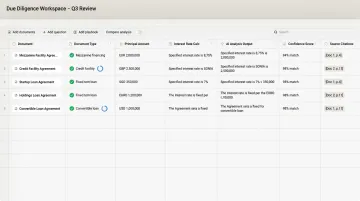
Hebbia is built for high-volume, document-intensive workflows — due diligence reviews, contract analysis, and data room synthesis across large unstructured document sets. Its Matrix workspace is a grid-based interface that lets users run parallel AI reasoning across multiple documents simultaneously, with findings traced to source citations.
Integrations span SharePoint, Databricks, S3, Box, Snowflake, and financial data providers including FactSet, CapIQ, PitchBook, and Preqin. For asset managers reviewing deal files or fund managers working through data rooms, few platforms match its depth for document-intensive research.
| Attribute | Details |
|---|---|
| Best For | Investment teams conducting deep due diligence or reviewing large document sets |
| Key Features | Multi-document reasoning, Matrix grid interface, source-traced outputs, enterprise integrations, collaborative workflows |
| Pricing | Not publicly disclosed; demo required |
Rogo
Rogo is a generative AI platform built for financial professionals, focused on accelerating research, drafting outputs, and automating repetitive workflows through a chat-first interface and agent-driven automation. It connects firm content with external licensed providers including LSEG, Capital IQ, PitchBook, Preqin, Daloopa, and Dow Jones.
Output quality depends heavily on the data licenses a firm already holds. Teams with strong existing data infrastructure will get the most from Rogo's automation and workflow agents.
| Attribute | Details |
|---|---|
| Best For | Investment teams automating repetitive research tasks and accelerating first-draft deliverables |
| Key Features | Chat interface, workflow agents, LSEG and PitchBook integrations, API/SDK extensibility, internal document upload |
| Pricing | Bespoke deployment; contact Rogo directly |
YCharts
YCharts targets financial advisors and asset managers who need portfolio construction tools, data visualization, and client-ready reporting. Its AI assistant — now branded as Y — supports natural language querying against YCharts' datasets, including SEC filings and economic data series.
Best suited for advisors focused on data visualization and client communication. Earnings call transcripts and full-text broker research were not confirmed on current plan pages, so it is not the right fit for deep thematic research.
| Attribute | Details |
|---|---|
| Best For | Financial advisors and investment professionals focused on portfolio construction and client communications |
| Key Features | Fundamental charts, stock screeners, model portfolios, AI assistant (Y), branded report templates, SEC filing alerts |
| Pricing | Free 7-day trial; four tiers (Analyst, Presenter, Professional, Enterprise) — pricing on request |
Verity
Verity (verityplatform.com) is a research management platform for equity analysts and fund managers who need to centralize internal research, automate model updates, and generate AI-powered summaries. Its VerityRMS system connects analyst notes, earnings summaries, and internal content by ticker or theme.
Unlike some platforms that advertise a proprietary LLM, Verity now lets customers choose their AI provider — including Anthropic, OpenAI, and Azure AI — and connects via an Excel Add-In for refreshable model automation.
| Attribute | Details |
|---|---|
| Best For | Fund managers and equity analysts centralizing and automating internal research workflows |
| Key Features | VerityRMS research management system, customer-chosen LLM, Excel Add-In automation, AI summarization, insider and behavioral analytics |
| Pricing | Custom pricing based on organization size; contact Verity directly |
Koyfin
Koyfin delivers a Bloomberg-style experience at a significantly lower price point — making institutional-quality financial data accessible to independent analysts and boutique investment firms. It covers macro dashboards, earnings analysis, fund research, and now earnings call transcripts for more than 100,000 global stocks.
The platform offers less AI-driven synthesis than newer specialized financial platforms, and full-text broker research was not confirmed on current plan pages. For teams that need broad data coverage without enterprise pricing, it is a strong value option.
| Attribute | Details |
|---|---|
| Best For | Independent analysts and boutique investment firms seeking institutional-quality financial data at accessible pricing |
| Key Features | Macro dashboards, earnings transcripts, fund research, news aggregation, customizable watchlists, screening tools |
| Pricing | Free ($0), Plus ($39/month), Pro ($79/month), Advisor Core ($209/month), Advisor Pro ($299/month) |
ChatGPT / Claude (General-Purpose LLMs)
Both ChatGPT (OpenAI) and Claude (Anthropic) are increasingly used as research assistants — capable of summarizing financial documents, analyzing uploaded filings, explaining complex concepts, and assisting with modeling tasks. Both now offer web search functionality, though this is not equivalent to a licensed professional market data feed.
The accessibility advantage is real, but so are the gaps: neither tool includes proprietary financial datasets, real-time market data, or the hallucination safeguards built into specialized financial platforms. CFA Institute guidance recommends retrieval-augmented generation over controlled data, task-specific validation, and human oversight rather than unverified reliance on a general LLM.
| Attribute | Details |
|---|---|
| Best For | Individual investors and analysts needing accessible AI assistance for document review, summarization, and research drafting |
| Key Features | Natural language document analysis, financial concept explanation, draft generation, file upload, web search |
| Pricing | ChatGPT Plus: $20/month; Claude Pro: $20/month (or ~$17/month billed annually) |
How We Chose the Best AI Tools for Financial Analysis
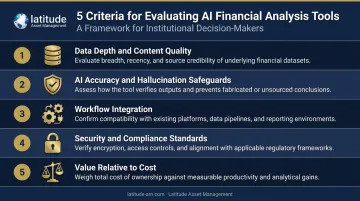
Selection was based on five evaluation dimensions:
- Data depth and content quality — does the platform bundle licensed financial content, or depend on what users bring?
- AI accuracy and hallucination safeguards — are outputs source-traced, verifiable, and calibrated for financial use cases?
- Workflow integration — does the tool connect with Excel, CRM platforms, document repositories, and existing data licenses?
- Security and compliance standards — is confidential input data protected and does it remain outside model training pipelines?
- Value relative to cost — does pricing align with the research workflows the platform actually supports?
A common mistake in tool selection is choosing based on brand name or price alone. For hotel investors and asset managers who need to synthesize macro market data, process deal documents across multiple jurisdictions, and model scenarios at the asset level, the right platform has to match the actual research workflow — not just a general use case.
Teams like those at Latitude Asset Management — where financial analysis spans acquisitions, portfolio strategy, and cross-border market intelligence across the Americas — face a distinct set of research demands. Multi-document reasoning tools like Hebbia and enterprise intelligence platforms like AlphaSense address different parts of that workflow. No single tool covers everything, which is why evaluating fit against a specific workflow matters more than picking the most recognized name.
Three factors frequently get overlooked during tool selection but consistently determine long-term adoption:
- Pricing transparency — hidden costs surface after contracts are signed
- Support quality — response times and onboarding depth vary widely between vendors
- System integration — compatibility with existing data licenses and workflows drives actual usage
Conclusion
AI tools for financial analysis are no longer supplementary. For serious investment professionals, they are the infrastructure that separates fast, well-informed decisions from slow, incomplete ones. In hospitality real estate specifically, the ability to synthesize market data, process deal documents, and model scenarios at speed is a genuine competitive advantage.
The right tool depends on fit: the type of assets you analyze, the scale of your research workflows, the data licenses you already hold, and the level of security your organization requires. Total cost of ownership — licensing, integration, and long-term scalability — should carry equal weight alongside day-one capabilities.
Selecting the right tools is only part of the equation. How you apply them to specific hotel assets, deal structures, and market conditions is where the analysis actually creates value. Latitude Asset Management applies institutional financial discipline to hotel investment strategy across the Americas, pairing data-driven research with hands-on market expertise. Investors looking to understand how that translates into acquisition decisions, portfolio strategy, or asset performance can reach the Latitude team directly to discuss their specific situation.
Frequently Asked Questions
What is the best AI for investment analysis?
AlphaSense is widely regarded as the most comprehensive enterprise-grade platform, combining proprietary data with generative AI across broker research, filings, and expert calls. Fiscal.ai and Koyfin serve more accessible price points. Evaluate based on content depth, accuracy, and workflow fit before committing.
How do you use AI for investment analysis?
Feed the tool with relevant documents — filings, reports, transcripts — and query using natural language. Use outputs to accelerate summarization, benchmarking, and scenario modeling. Always validate AI outputs against primary sources before using them to inform investment decisions.
Are AI financial analysis tools suitable for real estate and hotel investment?
Several tools are well-suited, particularly those supporting due diligence and document-intensive workflows. Hebbia's multi-document reasoning and AlphaSense's macro market intelligence are especially relevant for asset managers analyzing hotel properties across multiple geographies and regulatory environments.
Can AI tools replace human financial analysts?
No. AI tools extend an analyst's capacity — accelerating data gathering, summarization, and pattern recognition. Human judgment remains essential for interpreting context, assessing qualitative risk, and making final investment decisions, particularly in asset classes like hospitality real estate where on-the-ground knowledge matters.
What should I look for when choosing an AI tool for financial analysis?
Prioritize these factors when evaluating platforms:
- Depth and quality of underlying data sources
- Accuracy safeguards and hallucination controls
- Security and data governance standards
- Integration with Excel and existing workflows
- Purpose-built financial design, not adapted from a general-purpose LLM
Are free AI tools reliable for professional financial analysis?
Free tools like ChatGPT can assist with summarization and drafting, but they lack real-time financial data, proprietary datasets, and safeguards against inaccurate outputs — making purpose-built financial AI platforms the stronger choice for professional or institutional use.