
Introduction
Owning a hotel asset and running it well are fundamentally different disciplines. Many investors hold genuinely valuable hospitality properties that consistently underperform — not because the asset is flawed, but because the expertise to manage it isn't in place.
Revenue stays on the table. Operator relationships drift without accountability. Decisions that should be data-driven become reactive.
Outsourced hotel management addresses this gap directly. It means engaging a qualified external firm to take on strategic oversight, commercial performance, and asset-level management on the owner's behalf, not simply delegating housekeeping or call center functions to a vendor.
According to JLL's Global Hotel Investment Outlook, nearly half of branded hotels globally are already managed by third parties. For independent and investor-owned assets, that share is rising steadily as ownership structures grow more complex.
This guide covers what outsourced hotel management actually includes, the core benefits for owners and investors, the risks worth watching, and how to select the right partner — with particular focus on the Americas.
Key Takeaways
- Outsourced hotel management means engaging a specialized firm for strategic oversight, not just delegating back-office tasks
- Owners gain multidisciplinary expertise — operations, finance, brand strategy — without building a permanent in-house team
- Choose a partner who combines hospitality operating experience with investment discipline to optimize returns at every ownership stage
- Risks like misaligned incentives and brand control issues are manageable with clear KPIs, SLAs, and rigorous partner vetting
- Cross-border expertise and local market relationships directly affect deal terms, compliance, and on-the-ground execution across the Americas
What Is Outsourced Hotel Management?
Outsourced hotel management is the practice of engaging a qualified external firm to oversee a hotel property's strategic and operational performance on behalf of the owner. The scope typically spans commercial strategy, revenue management, operator oversight, brand negotiations, and ongoing asset performance monitoring.
Two Levels That Often Get Conflated
Not all hotel outsourcing is the same. There's an important distinction:
- Departmental outsourcing — contracting external vendors for specific functions such as housekeeping, IT support, or reservations. The scope is operational and transactional, with limited impact on overall asset value.
- Full strategic management outsourcing — retaining a third-party firm as the owner's management partner across all performance dimensions: financial oversight, operator accountability, and brand strategy.
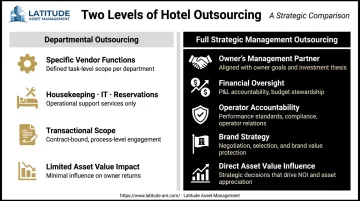
This guide focuses on the second category: the kind that directly influences asset value, not just day-to-day operations. Understanding which ownership structures benefit most from this model helps clarify whether it's the right fit.
Where This Model Is Most Common
Outsourced hotel management applies across several ownership structures:
- Independently owned hotels without an in-house management platform
- Investor-owned assets operating under a hotel brand or franchise agreement, where the owner needs a knowledgeable advocate monitoring the operator
- Multi-property portfolios where a central management firm oversees performance across assets of different sizes, brands, and markets
Types of Hotel Management Services That Can Be Outsourced
Revenue and Commercial Strategy
Dynamic pricing, distribution channel optimization, market segmentation, yield management — these require specialized skill sets that are costly and hard to staff in-house, particularly for independent or smaller properties.
An outsourced firm brings dedicated revenue management expertise across the full commercial stack, identifying where pricing is underperforming and where channel mix is eroding margins.
Operator Oversight and Brand Management
When an owner has engaged a hotel management company or brand, they still need someone watching the watchers. A third-party asset manager acts as the owner's representative, ensuring the operator is delivering on contractual commitments, brand standards, and financial targets.
As HAMA's membership criteria make clear, genuine hotel asset management requires authority and independence to act in the owner's best interest — a standard that distinguishes a real advocate from a passive observer.
Pre-Opening and Hotel Launch Management
The pre-opening phase is where many costly mistakes happen. An experienced outsourced firm guides owners through:
- Operator and brand selection
- Pre-opening budget oversight
- Staffing and organizational planning
- Market positioning decisions
Historical Cornell research found that average occupancy stabilization takes 3.08 years, with 61.9% of hotels stabilizing within two to four years. Getting pre-opening decisions right directly compresses that timeline.
Asset Repositioning and Performance Turnaround
Underperforming assets require more than operational tweaks. Specialized firms identify root causes — whether market positioning, brand fit, operator quality, or capital structure — then develop and execute repositioning strategies that recover market share and rebuild asset value.
Execution can include rebranding, renovation planning, operator replacement, and revenue strategy overhaul. In Latin American markets, brand conversions alone can unlock ADR uplifts of +15–40%, but only when executed with the right expertise and relationships.
Financial Oversight and Investor Reporting
Repositioning work only creates lasting value when the numbers are tracked with the same rigor applied to the strategy. Outsourced firms provide financial oversight through an investment lens, not just an operational one:
- Disciplined financial reporting and budget review
- Capital expenditure planning
- Scenario analysis
- Performance tracking against metrics like NOI, RevPAR, and cap rate
The result is a clear line between what the operator reports and what the investor actually needs to know about their asset's value trajectory.
Key Benefits of Outsourcing Hotel Management
Access to Multidisciplinary Expertise Without the Overhead
Building an in-house team with genuine depth across hotel operations, real estate finance, revenue management, and brand strategy is prohibitively expensive for most owners. A strong outsourced management firm makes all of those disciplines available through a single, integrated engagement.
Consider what that team actually needs to include:
- Hotel operators with GM-level experience across major brands
- Financial analysts with institutional-grade underwriting capability
- Brand and franchise specialists with genuine negotiating relationships
- Regional market experts with on-the-ground local networks
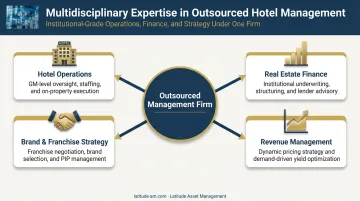
Assembling this independently — for a single asset — rarely pencils out.
Institutional Discipline Applied to Every Ownership Phase
Experienced outsourced firms apply structured methodologies from acquisition underwriting through stabilized operations. Decisions are grounded in market data, cycle intelligence, and investment logic — not just operational instinct or the operator's own benchmarking.
This discipline matters most during the transition moments that define asset value:
- Pre-opening setup and ramp-up
- Brand conversion and repositioning
- Operator replacement and transition
- Pre-sale preparation and disposition readiness
Stronger Operator Accountability
Hotel management companies and brand operators perform better when a sophisticated, well-resourced third party monitors their performance. That means a partner who can:
- Read management reports critically, not just accept them
- Benchmark results against the competitive set with market context
- Escalate issues with credibility before they compound
Without this oversight, performance can quietly erode well before it shows up in the financials.
Scalability Across a Portfolio
Outsourced management enables investors to grow a multi-property portfolio without proportionally scaling their internal team. The external firm applies consistent oversight across assets of different sizes, brands, and markets — managing both the portfolio architecture and individual asset performance simultaneously.
Local Market Intelligence With Cross-Border Reach
For owners investing across the Americas or in emerging hospitality markets, an outsourced partner with genuine regional networks provides access to deal flow, operator relationships, regulatory navigation, and market intelligence that takes years to build independently. Latin American markets in particular are more opaque and relationship-driven than U.S. markets. Embedded local presence — with existing relationships among owners, operators, and regulators — can determine whether a deal closes or a problem gets resolved.
Common Risks and How to Mitigate Them
Every outsourced management arrangement carries risks. The owners who navigate them successfully go in with clear eyes.
| Risk | Mitigation |
|---|---|
| Misaligned incentives | Structure agreements around performance-linked KPIs; seek partners with stated owner-alignment principles. Base fees can compensate operators regardless of profitability — incentive fees are what align compensation with results. |
| Brand control and service consistency | Establish clear role delineation, service-level agreements, and regular performance reviews to prevent accountability gaps across multiple parties. |
| Communication gaps | Require centralized reporting structures, agreed cadences, and a single point of accountability within the outsourced firm to prevent fragmented information flows between owner, manager, and on-property teams. |
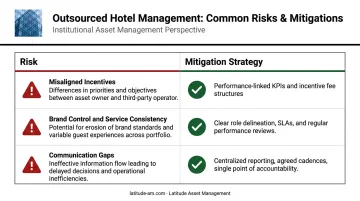
HVS has highlighted that base fees compensate operators regardless of profitability, while incentive fees are designed to align compensation with operating results. The same logic applies to asset managers — fee structure signals whose interests the firm is actually serving.
How to Choose the Right Outsourced Hotel Management Partner
Not every firm that calls itself a hotel management partner is equipped to perform like one. Before committing to an engagement, evaluate potential partners across five areas that separate genuine expertise from polished marketing.
Evaluate Operational Experience, Not Just Credentials
The ideal partner has actually operated hotels — not just advised on them. That operational history means they can engage with management companies and brand teams as peers, identify performance gaps from experience, and hold operators accountable with earned authority rather than spreadsheet analysis.
Assess Financial and Investment Literacy
Look for partners who speak the language of NOI, IRR, debt covenants, and capital structure — not just occupancy and guest satisfaction scores. A firm that understands how hotel performance translates to asset valuation is a fundamentally different partner than one focused purely on day-to-day operations.
Verify Regional Market Knowledge and Local Relationships
In geographically diverse markets across the Americas, the best partners combine institutional standards with genuine on-the-ground networks: relationships with local operators, brands, regulators, lenders, and development communities built over decades.
Clarify Scope, Fees, and Performance Benchmarks Upfront
Before signing anything, ensure the management agreement clearly defines:
- Deliverables and reporting requirements
- Decision-making authority and owner approval rights
- Fee structure (fixed, performance-based, or hybrid)
- How success is measured and over what time horizon
A well-structured agreement should tie performance benchmarks to measurable outcomes — RevPAR index targets, NOI thresholds, or stabilization timelines — not just effort or activity.
Check References and Track Record Across Comparable Assets
Request case studies or direct conversations with other owners the firm has served. Look for specific, measurable evidence: RevPAR growth, turnaround timelines, successful brand transitions, or capital return outcomes. Ask for before-and-after NOI figures or RevPAR index movement — if a firm can't point to specific numbers, treat that as a red flag.
How Latitude Asset Management Delivers Outsourced Hotel Management
Latitude Asset Management is a specialized hotel investment and asset management firm built for owners and investors across the Americas. The firm combines institutional investment discipline — including Cornell-certified and CFA-credentialed professionals — with deep, hands-on hospitality operating experience across major brands and markets.
What distinguishes Latitude is the depth of direct experience at the leadership level. CEO Haizar Baiz brings 18+ years spanning hotel operations, brand representation, and investor advocacy — a genuine 360° view of the hotel business. Chief Business Development Officer Anthony Del Gaudio adds 35+ years across Hyatt Hotels (14 years), Loews Hotels (19 years), and IHG (3 years). Chief Brand Strategy Officer Reid Morrison contributes over three decades of commercial strategy and revenue performance leadership across major markets.
Latitude's regional structure extends this depth into key markets:
- Mexico — Germán Ongay, former CEO of Óptima Hoteles de México and Regional VP at IHG Mexico, with 40+ years in the Mexican hotel industry
- Colombia and Latin America — Olmedo Herrera, a veteran General Manager with decades running full-service hotels across the region
- Caribbean — Simon Lagardera, bringing hotel operations experience alongside entrepreneurial leadership across Caribbean markets

The firm's engagement model covers every stage of ownership — from pre-acquisition underwriting and operator selection through active performance monitoring, brand transitions, and value-creation initiatives. Owners receive consistent strategic support throughout the investment lifecycle, not only at inflection points.
That continuity reflects a core alignment: Latitude's incentives are tied to owner outcomes, not fee volume. The firm grows when its partners do.
Frequently Asked Questions
What is outsourcing in hotels?
Hotel outsourcing means engaging external specialists to manage specific functions — such as housekeeping or IT — or the overall strategic oversight of a property. At the strategic level, a third-party firm handles commercial performance, operator accountability, and asset value on the owner's behalf.
What's the salary for a hotel manager, and how does outsourcing compare?
The BLS reports a median wage of $68,130 for U.S. lodging managers as of May 2024, though senior full-service hotel GMs typically earn more. Outsourced management fees — retainers, revenue percentages, or performance incentives — are generally more variable and results-aligned than fixed employment overhead.
What is the difference between a hotel management company and a hotel asset manager?
A hotel management company operates the day-to-day business — staffing, F&B, front desk, and commercial execution. A hotel asset manager represents the owner's interests, monitoring operator performance, optimizing financial returns, and ensuring all parties remain aligned with investment objectives. The roles are complementary, not interchangeable.
What services does an outsourced hotel management firm typically provide?
Core service areas typically include:
- Revenue and commercial strategy
- Operator oversight and brand management
- Pre-opening management
- Asset repositioning and turnaround
- Financial reporting and capital planning
- Brand and franchise negotiations
When should a hotel owner consider outsourcing hotel management?
Key triggers include: lacking in-house operational expertise, underperformance relative to the competitive set, entering a new market, preparing an asset for refinancing or sale, or managing a brand or operator transition.
How are fees typically structured for outsourced hotel management services?
Fee structures typically include a fixed monthly retainer, a percentage of gross revenue or GOP, and/or performance-based incentive fees tied to NOI or RevPAR benchmarks. A well-structured arrangement ties the partner's compensation directly to the owner's return objectives, not just top-line revenue.