Introduction
When a hotel deal reaches a certain scale — a portfolio sale, a refinancing, a capital raise — investment banks enter the picture. Most owners and developers have worked with them. Far fewer understand how they actually operate: who does what, how decisions get made, and whose interests the bank is serving.
That gap creates real friction. Without understanding the structure, investors can struggle to identify the right contacts, misread fee proposals, or miss signals about where a deal is headed.
According to LSEG, the global investment banking fee pool reached $117.4 billion in 2024, up 14% year over year — a market scale that reflects the volume of transactions flowing through these institutions annually. Hotel and real estate deals represent a meaningful slice of that activity.
This article explains investment banking from the ground up: what these firms do, how they are organized, who holds each role, and what all of it means for hotel owners and investors navigating major transactions.
Key Takeaways
- Investment banks primarily serve two functions: M&A advisory and capital raising through debt or equity underwriting.
- They are organized into distinct divisions: the Investment Banking Division (IBD), Sales and Trading, and Research are the three that matter most.
- The hierarchy runs from Analyst to Managing Director, with seniority tied to client relationships and deal origination, not execution work.
- Bulge bracket banks offer full-service capital access, while elite boutiques provide independent advisory free of balance sheet conflicts.
- Understanding this structure helps hotel investors engage the right people at the right time, and sidestep costly missteps in the process.
What Investment Banking Actually Does
Investment banking is a specialized segment of financial services that acts as an intermediary between clients who need capital or strategic guidance and the markets or counterparties who can provide it. Here's what that looks like on the ground.
The Two Core Functions
M&A Advisory — When a company (or hotel portfolio) is bought, sold, or merged, investment bankers guide the process. They run valuations, structure the deal, manage negotiations, and coordinate due diligence on behalf of either the buyer or the seller.
Securities Underwriting — When a company needs to raise capital, investment banks structure and sell securities — debt or equity — to institutional investors. This is how large-scale hotel developments or REITs access the capital markets.
These two functions drive the bulk of IB revenue, earned through advisory fees on M&A and restructuring mandates, and underwriting fees on capital raises.
Sell-Side vs. Buy-Side
This distinction matters for anyone hiring an investment bank. Investment banks sit on the sell side — they provide advisory services for fees and do not deploy capital themselves. The buy side refers to the institutional investors who actually put money to work: private equity firms, pension funds, hedge funds, family offices.
When a hotel owner hires an investment bank to run a sale process, the bank is working for the seller. When that same bank advises a private equity firm on an acquisition, it is working for the buyer. The bank's mandate — and its fee structure — follows whoever signs the engagement letter.
Cycle Sensitivity
IB activity is not constant. M&A volumes track economic conditions closely. Global M&A fell 18% to approximately $3 trillion in 2023 after reaching an all-time record of $5.63 trillion in 2021. Deal availability, financing terms, and buyer appetite for hotel assets all shift accordingly — timing a transaction to the cycle is as consequential as the deal terms themselves.
How an Investment Bank Is Organized
A large investment bank operates as a collection of distinct business divisions, each with separate functions, cultures, and revenue models.
The Primary Divisions
| Division | Primary Function |
|---|---|
| Investment Banking Division (IBD) | M&A advisory and capital raising mandates |
| Sales and Trading | Market-making and trade execution across asset classes |
| Equity Research | Company and sector analysis for investors |
| Asset Management | Managing institutional and private client capital |
| Wealth Management | Services for high-net-worth individuals |
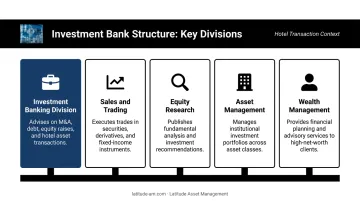
For hotel owners and investors, IBD is the division that drives transactions — acquisitions, dispositions, recapitalizations, and debt raises all originate there.
Inside IBD: Product Groups vs. Industry Groups
IBD is further divided into two types of teams that work together on every deal:
Product groups specialize by transaction type:
- Mergers & Acquisitions (M&A)
- Leveraged Finance
- Equity Capital Markets (ECM)
- Debt Capital Markets (DCM)
- Restructuring
Industry groups specialize by sector — Real Estate, Technology, Healthcare, Energy, and others. For hotel and hospitality transactions, the relevant group is typically Real Estate Investment Banking, which may also carry a Lodging or Gaming coverage mandate. Jefferies, for example, names Real Estate, Gaming & Lodging as a dedicated sector group. RBC's Real Estate Group explicitly covers acquisitions, dispositions, M&A, ECM, DCM, and leveraged finance.
In practice, the industry group owns the client relationship and brings in product group specialists as needed. When a hotel portfolio goes to market, the Real Estate bankers run the process but may pull in Leveraged Finance or DCM colleagues to structure the debt component.
The Chinese Wall in Research
One important regulatory boundary: a formal information barrier — known as the Chinese Wall — separates Equity Research from IBD. FINRA Rule 2241 prohibits investment banking personnel from supervising research analysts or directing report content. Research is not the deal team's promotional arm. Investors should treat research reports and M&A pitches as coming from structurally separate functions.
The Investment Banking Hierarchy
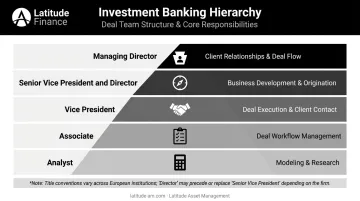
The IB hierarchy is one of the most rigid in professional services. Every major bank uses the same structure, though title conventions vary slightly across institutions and geographies.
Standard Ranking (Junior to Senior)
Analyst Entry-level. Recruited from top undergraduate or graduate programs and responsible for the foundational workload: financial modeling, research, and due diligence. Most analyst programs run two to three years. They produce the models and materials every pitch and transaction depends on.
Associate Typically MBA graduates or promoted analysts. Associates supervise analyst output, manage deal workflows, and begin developing direct client communication. In practice, they sit between junior staff and senior bankers: translating instructions into deliverables and flagging problems before they escalate.
Vice President (VP) The first genuinely senior title. VPs manage deal execution end-to-end, own pitch book timelines, and maintain direct client contact. They keep transactions moving by managing counterparty relationships and delegating work down while reporting progress up.
Senior Vice President / Director Focused heavily on business development — sourcing new clients, expanding existing relationships, and building sector expertise. SVPs and Directors travel extensively and are evaluated primarily on the mandates they bring in.
Managing Director (MD) The top of the client-facing hierarchy. MDs are responsible for the bank's overall deal flow and profitability within their coverage group. They rarely touch operational deal details but are essential for winning mandates, managing high-level relationships, and directing strategy. MD compensation can reach seven figures in strong years, reflecting the revenue responsibility the role carries.
Note on title variation: European banks sometimes insert additional levels such as Assistant Vice President or use "Director" differently than U.S. firms. Titles are not perfectly comparable across institutions.
Front Office, Middle Office, and Back Office
These three layers cut across all business divisions and describe functional role types rather than business units.
Front Office
Revenue-generating, client-facing roles. This includes IBD, Sales and Trading, and Research. Front-office professionals are the bankers clients interact with directly. Prestige and compensation in investment banking are concentrated here.
Middle Office
Risk management, compliance, and internal controls. The middle office monitors the bank's exposure across its activities and serves as a regulatory guardrail. In complex real estate debt and structured finance transactions — CMBS, mezzanine financing, CLOs — middle office risk teams play a meaningful role in approving how the bank's capital or reputation is deployed.
Back Office
Operations, trade settlement, technology, HR, and infrastructure. The back office is the operational backbone that ensures everything executed in the front office actually clears and settles correctly.
When a hotel owner engages an investment bank for an M&A mandate or capital raise, they interact almost exclusively with front-office deal teams. Speed and reliability of execution, however, depend on the middle and back office running cleanly in the background — teams the client never meets but whose performance shapes every closing timeline.
Bulge Bracket vs. Elite Boutique Banks
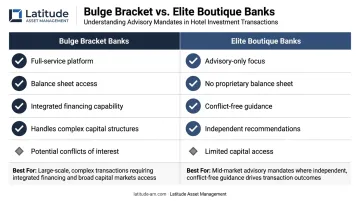
Choosing the right type of advisor for a hotel transaction is not purely a prestige decision. The structural differences between bank types have real implications for how deals get structured and which conflicts may be present.
Bulge Bracket Banks
Large, full-service institutions that offer M&A advisory, underwriting, sales and trading, research, asset management, and corporate banking under one roof. The current bulge bracket group includes:
- JPMorgan Chase
- Goldman Sachs
- Morgan Stanley
- Bank of America (BofA Securities)
- Citigroup
- Barclays
- UBS
Their key differentiator is balance sheet access — they can both advise on a deal and help finance it. For large hotel portfolio transactions requiring complex capital structures, this integration can be a practical advantage.
Elite Boutique Banks
Independent advisory firms that specialize exclusively in financial and strategic advisory, without the conflicts of a proprietary balance sheet. Prominent examples include:
Independent advisory firms that specialize exclusively in financial and strategic advisory, without the conflicts of a proprietary balance sheet. Prominent examples include:
- Evercore
- Moelis
- Lazard
- Centerview Partners
- PJT Partners
- Rothschild & Co. (particularly prominent in Europe)
Without a balance sheet to push, boutique advisors tend to give more objective guidance on financing options. The tradeoff: bulge brackets bring capital access that matters when financing must be arranged alongside advisory work — a real consideration in complex, large-scale transactions.
Hotel and Real Estate Specialists
For most hotel owners and investors, neither bulge brackets nor boutiques are the primary counterparty. Mid-market hotel transactions — single assets, regional portfolios, or deals below the threshold where bulge brackets compete aggressively — are largely intermediated by a third category:
- Eastdil Secured — real estate investment bank recognized as a leader in U.S. and European hotel investment sales for transactions above $100M
- Hodges Ward Elliott — hotel investment sales and capital stack advisory; over 1,800 hotel transactions completed since 1990
- JLL Hotels & Hospitality — advised on $9.2 billion of hotel investment transactions in 2024
- CBRE Hotels — investment sales, debt and structured finance, advisory, and valuation
- HVS — hotel sales, acquisition advisory, and sourcing of senior, mezzanine, and equity capital
These platforms are not securities investment banks in the regulatory sense, but they operate as the primary capital markets intermediaries for the majority of hotel transactions in the Americas.
Map the mandate first — corporate M&A, property disposition, CMBS placement, mezzanine, or some combination — then select the advisor with the licenses, products, and hotel execution record that match the requirement.
How Investment Banking Connects to Hotel Transactions
JLL measured $57.3 billion in global hotel investment in 2024, up 7% from the prior year, though still below historical norms. That volume represents a significant number of transactions — acquisitions, dispositions, recapitalizations, financings — where investment banks structured or advised on the deal.
Where IB Advisory Appears in Hotel Deals
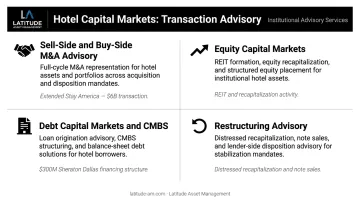
Hotel investors encounter investment banking services across several distinct transaction types:
- Sell-side and buy-side M&A advisory — when a hotel portfolio changes hands, banks are typically engaged by one or both sides to run the process, manage valuation, and coordinate due diligence. The Extended Stay America sale to Blackstone and Starwood Capital (approximately $6 billion, 2021) used Goldman Sachs and BofA Securities on the sell side, with JPMorgan, Citigroup, and Deutsche Bank advising the buyers.
- Equity capital markets — raising equity for development, recapitalization, or REIT activity
- Debt capital markets and CMBS — structuring hotel financing, including single-asset single-borrower CMBS deals. JLL arranged a $300 million package for the Sheraton Dallas combining a Goldman Sachs-led $270 million CMBS loan with $30 million in mezzanine debt from Driftwood Capital.
- Restructuring advisory — when a hotel asset or ownership structure is in financial distress, restructuring bankers advise on recapitalization options, note sales, or orderly dispositions.
Knowing Who to Engage and When
Understanding IB hierarchy makes the client relationship more efficient:
- MDs and SVDs own client relationships and originate mandates — the initial outreach and pitch phase is their domain
- VPs manage deal execution — once a mandate is awarded, the VP is the primary day-to-day contact
- Associates and Analysts produce the financial models, offering memoranda, and due diligence materials that drive the process
For hotel investors, arriving at that process well-prepared matters enormously. Latitude Asset Management bridges this gap by combining institutional finance discipline — the underwriting, scenario analysis, and capital structure evaluation that Javier Revelo, CFA, leads — with the operational depth Anthony Del Gaudio's 35 years across Hyatt, Loews, and IHG provides.
When an investment banking team puts together an offering memorandum for a hotel asset, the assumptions embedded in it (ADR trajectory, RevPAR benchmarks, NOI margins) need to be stress-tested by someone who understands both how the numbers are modeled and how the hotel actually performs. That dual capability is what prevents investors from overpaying based on pro forma projections that don't hold in practice.
That same expertise extends to lender-side situations. Latitude supports REO disposition when hotel assets revert to bank ownership following borrower default, putting the firm in direct contact with the financial institutions and advisory teams managing distressed hotel collateral.
Frequently Asked Questions
What is the main difference between investment banking and commercial banking?
Investment banks advise on M&A transactions and help raise capital through securities, earning fees for advisory services. Commercial banks take deposits and make loans. The two models serve different clients, offer different services, and generate revenue through entirely separate structures — some large holding companies operate both, but the businesses remain distinct.
What are the primary functions of an investment bank?
Two core functions: M&A advisory (guiding buy-side and sell-side transactions through valuation, negotiation, and deal management) and securities underwriting (helping clients raise debt or equity capital in the capital markets by structuring and selling securities to institutional investors).
What is the difference between a bulge bracket and a boutique investment bank?
Bulge brackets are full-service institutions with balance sheet access: they can advise on a deal and help finance it. Elite boutiques are independent advisory firms without a proprietary balance sheet, which their proponents argue produces more conflict-free advice on financing options. The right choice depends on what the transaction requires.
What does "front office" mean in investment banking?
Front office refers to the revenue-generating, client-facing divisions: IBD, Sales and Trading, and Research — the roles clients interact with directly. Middle office handles risk and compliance; back office manages operations and settlement.
How do investment banks get involved in hotel or real estate transactions?
Investment banks advise on hotel portfolio acquisitions, capital raises, and divestitures through dedicated Real Estate banking groups, acting as sell-side or buy-side advisors. They also structure CMBS and mezzanine debt financings, often working alongside specialized hotel advisory platforms.
What is the highest rank in an investment bank?
Managing Director (MD) is the most senior client-facing role. MDs are responsible for deal origination, high-level client relationships, and the overall revenue performance of their coverage group. Compensation at this level can reach seven figures in strong market years.