Introduction
Most hotel investors and developers encounter terms like LP, GP, and LLC within the first pages of any fund document. Few pause to understand how these entities actually connect — or why the structure was built this way in the first place.
That gap matters. Whether you're evaluating a structured hotel fund vehicle, deploying institutional capital across the Americas, or considering an LP commitment for the first time, understanding the legal architecture behind the fund isn't optional. Knowing the structure means you can evaluate what you're actually agreeing to — not just what the summary says.
This guide breaks down the core legal entities in a private investment fund, explains why the limited partnership model dominates, and clarifies how economics — fees, carry, and waterfalls — actually flow through the structure.
Key Takeaways:
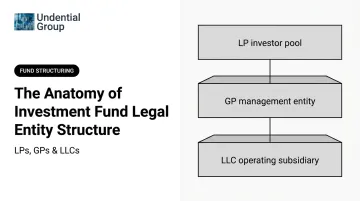
- A private fund is not one entity — it's a system of at least three or four distinct legal structures, each serving a specific purpose
- The limited partnership dominates by combining pass-through taxation, liability protection, and contractual flexibility in one structure
- 20% carried interest and an 8% preferred return hurdle are standard in most fund agreements; management fees have since compressed below the historical 2%
- The LPA governs the fund: its waterfall mechanics and GP restrictions directly determine net LP returns
- Delaware remains the jurisdiction of choice for most institutional fund formation, even when investments span multiple countries
What Is a Private Investment Fund Structure?
A private investment fund structure is the legal and financial framework that allows multiple investors to pool capital into a single vehicle to invest in private assets. Rather than a single company, it is a system of separate legal entities, each designed to perform a distinct function.
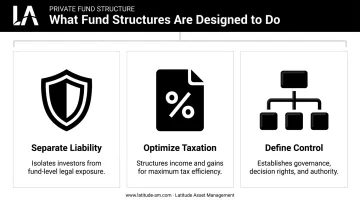
The mechanics serve three core goals:
- Separate liability — protecting investors from the fund's obligations, and the fund from the management company's operational risks
- Optimize taxation — routing profits through pass-through treatment rather than creating a second layer of tax at the entity level
- Define control — clearly establishing who makes decisions, who provides capital, and how each party gets paid
While several fund models exist — LLCs, Business Development Companies, Real Estate Investment Trusts — the limited partnership (LP) structure is, as Debevoise describes it, "the traditional (and by far the most common) vehicle for establishing a fund." That dominance reflects deliberate legal, tax, and operational advantages that corporate structures cannot fully replicate.
The Key Legal Entities in a Fund Structure
A fund is built from at least three to four distinct legal entities. Each plays a specific role, and confusing them is one of the most common mistakes investors make when reading through fund documents.
The General Partner (GP)
The GP is the fund's decision-maker — managing deal flow, conducting due diligence, executing investments, and bearing full legal liability for the fund's obligations. Despite the name, the GP entity is almost always structured as an LLC, giving individual fund managers a liability shield rather than exposing them personally to fund-level obligations.
The Management Company
Behind every fund sits a management company: the operating business that employs the investment team, pays salaries, covers office costs, and handles day-to-day expenses. It is kept legally separate from the fund itself. A lawsuit against the management company cannot reach the fund's portfolio assets, and LP capital remains insulated from the firm's operational liabilities.
The Fund (Limited Partnership)
The fund is the core investment vehicle, typically structured as a limited partnership. It holds capital commitments from investors and legally owns equity in portfolio companies or assets. The fund generally limits participation to accredited investors or qualified purchasers under Investment Company Act exemptions.
Two exemptions govern most private funds, each with distinct standards:
- Section 3(c)(1): Limits beneficial owners to 100 (up to 250 for qualifying venture funds under $12M in assets)
- Section 3(c)(7): Requires investors to meet the qualified purchaser threshold — generally $5M in investments for individuals
The Limited Partners (LPs)
LPs are passive capital providers who typically contribute more than 98% of a fund's total capital. They make no investment decisions and do not participate in fund management. Under Delaware law, an LP generally has no personal liability for fund obligations, though they remain contractually bound to fulfill uncalled capital commitments per the LPA.
LP profiles span a wide range:
- Pension funds and endowments
- Insurance companies
- Family offices
- High-net-worth individuals
- Sovereign wealth funds

In hotel-focused funds, institutional investors and family offices frequently occupy the LP seat — particularly in structured vehicles targeting the Americas, where firms like Latitude Asset Management help connect those capital partners with qualified operators and assets.
Why the Limited Partnership Is the Industry Standard
Four structural advantages have made the LP the default fund vehicle. Each one carries real practical weight, not just legal elegance.
Liability protection: LP investors generally cannot lose more than the capital they committed. The GP's LLC formation adds another layer, protecting individual managers from personal exposure. Corporate structures don't offer the same clean separation between owner liability and operational risk.
Pass-through taxation: Partnerships file an information return but do not pay federal income tax at the entity level — profits and losses flow directly to partners and are reported on their individual returns. This avoids the double taxation that erodes returns in corporate fund structures.
Operational flexibility: The LP model accommodates customized investor terms through side letters, supports capital call mechanics, and provides a legally tested framework for distributions. Approximately 76% of LP respondents in a 2023 ILPA analysis said their organizations could not invest in private equity without side letters. That figure reflects how central side letter flexibility has become to institutional deal-making — without it, many LPs simply cannot participate.
Regulatory familiarity: The LP structure is so well-established that legal counsel, accountants, auditors, and regulators operate within it comfortably. That shared fluency lowers complexity across fund formation, ongoing compliance, and eventual wind-down — which matters when multiple parties are working against the same timeline.
How Fund Economics Flow: Fees, Carry, and Waterfalls
The "2 and 20" Benchmark — And Where It Stands Today
The traditional fund compensation model — 2% management fee and 20% carried interest — remains the reference point, but current data tells a more nuanced story.
Preqin's 2024 analysis shows mean management fees by strategy:
| Strategy | Mean Management Fee (2024) |
|---|---|
| Growth Equity | 1.93% |
| Buyout | 1.74% |
| Real Estate | 1.31% |
Bain's 2025 analysis places the average buyout fee at 1.6% — roughly 20% below the historical 2% level. The median headline fee remains 2%, but the gap between median and mean reflects real pressure from institutional LPs negotiating fee breaks.
Management Fees
The management fee is paid to the management company regardless of performance — typically as an annual percentage of committed or deployed capital. It covers salaries, overhead, and operations. Investors should understand it as the cost of keeping the investment team in operation, not a reward for returns.
Carried Interest
Carried interest is the GP's performance fee — earned only after LPs have received their invested capital back plus an agreed preferred return (hurdle rate). ILPA's 2021 study found 20% carry in 71% of sampled funds, with an 8% preferred return hurdle in 67%. These are common terms, not universal requirements — both are negotiable.
The Distribution Waterfall
The waterfall defines the sequence of profit distribution:
- Return LP capital — investors receive their contributed capital back first
- Pay the preferred return — LPs receive the agreed hurdle rate (typically 8%)
- GP catch-up — the GP receives a disproportionate share until it reaches its target carry percentage
- Residual split — remaining profits split at the negotiated carry ratio (commonly 80/20)
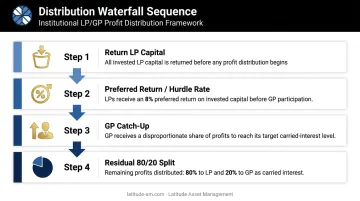
The distinction between a whole-fund waterfall and a deal-by-deal waterfall matters for LP returns. Whole-fund waterfalls — which ILPA models favor — protect investors by requiring portfolio-wide return of capital before carry flows to the GP.
The Limited Partnership Agreement: The Fund's Legal Backbone
The LPA is the binding contract between the GP and all LPs. It governs every aspect of the fund's life and can run hundreds of pages, with legal counsel representing each side.
Core provisions the LPA covers:
- Capital commitment amounts and call procedures
- Investment period duration and restrictions
- Management fees, expenses, and fee offsets
- Distribution waterfall mechanics and carry calculations
- LP reporting rights and LPAC governance
- Key-person provisions and GP removal rights
- Fund term, extensions, and wind-down procedures
- Recycling and clawback provisions

Each partner's ownership percentage is defined relative to their capital contribution. That structure also lets the LPA override default state partnership law with customized terms — a flexibility corporations don't provide as cleanly.
Amended and Restated LPAs (A&R LPAs) are standard when significant terms change — whether through regulatory shifts, investor negotiations, or structural updates. In those cases, the LPA is replaced entirely, and the effective date of the A&R LPA becomes the controlling document going forward.
Common Fund Structure Variations and Jurisdiction Considerations
Special Purpose Vehicles (SPVs)
An SPV is a single-purpose entity — typically an LLC or LP — created to make one specific investment. They're commonly used by emerging managers building a track record before raising a full fund, and by established GPs offering co-investment opportunities alongside their main vehicle. SPVs carry their own legal, tax, and filing requirements separate from the main fund.
Parallel Funds and Master-Feeder Structures
Parallel funds are separate vehicles that invest proportionally alongside the main fund. They're typically created to accommodate investors with different tax or regulatory profiles. A common structure pairs a Delaware main fund with a Cayman Islands or Luxembourg parallel vehicle for international investors — each investing on the same terms while satisfying jurisdiction-specific requirements.
Master-feeder structures take a different approach: multiple feeder funds pool capital into one central master fund that executes all portfolio investments. This consolidates investment management while preserving investor-specific legal wrappers. In cross-border hotel investment strategies across the Americas, this design allows U.S. institutional LPs, tax-exempt entities, and offshore investors to participate in the same portfolio — each housed in a legal vehicle matched to their specific regulatory requirements.
Why Delaware?
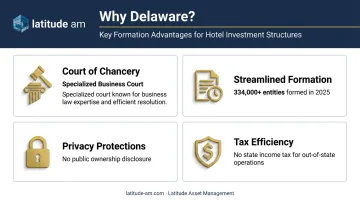
Most of the structures above — whether domestic or part of a parallel arrangement — anchor their U.S. entity in Delaware. That's not convention; it's a calculated choice. Key advantages:
- Court of Chancery: A specialized business court with no jury trials, deep precedent, and judges with genuine expertise in corporate and partnership law
- Streamlined formation: Delaware processed over 334,000 new entity formations in 2025, with efficient, well-understood filing procedures
- Privacy protections: Delaware does not require public disclosure of entity ownership
- No state income tax on entities that don't conduct business within the state
Most institutional LPs expect Delaware formation. Choosing a different jurisdiction without a clear structural rationale introduces unnecessary friction — and rarely improves outcomes for anyone at the table.
Frequently Asked Questions
What is the legal structure of an investment fund?
Most private investment funds are structured as limited partnerships (LPs) rather than corporations, to avoid double taxation and provide liability protection. The structure typically involves separate legal entities for the fund itself, the general partner, and the management company — each serving a distinct function.
What is the difference between a GP and an LP in a fund?
The GP manages the fund and bears legal liability for its obligations, though individual managers are typically protected through an LLC structure. The LP is a passive capital provider whose liability is generally limited to fulfilling their committed capital contribution under the LPA.
What does the Limited Partnership Agreement (LPA) cover?
The LPA is the binding governing document covering the fund's lifespan, capital call procedures, fee structures, distribution waterfall mechanics, LP reporting rights, LPAC governance, and GP activity restrictions. Critically, it can override default state partnership law with customized terms negotiated by both sides.
What is carried interest, and how does it differ from a management fee?
The management fee is a fixed annual operational payment — typically a percentage of committed or deployed capital — regardless of fund performance. Carried interest is the GP's performance-based share of profits, paid only after LPs recover their invested capital plus any agreed preferred return.
What is an SPV and how does it differ from a full fund?
An SPV is a single-investment legal entity created for one specific deal, whereas a traditional fund is a pooled vehicle making multiple investments over a defined investment period. SPVs are commonly used by emerging managers or for co-investment opportunities alongside an established fund.
Why do most investment funds form in Delaware even when operating in other states or countries?
Delaware offers a specialized business court (Court of Chancery), well-established entity formation processes, privacy protections, and no state income tax on entities that don't operate within the state. Most institutional LPs expect Delaware formation, making it the default expectation for most institutional fundraises.