

Introduction
Hotel owners and investors are navigating a narrowing margin environment. According to CBRE, 2024 hotel revenue rose 2.3% while above-GOP expenses climbed 4.1% and insurance costs jumped 17.4% — with both GOP and EBITDA margins declining as a result. Meanwhile, U.S. RevPAR contracted 0.3% in 2025, the first annual decline since 2020.
In that environment, pricing discipline is a margin defense mechanism — and dynamic pricing is its most direct instrument. Done right, it shapes NOI, RevPAR, and ultimately how an asset is valued at disposition.
This article breaks down how dynamic pricing functions as a revenue management engine, what it measurably improves, and what it costs when it's absent or mismanaged.
Key Takeaways
- Dynamic pricing adjusts room rates in real time based on live demand signals, replacing fixed rate grids
- Hotels using it consistently lift ADR and occupancy simultaneously, improving both RevPAR and NOI
- Static pricing leaves revenue on the table during compression events — periods when demand spikes justify higher rates
- Core advantages span revenue maximization, demand forecasting accuracy, and competitive rate positioning
- For hotel owners and investors, pricing strategy is an asset-level financial decision, not a back-office setting
What Is Dynamic Pricing in Hotel Revenue Management?
Dynamic pricing is the practice of adjusting room rates continuously, daily or intra-day, based on real-time inputs:
- Current occupancy levels and booking pace
- Competitor rates and local event calendars
- Demand signals from OTAs, GDS, and direct channels
This contrasts with static pricing, which sets fixed rates by season or day type regardless of live market conditions.
In practice, dynamic pricing is executed through a Revenue Management System (RMS) — software that applies analytics and automation to price rooms and forecast demand. The RMS integrates with the hotel's Property Management System (PMS) and channel manager, pushing rate changes simultaneously across all distribution channels: direct booking, OTAs, GDS, and brand platforms.
Providers like IDeaS and Duetto represent the established standard in hotel RMS technology. IDeaS reports deployment across 31,000+ properties globally; Duetto integrates with PMSs, booking engines, and channel managers to automate rate decisions at scale.
For owners and investors, the core principle is price alignment: matching the rate to what the market will actually bear at any given moment. That means capturing full RevPAR potential during high-demand windows and reducing barriers to occupancy when demand softens.
Three Key Advantages of Dynamic Pricing for Hotel Revenue Management
The advantages below are grounded in measurable operational outcomes, not abstract theory. Each connects directly to the KPIs that drive asset value.
Advantage 1: Revenue Maximization Across Demand Cycles
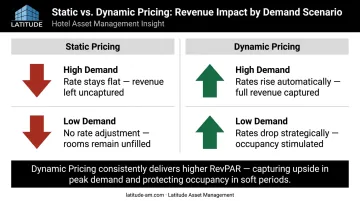
Dynamic pricing enables hotels to capture maximum revenue on both sides of the demand curve. When booking pace accelerates or a competitor sells out, the RMS automatically increases rates to reflect the supply-demand shift. When demand softens ahead of an arrival date, targeted rate reductions attract last-minute bookings that would otherwise go unfilled.
Static pricing models fail at both ends. During high-demand windows (concerts, sports championships, major conferences) fixed rate grids leave significant revenue uncaptured because rates never adjust to reflect true market scarcity. The scale of this opportunity is substantial: STR reported hotel RevPAR up 226% year over year during the final Taylor Swift Eras Tour weekend in New Orleans. Hotels locked into static rates during that window sold rooms well below their market ceiling.
On the other end, static pricing provides no mechanism to stimulate demand during slow periods: rooms go unfilled.
KPIs this advantage influences:
- Average Daily Rate (ADR)
- Revenue Per Available Room (RevPAR)
- Occupancy Rate
- Gross Operating Profit Per Available Room (GOPPAR)
When it matters most: Compression events (championships, festivals, major conventions) and shoulder seasons, where proactive rate management closes the gap between peak and off-peak performance.
For owners, the investor-facing implication is direct: higher ADR during peak periods flows into RevPAR, which is the primary metric used to evaluate a hotel's income-generating capacity. RevPAR is also the key input into stabilized NOI used by appraisers.
Advantage 2: Improved Forecasting and Proactive Revenue Positioning
Dynamic pricing systems don't just set rates — they generate and rely on continuous streams of booking data that build increasingly accurate demand forecasts over time. The result is forward-positioned pricing strategy rather than day-of course corrections.
In practice, this means historical booking patterns, pace analysis, competitor rates, local event calendars, and forward-looking demand signals are synthesized to produce pricing recommendations weeks or months in advance. Leadership knows a compression event is coming and prices accordingly, rather than reacting once occupancy spikes.
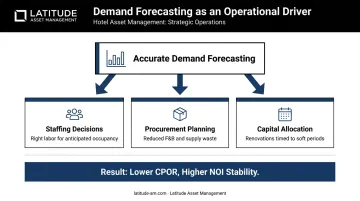
Improved forecasting cascades beyond pricing. Better demand visibility informs:
- Staffing decisions — scheduling the right labor for actual anticipated occupancy
- Procurement planning — reducing waste in F&B and operational supplies
- Capital allocation — timing renovations and improvements around projected soft periods
This dynamic is especially consequential in markets with pronounced seasonality or less predictable demand cycles. Latitude's regional teams in Latin America and the Caribbean observe firsthand that many operators in these markets still rely on manual or intuition-based forecasting, creating compounding pricing blind spots.
Where international arrivals fluctuate or seasonal tourism patterns shift rapidly, the performance gap between data-driven and manual forecasting is most costly.
KPIs this advantage influences:
- RevPAR forecast accuracy
- NOI stability
- Booking window optimization
- Cost-per-occupied-room (CPOR) through better staffing alignment
For investors: Accurate forecasting reduces variance in projected returns. That matters both for active asset management and for the credibility of budgets and pro formas presented to lenders and ownership groups.
Advantage 3: Competitive Advantage Through Real-Time Market Responsiveness
Dynamic pricing gives hotels a structural advantage over competitors still relying on static or manually adjusted rates, particularly when sudden demand shifts determine who captures the booking.
Speed is the differentiator. When a competitor sells out, an RMS detects the reduced market supply and automatically adjusts rates upward to capitalize on increased demand concentration. When a competitor drops rates aggressively, the system responds without delay to protect occupancy share. A hotel relying on manual rate reviews — even if reviewed daily — can't match that response time.
The Grupo Posadas case illustrates the competitive impact of real-time revenue management at scale. After transitioning from manual processes to Duetto's RMS and Open Pricing, 82% of the portfolio ranked first or second in its competitive set, with 4% market-share growth reported. This is a vendor case study rather than a controlled trial, but the directional outcome is consistent with how real-time responsiveness reshapes competitive positioning.
KPIs this advantage influences:
- RevPAR Index (RGI)
- Market Penetration Index (MPI)
- ADR Index
- Competitive occupancy share
When it matters most: Dense urban markets, resort corridors, and any market where a single major event temporarily reshapes the entire competitive landscape — conditions common across the hotel markets in the Americas where Latitude operates.
From an asset management standpoint: a hotel that consistently outperforms its competitive set on RGI generates stronger investor returns and commands a higher valuation multiple at disposition.
What Happens When Dynamic Pricing Is Missing or Ignored
The pattern in underperforming hotel assets on static pricing is consistent:
- Rate floors stay in place during high-demand periods — rooms sell out too early at below-market rates
- No mechanism exists to stimulate demand during slow periods — occupancy gaps persist
- Competitor moves go unanswered — a dynamically priced rival captures disproportionate market share
Each of these operational failures carries a direct financial cost. For owners and investors, the consequences compound:
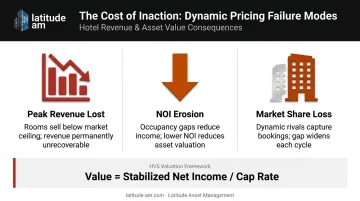
- Peak-period revenue is permanently lost — there is no recovery mechanism once demand passes
- Occupancy gaps during slow periods reduce NOI directly, and lower NOI flows straight into asset valuation
- Reactive pricing creates a ratchet effect — each market cycle widens the gap between disciplined and undisciplined operators
Latitude's own observations across Latin America reinforce this. The firm identifies that "distribution and pricing strategies vary widely" among operators in these markets, with many assets lacking professional asset management entirely. Suboptimal pricing is a systemic condition across many emerging hotel markets — not a series of isolated exceptions.
Brand conversions facilitated by Latitude have been associated with ADR uplifts of 15–40%, a figure that reflects how far below market potential many operators are already priced.
The HVS hotel valuation framework makes the financial consequence explicit:
Value = Stabilized Net Income / Capitalization Rate
Any sustained depression of NOI from pricing underperformance flows directly into a lower appraised value — not as a theoretical risk, but as an arithmetic outcome.
How to Get the Most Value from Dynamic Pricing
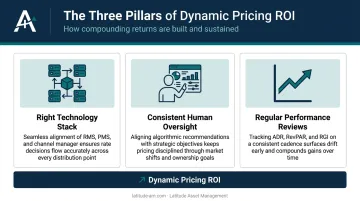
Dynamic pricing delivers compounding returns when three things are in place:
- The right technology stack — an RMS integrated with the PMS and channel manager, appropriate for the hotel's market size, type, and competitive set
- Consistent human oversight — reviewing algorithmic recommendations and aligning them with broader strategic objectives (a brand conversion, a renovation period, a new competitor entering the market)
- Regular performance reviews — tracking ADR, RevPAR, and RGI against the competitive set on a defined cadence
Pricing strategy cannot be set and forgotten. Market conditions, competitive supply, and demand patterns evolve continuously. Rate floors, ceilings, and seasonal parameters require ongoing calibration — not annual review.
That calibration responsibility falls on the operator — but who holds the operator accountable? For owners and investors, independent oversight by an experienced hotel asset manager is a critical safeguard. The operator controls the RMS and the rate decisions. Without independent review, ownership has no reliable way to confirm that pricing strategy is driving return objectives rather than simply minimizing operational friction.
This is the oversight function Latitude Asset Management provides to hotel owners and investors across the Americas. The team brings together former brand executives with direct experience at Hyatt, Loews, and IHG alongside institutional financial discipline from CFA-level analysts — ensuring pricing strategy is assessed against ownership's return objectives, not just operator benchmarks.
Conclusion
Hotels that apply dynamic pricing with discipline consistently outperform those that don't — and the gap widens over time. Each market cycle, each compression event, and every slow-demand stretch where rates go unstimulated adds to that divergence. The compounding effect is real and measurable in RevPAR, NOI, and appraised asset value.
For owners and investors, dynamic pricing deserves the same oversight as any other dimension of investment performance. Delegating it entirely to an operator, without independent review, leaves ownership without visibility into the lever most directly tied to asset value.
Effective owner-side pricing oversight typically includes:
- Reviewing rate strategy against competitive set benchmarks regularly
- Tracking forecasting accuracy and RevPAR index trends over time
- Auditing compression-period capture and shoulder-night performance
- Ensuring the operator's pricing logic aligns with ownership's return objectives
Latitude Asset Management works with hotel owners and investors across the Americas to provide exactly this kind of independent oversight — keeping pricing strategy accountable to investment performance, not just operational convenience.
Frequently Asked Questions
What is dynamic pricing in hotel revenue management?
Dynamic pricing is the practice of adjusting hotel room rates continuously — daily or intra-day — based on real-time inputs including demand, occupancy, competitor behavior, local events, and seasonality. The goal is to maximize revenue across all demand conditions rather than relying on fixed rate grids that ignore market signals.
What companies are implementing dynamic pricing?
Dynamic pricing is standard practice across major hotel brands — Marriott, Hilton, Hyatt, and IHG have all confirmed active revenue management programs and system investments. Independent and boutique properties increasingly adopt RMS platforms from providers such as IDeaS and Duetto, with adoption accelerating across all property types and markets worldwide.
What is the 80/20 rule in hotels?
The 80/20 principle in hotels generally holds that a significant portion of total revenue is generated during a minority of high-demand periods or from a concentrated guest segment. Dynamic pricing targets those peak windows directly, which is where its impact on ADR and NOI is most measurable.
Which is the largest revenue-generating department in hotels?
The rooms department is consistently the largest revenue source in most hotels. CBRE identifies rooms revenue as the largest revenue category, which gives dynamic pricing an outsized effect on total hotel financial performance.
How does dynamic pricing affect hotel asset value?
Hotel valuations are largely driven by stabilized NOI and RevPAR performance relative to the competitive set. A hotel that consistently outperforms its comp set through disciplined dynamic pricing generates higher income, supports a stronger appraised value under the income capitalization approach, and improves risk-adjusted returns at disposition.
What is the difference between static and dynamic pricing in hotels?
Static pricing sets fixed room rates by season or day type regardless of real-time market conditions. Dynamic pricing adjusts rates continuously based on live demand data. The practical difference shows up in RevPAR and occupancy performance — particularly during compression events, where static pricing leaves meaningful revenue permanently uncaptured.